


Hochladen Photos und videos
Bilder | Google Bild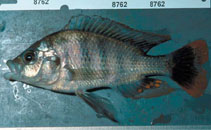 Haplochromis labiatus
Male Photo von Schraml, E.
Bilder | Google Bild
Male Photo von Schraml, E.
Klassifizierung / Names Namen | Synonyme | Catalog of Fishes(Gattung, Arten) | ITIS | CoL | WoRMS | Cloffa
> Cichliformes (Cichlids, convict blennies) > Cichlidae (Cichlids) > Pseudocrenilabrinae
Etymology: Haplochromis: Greek, Haploos = single + Greek, chromis = a fish, perhaps a perch (Ref. 45335); labiatus: Origin of specific name not explained in original description, adjective derived from the Latin noun 'labium', lip, referring to the lobed lips of this species (Ref. 126507).
More on author: Trewavas.
Etymology: Haplochromis: Greek, Haploos = single + Greek, chromis = a fish, perhaps a perch (Ref. 45335); labiatus: Origin of specific name not explained in original description, adjective derived from the Latin noun 'labium', lip, referring to the lobed lips of this species (Ref. 126507).
More on author: Trewavas.
Umwelt: Milieu / Klimazone / Tiefenbereich / Verbreitungsgebiet Ökologie
; süßwasser benthopelagisch. Tropical; 0° - 1°S
Verbreitung Territorien | FAO Gebiete | Ökosysteme | Vorkommen | Punkt Karte | Einführungen | Faunafri
Africa: Lake Edward system, only known from Lake Edward (Ref. 126507). Also reported from Lake George (Ref. 4983), but its morphology suggests that it belongs to a more generalistic species (Ref. 126507).
Größe / Gewicht / Alter
Kurzbeschreibung Bestimmungsschlüssel | Morphologie | Morphometrie
Rückenflossenstacheln (insgesamt) : 15 - 17; Rückenflossenweichstrahlen (insgesamt) : 8 - 10; Afterflossenstacheln: 3; Afterflossenweichstrahlen: 7 - 10; Wirbelzahl: 29 - 31. Diagnosis: Haplochromis labiatus differs from all known species of Haplochromis from the Lake Edward system by a combination of a blunt snout, retro- to isognathous jaws, deep lower jaw with blunt teeth, and lobed lips (Ref. 126507). It can be confused with H. lobatus as both have lobed lips, a small gape, a curved upper jaw with a relatively long premexillary pedicel, 78.7-111.4% of upper jaw length, stout and unicuspid outer teeth that strongly decrease in size, and a lower jaw set anteriorly with procumbently implanted outer teeth on the anterior margin of the lower jaw, 40-60° to vertical; it differs from this species by a straight to convex vs. straight to concave head, and a blunt and more broad snout vs. elongated and slender snout; it differs further in its trophic morphology: lower jaw slightly shorter, 27.7-34.3% of head length vs. 31.2-40.7%, and more broa, 71.4-92.4% of lower jaw length vs. 48.5-70.5%, jaws iso- to retrognathous vs. iso- to strongly prognathous, and anteriormost outer teeth in lower jaw more closely set, 0-1 vs. 1-2 outer tooth widths between adjacent teeth, and with shorter major cusps (Ref. 126507). Haplochromis labiatus resembles H. paucidens from Lake Kivu by a blunt head, lobed lips, and insectivorous diet; it differs by a shallower lacrimal and a larger eye, lacrimal depth 36.3-50.9% of eye diameter vs. 51.7-62.4%, and a slightly broader head, 46.1-51.0% of head length vs. 43.9-47.1%; it further differs by mainly unicuspid vs. bicuspid outer teeth with stouter major cusps and mainly unicuspid vs. tricuspid inner teeth; no notable difference in dominant male colouration has been observed but a piebald colouration is seemingly absent in H. labiatus, while it is frequently observed in H. paucidens (Ref. 126507). Haplochromis labiatus resembles superficially H. chilotes from Lake Victoria by lobed lips but differs by a blunt vs. acute snout and a larger eye, eye diameter 31.0-36.9% of head length vs. 21.8-28.6% (Ref. 126507).
Diet insectivorous (Ref. 126507).
Lebenszyklus und Paarungsverhalten Geschlechtsreife | Fortpflanzung | Ablaichen | Eier | Fruchtbarkeit | Larven
Mouthbrooding by females.
Hauptreferenz
Laden Sie Ihre Referenzen hoch | Referenzen | Koordinator : Kullander, Sven O. | Partner
Vranken, N., M. Van Steenberge, A. Kayenbergh and J. Snoeks, 2020. The lobed-lipped species of Haplochromis (Teleostei, Cichlidae) from Lake Edward, two instead of one. J. Great Lakes Res. 46(5):1079-1089. (Ref. 126507)
IUCN Rote Liste Status (Ref. 130435: Version 2025-2 (Global))
Gefährdung zunehmend (NT) ; Date assessed: 31 January 2006
CITES
Not Evaluated
Bedrohung für Menschen
Harmless
Nutzung durch Menschen
FAO - Publication: search | FishSource |
Mehr Information
Trophische Ökologie
Lebensmittel (Beutetiere)
Nahrungszusammensetzung
Nahrungsaufnahme
Lebensmittelrationen
Räuber
Lebensmittel (Beutetiere)
Nahrungszusammensetzung
Nahrungsaufnahme
Lebensmittelrationen
Räuber
Populationsdynamik
Wachstumsparameter
Max. Alter/Größen
Länge-Gewicht-Rel.
Länge-Länge-Verhältnis.
Längenhäufigkeiten
Massenkonvertierung
Rekrutierung
Dichte
Wachstumsparameter
Max. Alter/Größen
Länge-Gewicht-Rel.
Länge-Länge-Verhältnis.
Längenhäufigkeiten
Massenkonvertierung
Rekrutierung
Dichte
Lebenszyklus
Fortpflanzung
Geschlechtsreife
Reifung/Kiemen rel.
Fruchtbarkeit
Ablaichen
Laichaggregationen
Eier
Eientwicklung
Larven
Larven Pop.Dyn.
Fortpflanzung
Geschlechtsreife
Reifung/Kiemen rel.
Fruchtbarkeit
Ablaichen
Laichaggregationen
Eier
Eientwicklung
Larven
Larven Pop.Dyn.
Anatomie
Kiemenoberfläche
Gehirn
Otolith
Kiemenoberfläche
Gehirn
Otolith
Physiologie
Körperliche Zusammensetzung
Nährstoffe
Sauerstoffverbrauch
Schwimmart
Schwimmgeschwindigkeit
Visuelle Pigmente
Fischgeräusche
Krankheiten und Parasiten
Toxizität (LC50s)
Körperliche Zusammensetzung
Nährstoffe
Sauerstoffverbrauch
Schwimmart
Schwimmgeschwindigkeit
Visuelle Pigmente
Fischgeräusche
Krankheiten und Parasiten
Toxizität (LC50s)
Genetik
Genom
Genetik
Heterozygotie
Vererbbarkeit
Genetische Vielfalt
Genom
Genetik
Heterozygotie
Vererbbarkeit
Genetische Vielfalt
Menschenbezogen
Aquakultur-Systeme
Aquakultur Profile
Zuchtlinien
Ciguatera-Fälle
Briefmarken, Münzen, Verschiedenes.
Aquakultur-Systeme
Aquakultur Profile
Zuchtlinien
Ciguatera-Fälle
Briefmarken, Münzen, Verschiedenes.
Tools
Zusatzinformationen
Download XML
Zusammenfassung | Punktdaten | Namen | Photos
Internet Quellen
AFORO (otoliths) | Aquatic Commons | BHL | Cloffa | Websites from users | FishWatcher Einträge suchen | CISTI | Catalog of Fishes: Gattung, Arten | DiscoverLife | ECOTOX | FAO - Publication: search | Faunafri | Fishipedia | Fishtrace | GloBI | Google Books | Google Scholar | Google | IGFA World Record | OneZoom | Open Tree of Life | Otolith Atlas of Taiwan Fishes | PubMed | Reef Life Survey | Socotra Atlas | TreeBase | Tree of Life | Wikipedia: Gehe zu, Suchen | World Records Freshwater Fishing | Zoobank | Zoologischer Rekord
Schätzungen auf der Grundlage von Modellen
Phylogenetischer Diversitätsindex (Ref. 82804): PD50 = 0.5000 [Uniqueness, from 0.5 = low to 2.0 = high].
Bayesian length-weight: a=0.01445 (0.00671 - 0.03113), b=2.99 (2.82 - 3.16), in cm total length, based on LWR estimates for this (Sub)family-body shape (Ref. 93245).
Trophische Ebene (Ref. 69278): 3.4 ±0.4 se; based on size and trophs of closest relatives
Widerstandsfähigkeit (Ref. 120179): hoch, Verdopplung der Population dauert weniger als 15 Monate. (Preliminary K or Fecundity.).