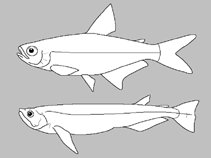
Classification / Names
Nomi Comuni | Sinonimi | Catalog of Fishes(Genere, Specie) | ITIS | CoL | WoRMS | Cloffa
>
Characiformes (Characins) >
Characidae (Characins; tetras) > Cheirodontinae
Etymology: Serrapinnus: Latin, serran, serranus, saw and a fish of genus Serranus + Latin, pinna = spiny, thorn (Ref. 45335); lucindai: Named for Paulo Henrique Franco Lucinda (UNT), in recognition of his contribution to the taxonomy of Neotropical freshwater fish, mainly those of the rio Tocantins basin.
Eponymy: Dr Paulo Henrique Franco Lucinda is a Brazilian zoologist, bio-geographer and ichthyologist at Universidade Federal do Tocantins, Porto Nacional, Brazil, where he is Associate Professor I. [...] (Ref. 128868), visit book page.
Environment: milieu / climate zone / distribuzione batimetrica / distribution range
Ecologia
; acqua dolce benthopelagico. Tropical
South America: Rio Tocantins-Araguaia basin, Brazil.
Size / Peso / Age
Maturità: Lm ? range ? - ? cm
Max length : 3.0 cm SL maschio/sesso non determinato; (Ref. 96959)
Short description
Chiavi di identificazione | Morfologia | Morfometria
Raggi dorsali molli (totale) : 11. Serrapinnus lucindai can be primarily diagnosed from its congeners by having 17 to 19 ventral procurrent caudal-fin rays (vs. less than 17). Furthermore, it differs from other species of the genus by having the following characters: anal-fin hooks on the first unbranched and five branched rays of mature males (vs. anal-fin hooks on at least the anterior six branched rays on the remaining species of the genus); 9 to 11 cusps on the premaxillary teeth (vs. 5 in S. microdon and S. potiguar, 7 in S. aster, 7 to 9 in S. calliurus, S. heterodon, S. kriegi, S. micropterus, S. notomelas and S. piaba, and 10 to 12 in S. gracilis and S. littoris); continuous mid-lateral black stripe extending from the opercular region to the caudal-peduncle spot absent (vs. present in S. sterbai); dentary teeth without expanded cusps forming a sharp cutting edge and the incomplete lateral line (vs. dentary teeth with expanded cusps forming a sharp cutting edge and complete lateral line in S. heterodon); hyaline dorsal fin (vs. fin with a proximal black blotch in S. notomelas); and black spot absent in the posteroventral region of the abdomen (vs. present in S. kriegi) (Ref. 96959).
Body shape (shape guide): elongated.
Life cycle and mating behavior
Maturità | Riproduzione | Deposizione | Uova | Fecundity | Larve
Malabarba, L.R. and F.C. Jerep, 2014. Review of the species of the genus Serrapinnus Malabarba, 1998 (Teleostei: Characidae: Cheirodontinae) from the rio Tocantins-Araguaia basin, with description of three new species. Zootaxa 3847(1):057-079. (Ref. 96959)
IUCN Red List Status (Ref. 130435: Version 2025-1)
Threat to humans
Harmless
Human uses
Pesca: di nessun interesse
Strumenti
Special reports
Download XML
Fonti Internet
Estimates based on models
Phylogenetic diversity index (Fonte Biblio.
82804): PD
50 = 0.5000 [Uniqueness, from 0.5 = low to 2.0 = high].
Bayesian length-weight: a=0.01122 (0.00461 - 0.02730), b=3.08 (2.89 - 3.27), in cm total length, based on LWR estimates for this Genus-body shape (Ref.
93245).
Trophic level (Fonte Biblio.
69278): 2.7 ±0.5 se; based on size and trophs of closest relatives
Fishing Vulnerability (Ref.
59153): Low vulnerability (10 of 100).
🛈