Classificação / Nomes
Nomes comuns | Sinônimos | Catalog of Fishes(Gênero, Espécies) | ITIS | CoL | WoRMS | Cloffa
>
Cichliformes (Cichlids, convict blennies) >
Cichlidae (Cichlids) > Pseudocrenilabrinae
Etymology: Parananochromis: Greek, para = the side of + Latin, nannus = small + Greek, chromis = a fish, perhaps a perch (Ref. 45335); orsorum: The species is named after Rose and Tony Orso, Vernon (USA), who helped to import a number of new species of cichlids over the years and donated specimens for scientific research; this provided the initial stimulus to check collections for additional species of the genus Parananochromis (Ref. 97361).
Eponymy: Rose and Anthony ‘Tony’ Orso of Vernon, New Jersey, USA are aquarium-fish importers and breeders, and lovers of tropical fish. [...] (Ref. 128868), visit book page.
Meio ambiente: milieu / Zona climática / intervalo de profundidade / faixa de distribuição
Ecologia
; Água doce pelágico(a,os,as). Tropical
Africa: upper tributaries of Lokoundje River and northern tributaries of Ntem River in Cameroon (Ref. 97361).
Tamanho / Peso / Idade
Maturidade: Lm ? range ? - ? cm
Max length : 7.1 cm SL macho/indeterminado; (Ref. 97361)
Descrição suscinta
Chaves de identificação | Morfologia | Morfometria
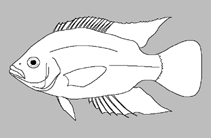
Espinhos dorsais (total) : 14 - 16; Raios dorsais (total) : 9 - 10; Espinhos anais: 3; Raios anais : 7 - 8. Diagnosis: Parananochromis orsorum is distinguished from P. brevirostris, P. elobatus and P. ornatus by the presence of 4 tubular infraorbital bones vs. 3; from P. brevirostris and P. elobatus by the presence of scales on the chest vs. absence, and a well developed pharyngeal pad vs. weakly developed; and from P. axelrodi by a shallower body depth, being 27,3-33,7% of standard length vs. 35,6-42,2% (Ref. 97361). It differs from Parananochromis caudifasciatus by a greater preorbital distance, 19-28% of head length vs. 17-19; absence of dots on caudal fin of females vs. rows of dots in females; and more pointed snout (Ref. 97361). It differs from Parananochromis gabonicus by fewer rows in both jaws, 2 rows in both jaws vs. 2-4 in upper jaw and 2-3 in lower jaw; and in colouration, intense and regular rows of pale blue spots in soft dorsal, caudal and soft anal fins of males, yellow colouration of distal part of anal fin of both sexes, black colouration of tip of pelvic fin of females vs. rows of spots in fins absent or pale and restricted to proximal parts of fins, distal part of anal fin clear, tip of pelvic fin clear to pale white in P. gabonicus (Ref. 97361). It differs from Parananochromis longirostris by the absence of the following features in P. orsorum: silver centers on body scales in both sexes, red colouration across dorsal portion of eye, spots in dorsal, caudal and anal fins of females; and a smaller size (Ref. 97361).
Body shape (shape guide): fusiform / normal; Cross section: oval.
Ciclo de vida ou comportamento de acasalamento
Maturidade | Reprodução | Desova | Ovos | Fecundidade | Larvas
Lamboj, A., 2014. Two new species of Parananochromis from Cameroon, Central Africa (Teleostei: Cichlidae). Ichthyol. Explor. Freshwat. 25(1):49-57. (Ref. 97361)
Status na Lista Vermelha da UICN (Ref. 130435: Version 2025-2)
Ameaça para os humanos
Harmless
Uso pelos humanos
Ferramentas
Relatórios especiais
Baixar XML
Fontes da internet
Estimativas baseadas em modelos
Índice de diversidade filogenética (Ref.
82804): PD
50 = 0.5039 [Uniqueness, from 0.5 = low to 2.0 = high].
Bayesian length-weight: a=0.01000 (0.00244 - 0.04107), b=3.04 (2.81 - 3.27), in cm total length, based on all LWR estimates for this body shape (Ref.
93245).
Nível Trófico (Ref.
69278): 3.3 ±0.4 se; based on size and trophs of closest relatives
Resiliência (Ref.
120179): Elevada, tempo mínimo de duplicação da população menor que 15 meses (Preliminary K or Fecundity.).
Vulnerabilidade da pesca (Ref.
59153): Low vulnerability (10 of 100).
🛈