This website uses cookies to enhance your browsing experience and ensure the functionality of our site. For more detailed information about the types of cookies we use and how we protect your privacy, please visit our Privacy Information page.
×
Cookie Settings
This website uses different types of cookies to enhance your experience. Please select your preferences below:
> Blenniiformes (Blennies) > Tripterygiidae (Triplefin blennies) > Tripterygiinae
Etymology: Enneanectes:Greek, ennea = nine times + Greek, nektos = that swimms (Ref. 45335); deloachorum:Named for Ned and Anna Deloach, in recognition of their contributions to the art of underwater photography of coral-reef animals, their development of very useful guides to reef organisms, and exceptional camaraderie on the expedition to Dominica; noun in the genitive case (plural). Eponymy: Ned DeLoach (d: 1944) graduated from Texas Tech University (1967) and moved to Florida to take up diving and underwater photography. [...] (Ref. 128868), visit book page.
Umwelt: Milieu / Klimazone / Tiefenbereich / Verbreitungsgebiet Ökologie
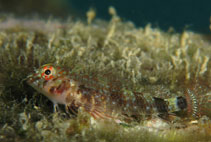
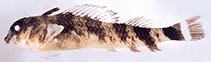
Rückenflossenstacheln (insgesamt) : 15 - 16; Rückenflossenweichstrahlen (insgesamt) : 8 - 9; Afterflossenstacheln: 2; Afterflossenweichstrahlen: 16 - 17. This species is distinguished by the following characters: belly, pectoral-fin base, and cheek naked, spiny preorbital bone in adults, snout blunt, 3 rows of scales above rear pored scales, first two rows about equal-sized, relatively short first dorsal fin (all characters of E. boehlkei complex); fourth and fifth body bars similarly dark and often much darker than preceding bars (which are about equal in intensity); accessory interspace bar or darkened patch between the fourth and fifth body bars; fifth bar sometimes narrower than the 4-5 interspace; 2 broad solid dark bands on the caudal fin; second dorsal fin with three rounded dark spots on the membranes near the spine bases and thin band of fine speckling on the outer rim of fin; anal fin with 3 or 4 dark patches; usually D III+XII-XIII+9 and A II,16-17; mode of 15 pored lateral-line scales and 22 scales in notched midline row (Ref. 93957). Body shape (shape guide): elongated; Cross section: circular.
Victor, B.C., 2013. The Caribbean roughhead triplefin (Enneanectes boehlkei): DNA barcoding reveals a complex of four West Indian sympatric cryptic species (Teleostei: Blennioidei: Tripterygiidae). J. Ocean Sci. Found. 7:44-73. (Ref. 93957)
IUCN Rote Liste Status (Ref. 130435: Version 2025-2 (Global))
Phylogenetischer Diversitätsindex (Ref. 82804): PD50 = 0.5000 [Uniqueness, from 0.5 = low to 2.0 = high].
Bayesian length-weight: a=0.00617 (0.00290 - 0.01310), b=3.04 (2.86 - 3.22), in cm total length, based on LWR estimates for this (Sub)family-body shape (Ref. 93245).
Trophische Ebene (Ref. 69278): 2.9 ±0.3 se; based on size and trophs of closest relatives
Widerstandsfähigkeit (Ref. 120179): hoch, Verdopplung der Population dauert weniger als 15 Monate. (Preliminary K or Fecundity.).
Anfälligkeit der Fischerei (Ref. 59153): Low vulnerability (10 of 100). 🛈