This website uses cookies to enhance your browsing experience and ensure the functionality of our site. For more detailed information about the types of cookies we use and how we protect your privacy, please visit our Privacy Information page.
×
Cookie Settings
This website uses different types of cookies to enhance your experience. Please select your preferences below:
> Blenniiformes (Blennies) > Tripterygiidae (Triplefin blennies) > Tripterygiinae
Etymology: Enneanectes:Greek, ennea = nine times + Greek, nektos = that swimms (Ref. 45335); wilki:Named for Les Wilk, for his contributions to the art of underwater photography of coral-reef animals, his development of the ReefNet underwater identification CDs, and his organization of the expedition to Dominica; noun in the genitive case. Eponymy: Les Wilk is a nuclear physicist, diver and underwater photographer. [...] (Ref. 128868), visit book page.
Ambiente: milieu / zona climatica / distribuzione batimetrica / gamma di distribuzione Ecologia
Maturità: Lm? range ? - ? cm Max length : 1.7 cm SL maschio/sesso non determinato; (Ref. 93957); 1.6 cm SL (female)
Breve descrizione Chiavi di identificazione | Morfologia | Morfometria
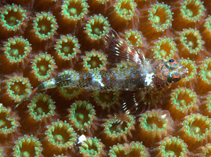
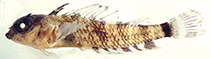
Spine dorsali (totale) : 15; Raggi dorsali molli (totale) : 8; Spine anali: 2; Raggi anali molli: 16. This species is distinguished by the following characters: belly, pectoral-fin base, and cheek naked; adults with spiny preorbital bone; snout blunt; 3 rows of scales above rear pored scales, the first 2 rows about equal-sized; relatively short first dorsal fin (all characters of E. boehlkei complex); fifth body bar is usually slightly darker than first four (not much darker than fourth) and usually narrower than 4-5 interspace; accessory interspace bar or darkened patch between the fourth and fifth body bars (yellow-ringed with dark-speckled center in life, especially ventrally); dusky red bar just behind fifth body bar; dark or dusky red bands on caudal fin, usually more than 2, often broken; usually no pale band dividing dark snout forward of eye; second dorsal fin with 3 rounded dark spots on membranes near spine bases and thin band of fine speckling on outer rim of fin; anal fin with 4-6 dark patches; modal fin rays D III+XII+8, A II, 16; mode of 14 pored lateral-line scales and 22 scales in notched midline row (Ref. 93957). Body shape (shape guide): elongated; Cross section: oval.
Ciclo vitale e comportamento di accoppiamento Maturità | Riproduzione | Deposizione | Uova | Fecondità | Larve
Victor, B.C., 2013. The Caribbean roughhead triplefin (Enneanectes boehlkei): DNA barcoding reveals a complex of four West Indian sympatric cryptic species (Teleostei: Blennioidei: Tripterygiidae). J. Ocean Sci. Found. 7:44-73. (Ref. 93957)
Stato della Lista Rossa IUCN (Ref. 130435: Version 2025-2 (Global))
Dinamica della popolazione Parametri di crescita Età massima / dimensioni massime Rapporto lunghezza-peso. Lunghezza-lunghezza rel. Lunghezza-frequenze Conversione di massa Reclutamento Abbondanza
Ciclo di vita Riproduzione Maturità Maturità/Gli occhielli sono relativi. Fecondità Deposizione Aggregazioni riproduttive Uova Sviluppo delle uova Larve Dinamica popolazioni larvali
Fisiologia Composizione corporea Nutrienti Consumo di ossigeno Tipo di nuoto Velocità di nuoto Pigmenti visivi Suono del pesce Malattie e parassiti Tossicità (LC50)
Indice di diversità filogenetica (Fonte Biblio. 82804): PD50 = 0.5000 [Uniqueness, from 0.5 = low to 2.0 = high].
Bayesian length-weight: a=0.00617 (0.00290 - 0.01310), b=3.04 (2.86 - 3.22), in cm total length, based on LWR estimates for this (Sub)family-body shape (Ref. 93245).
Livello trofico (Fonte Biblio. 69278): 3.0 ±0.3 se; based on size and trophs of closest relatives
Resilienza (Fonte Biblio. 120179): Alto, tempo minimo di raddoppiamento della popolazione meno di 15 mesi (Preliminary K or Fecundity.).
Vulnerabilità della pesca (Ref. 59153): Low vulnerability (10 of 100). 🛈