Classificazione / Nomi
Nomi Comuni | Sinonimi | Catalog of Fishes(Genere, Specie) | ITIS | CoL | WoRMS | Cloffa
>
Cichliformes (Cichlids, convict blennies) >
Cichlidae (Cichlids) > Geophaginae
Etymology: Geophagus: Greek, gea = the earth + Greek, phagein = to eat (Ref. 45335); mirabilis: Named from the the Latin adjective mirabilis, meaning extraordinary, marvelous, admirable, in reference to the unique color pattern that includes the row of black spots on the flanks and the iridescent spots and vermiculations on the side of the head in living individuals.
Ambiente: milieu / zona climatica / distribuzione batimetrica / gamma di distribuzione
Ecologia
; acqua dolce benthopelagico. Tropical
South America: Rio Aripuanã drainage in Brazil.
Dimensione / Peso / Età
Maturità: Lm ? range ? - ? cm
Max length : 16.2 cm SL maschio/sesso non determinato; (Ref. 102658)
Breve descrizione
Chiavi di identificazione | Morfologia | Morfometria
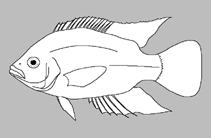
Spine dorsali (totale) : 15 - 17; Raggi dorsali molli (totale) : 9 - 12; Spine anali: 3; Raggi anali molli: 7 - 8. Geophagus mirabilisis distinguished from all congeners by having 2-6 black spots in a longitudinal row along middle of flank in specimens larger than 8.0 cm SL (vs. a single midlateral spot or spots absent from flank in individuals of G. altifrons), but spots other than midlateral spot absent in occasional specimens up to approximately 8.0 cm SL; live coloration of adults consists of rich pattern of iridescent blue, round or vermiculate marks on the side of head, unique for the genus; 4½-5½ scales between first dorsal-fin spine and upper caudal fin of adults with only one series of scales on each inter-radial membrane of ventral lobe, not imbricating with neighboring series and not completely covering base ofrays (vs. two series of scales on each inter-radial membrane of ventral lobe, imbricating both with one another and with neighboring rows and completely covering base of rays, in all other species in Geophagus). It differs from congeners except G. camopiensis and G. crocatus by having 7 scale rows around the caudal peduncle below lateral line (vs. 8-11); from G. camopiensis by having a narrower lower lip fold, not covering any of dentary lateralis foramina (vs. broader lower lip fold, covering at least dentary lateralis foramen 1, in some specimens also dentary lateralis foramen 2, by having light horizontal stripes on the posterior half of caudal fin (vs. only light dots) and by the inter-radial scales series on caudal fin not imbricated (vs. imbricated); from G. crocatus by the absence of preopercular mark(vs. presence). The following additional characters are useful to diagnose from subsets of Geophagus species: absence of a dark stripe across the cheek at all sizes (vs. present in G. argyrostictus, G. gottwaldi, G. grammepareius, G. harreri, and G. taeniopareius); absence of dark spot at the corner of the preopercle (preopercular mark) (vs. presence in G. brachybranchus, G. crocatus, G. dicrozoster, G. proximus and G. winemilleri; skin fold covering external gill filaments along first ceratobranchial narrow in comparison with filaments (vs. wide in G. brachybranchus, G. harreri and G. surinamensis; E1 scales 29-31 (vs. 33-35 in G. abalios, 33-36 in G. altifrons, 32-34 in G. argyrostictus, 32-33 in G. brachybranchus, 32-34 in G. brokopondo, 34-38 in G. dicrozoster, 34-36 in G. gottwaldi, 32-34 in G. megasema, 32-34 in G. proximus, 32-34 in G. surinamensis, 33-35 in G. sveni and 32-35 in G. winemilleri) (Ref. 102658).
Ciclo vitale e comportamento di accoppiamento
Maturità | Riproduzione | Deposizione | Uova | Fecondità | Larve
Deprá, G.C., S.O. Kullander, C.S. Pavanelli and W.J. da Graça, 2014. A new colorful species of Geophagus (Teleostei: Cichlidae), endemic to the rio Aripuanã in the Amazon basin of Brazil. Neotrop. Ichthyol. 12(4):737-746. (Ref. 102658)
Stato della Lista Rossa IUCN (Ref. 130435: Version 2025-2)
Minaccia per l'uomo
Harmless
Usi umani
Strumenti
Rapporti speciali
Scarica XML
Fonti Internet
Stime basate su modelli
Indice di diversità filogenetica (Fonte Biblio.
82804): PD
50 = 0.5000 [Uniqueness, from 0.5 = low to 2.0 = high].
Bayesian length-weight: a=0.02512 (0.01198 - 0.05266), b=2.99 (2.81 - 3.17), in cm total length, based on LWR estimates for this (Sub)family-body shape (Ref.
93245).
Livello trofico (Fonte Biblio.
69278): 2.3 ±0.1 se; based on size and trophs of closest relatives
Resilienza (Fonte Biblio.
120179): Alto, tempo minimo di raddoppiamento della popolazione meno di 15 mesi (Preliminary K or Fecundity.).
Vulnerabilità della pesca (Ref.
59153): Low vulnerability (10 of 100).
🛈