-

- À propos de cette page
- Langues
- Commentaires des utilisateurs
- Citation
- Téléchargements
- Espèces associées
-



Paraqianlabeo lineatus Zhao, Sullivan, Zhang & Peng, 2014
Envoyez vos Photos et vidéos
Images Google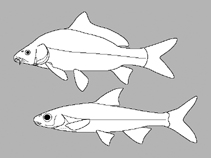 No image available for this species;
drawing shows typical species in Cyprinidae.
Images Google
drawing shows typical species in Cyprinidae.
Classification / Noms Noms communs | Synonymes | Catalog of Fishes(Genre, Espèce) | ITIS | CoL | WoRMS | Cloffa
> Cypriniformes (Carps) > Cyprinidae (Minnows or carps) > Labeoninae
Etymology: Paraqianlabeo: Dervied from a combination of the Latin word Para (beside; beyond or outside; associated with) and Qian (abbreviation for Guizhou Province), where the type species was collected, and the Latin word Labeo, a generic name and commonly utilized suffix for Labeoninae genera; lineatus: The specific name is from the Latin lineatus, meaning lined, in reference to the longitudinal dark stripe along the side of the body.
Etymology: Paraqianlabeo: Dervied from a combination of the Latin word Para (beside; beyond or outside; associated with) and Qian (abbreviation for Guizhou Province), where the type species was collected, and the Latin word Labeo, a generic name and commonly utilized suffix for Labeoninae genera; lineatus: The specific name is from the Latin lineatus, meaning lined, in reference to the longitudinal dark stripe along the side of the body.
Environnement : milieu / zone climatique / profondeur / gamme de distribution Écologie
; eau douce benthopélagique. Subtropical
Distribution Territoires | Zones FAO | Écosystèmes | Occurrences | Carte par point | Introductions | Faunafri
Asia: Wu-Jiang and Chishui-He rivers, Yangtze River basin in Guizhou Province, China.
Taille / Poids / Âge
Description synthétique Clés d'identification | Morphologie | Morphométrie
Rayons mous dorsaux (Total) : 10 - 11; Rayons mous anaux: 8. Paraqianlabeo lineatus can be diagnosed by having longitudinal dark stripe along side of body. It possesses a uniquely modified oromandibular morphology; i.e., arched, wide, rudimentary sucker formed by raised front and lateral margins of lower lip, postlabial groove and mental groove between middle and lateral lobes of lower lip chevron-shaped. Other unique combination of characters useful to identify this species include: anteroventral margin of rostral cap arched, thin and papillose; rostral cap not overlying upper lip, upper lip connected with lower lip around corners of mouth; well developed upper lip free from upper jaw; lower lip divided into two lateral fleshy lobes and one central plate, these two lateral fleshy lobes small and short, median lobe of lower lip large; anterior and anterolateral edges of upper and lower lip finely papillose; shallow, straight groove between lower lip and lower jaw; lower jaw bearing thin, cornified cutting edge; scales in ventral medial region from pectoral fins to pelvic fins half-hidden and subcutaneous; 3 scale rows below lateral line; and 7½-8 branched dorsal-fin rays (Ref. 96827).
Found in hill streams with clear water and sluggish flow over gravel substrate. Observed to swim slowly and hide among the rocks. Collected together with only two other cyprinid species: Carassius auratus and Pseudorasbora parva (Ref. 96827).
Cycle de vie et comportement reproducteur Maturité | Reproduction | Frai | Œufs | Fécondité | Larves
Référence principale
Téléchargez vos références | Références | Coordinateur | Collaborateurs
Zhao, H.-T., J.P. Sullivan, Y.-G. Zhang and Z.-G. Peng, 2014. Paraqianlabeo lineatus, a new genus and species of labeonine fishes (Teleostei: Cyprinidae) from South China. Zootaxa 3841(2):257-270. (Ref. 96827)
CITES
Not Evaluated
Menace pour l'homme
Harmless
Utilisations par l'homme
FAO - Publication: search | FishSource |
Plus d'informations
Écologie trophique
Aliments (proies)
Composition du régime alimentaire
Consommation alimentaire
Rations alimentaires
Prédateurs
Aliments (proies)
Composition du régime alimentaire
Consommation alimentaire
Rations alimentaires
Prédateurs
Dynamique des populations
Paramètres de croissance
Âges / tailles maximales
Longueur-poids rel.
Rel. longueur-longueur.
Fréquences de longueurs
Conversion de masse
Recrutement
Abondance
Paramètres de croissance
Âges / tailles maximales
Longueur-poids rel.
Rel. longueur-longueur.
Fréquences de longueurs
Conversion de masse
Recrutement
Abondance
Cycle de vie
Reproduction
Maturité
Maturité/épines rel.
Fécondité
Frai
Agrégats de frai
Œufs
Développement de l'œuf
Larves
Dynamique des populations larvaires
Reproduction
Maturité
Maturité/épines rel.
Fécondité
Frai
Agrégats de frai
Œufs
Développement de l'œuf
Larves
Dynamique des populations larvaires
Anatomie
Surface branchiale
Cerveau
Otolithe
Surface branchiale
Cerveau
Otolithe
Physiologie
Composition corporelle
Nutriments
Consommation d'oxygène
Type de natation
Vitesse de nage
Pigments visuels
Son de poisson
Maladies et parasites
Toxicité (CL50)
Composition corporelle
Nutriments
Consommation d'oxygène
Type de natation
Vitesse de nage
Pigments visuels
Son de poisson
Maladies et parasites
Toxicité (CL50)
Génétique
génôme
Génétique
Hétérozygotie
Héritabilité
Diversité génétique
génôme
Génétique
Hétérozygotie
Héritabilité
Diversité génétique
Liées à l'homme
Systèmes d'aquaculture
Profils d'aquaculture
Souches
Cas de ciguatera
Timbres, pièces de monnaie, divers
Systèmes d'aquaculture
Profils d'aquaculture
Souches
Cas de ciguatera
Timbres, pièces de monnaie, divers
Outils
E-book | Guide de terrain | Générateur de fréquences de longueur | Outil de dynamique de population | Carte par point |
Capture-MSY |
Articles particuliers
Télécharger en XML
Sources Internet
AFORO (otoliths) | Aquatic Commons | BHL | Cloffa | Websites from users | FishWatcher | CISTI | Catalog of Fishes: Genre, Espèce | DiscoverLife | ECOTOX | FAO - Publication: search | Faunafri | Fishipedia | Fishtrace | GloBI | Google Books | Google Scholar | Google | IGFA World Record | OneZoom | Open Tree of Life | Otolith Atlas of Taiwan Fishes | PubMed | Reef Life Survey | Socotra Atlas | TreeBase | Arbre de Vie | Wikipedia: aller à, chercher | World Records Freshwater Fishing | Zoobank | Zoological Record
Estimations basées sur des modèles
Indice de diversité phylogénétique (Réf. 82804): PD50 = 1.0000 [Uniqueness, from 0.5 = low to 2.0 = high].
Bayesian length-weight: a=0.00813 (0.00377 - 0.01751), b=3.05 (2.87 - 3.23), in cm total length, based on LWR estimates for this (Sub)family-body shape (Ref. 93245).
Résilience (Réf. 120179): Haut, temps minimum de doublement de population inférieur à 15 mois (Preliminary K or Fecundity.).