


Enteromius validus (Stiassny, Liyandja & Monsembula Iyaba, 2016)
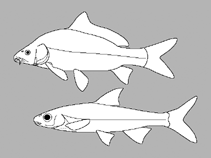
分類 / 名稱 俗名 | 同種異名 | Catalog of Fishes(屬, 種) | ITIS | CoL | WoRMS | Cloffa
Teleostei > Cypriniformes (Carps) 鯉形目 (Carps) > Cyprinidae (Minnows or carps) 鯉科 (Minnows or carps) > Smiliogastrinae
Etymology: Enteromius: Greek, enteron = intestine + Greek, myo, mys = muscle (Ref. 45335); validus: Specific name, validus, from the Latin meaning strong or powerful, in reference to the robust appearance of the species (Ref. 106731).
Etymology: Enteromius: Greek, enteron = intestine + Greek, myo, mys = muscle (Ref. 45335); validus: Specific name, validus, from the Latin meaning strong or powerful, in reference to the robust appearance of the species (Ref. 106731).
環境: 環境 / 氣候帶 / 深度上下限 / 配送範圍 生態學
; 淡水 底中水層性.
分布 領土 | FAO區域 | 生態系 | 發現紀錄 | 分布圖 | 簡介 | Faunafri
Africa: N’sele River and Mayi Ndombe River, Congo River basin in Democratic Republic of the Congo (Ref. 106731), and Léfini River in Congo Republic (Ref. 122753).
大小 / 重量 / 年齡
簡短描述 檢索表 | 型態特徵 | 形態測量圖
背棘 (總數) : 0; 背的軟條 (總數) : 11; 臀棘: 0; 臀鰭軟條: 8; 脊椎骨: 34 - 35. Diagnosis: It is distinguished from all other African smiliogastrin species by the following features that, in combination, uniquely diagnose the species: scales in midlateral series not enlarged relative to impinging rows above and below; barbels well developed, maxillary pair extending beyond level of mideye, mandibular pair reaching level of midopercle; numerous conical tubercles over snout and cheek, and dorsum of head; small circular occipital fontanel often present and located medially at parietal suture; gill rakers well developed, 8 or 9 on hypo- and ceratobranchial elements of first arch; last unbranched dorsal-fin ray weakly ossified, flexible, and lacking serrations along posterior edge; dorsal fin creamy white proximally, distal half to two thirds darkly pigmented (Ref. 106731).
Body shape (shape guide): fusiform / normal.
Body shape (shape guide): fusiform / normal.
This species is omnivorous and opportunistic (Ref. 106731). Gut contents contained disarticulated insect remains, woody debris, seeds, macerated grasses and terrestrial arthropod remains of spiders and ants (Ref. 106731). Specimens collected in June, July, and August showed no sign of maturation of ovaries or testes; most large individuals collected in March had enlarged testes or ovaries filled with numerous small, round eggs suggesting that peak breeding occurs at that time (Ref. 106731).
生命週期和交配行為 成熟度 | 繁殖 | 產卵場 | 卵 | 孕卵數 | 仔魚
主要參考資料
上傳您的推薦信 | 參考文獻 | 合作者 | 合作者
Stiassny, M.L.J, T.L.D. Liyandja and R.J.C. Monsembula Iyaba, 2016. A new small barb (Cyprininae: Smiliogastrini) from the N’sele and Mayi Ndombe rivers in the lower reaches of the middle Congo basin (Democratic Republic of Congo, Central Africa). Am. Mus. Novit. 3848:1-15. (Ref. 106731)
CITES
Not Evaluated
對人類具威脅
人類使用
漁業: 沒有興趣
FAO - Publication: search | FishSource |
更多資訊
解剖學
鰓區
腦部
耳石
鰓區
腦部
耳石
生理學
身體成分
營養素
耗氧量
游泳類型
游泳速度
視覺色素
魚聲
疾病與寄生蟲
毒性 (LC50s)
身體成分
營養素
耗氧量
游泳類型
游泳速度
視覺色素
魚聲
疾病與寄生蟲
毒性 (LC50s)
遺傳學
基因組
遺傳學
異種性
遺傳率
遺傳多樣性
基因組
遺傳學
異種性
遺傳率
遺傳多樣性
工具
特別的報告
下載 XML
網路資源
AFORO (otoliths) | Aquatic Commons | BHL | Cloffa | Websites from users | 檢查 FishWatcher | CISTI | Catalog of Fishes: 屬, 種 | DiscoverLife | ECOTOX | FAO - Publication: search | Faunafri | Fishipedia | Fishtrace | GloBI | Google Books | Google Scholar | Google | IGFA World Record | OneZoom | Open Tree of Life | Otolith Atlas of Taiwan Fishes | PubMed | Reef Life Survey | Socotra Atlas | TreeBase | 樹狀分類階層 | Wikipedia: 去, 搜尋 | World Records Freshwater Fishing | 動物學的記錄
基於模型的估計
系統發育多樣性指數 (參考文獻 82804): PD50 = 0.5000 [Uniqueness, from 0.5 = low to 2.0 = high].
Bayesian length-weight: a=0.00603 (0.00282 - 0.01286), b=3.06 (2.87 - 3.25), in cm total length, based on LWR estimates for this (Sub)family-body shape (Ref. 93245).
營養階層 (參考文獻 69278): 3.0 ±0.3 se; based on size and trophs of closest relatives
回復力 (參考文獻 120179): 高度, 族群倍增時間少於 15個月 (Preliminary K or Fecundity.).