>
Eupercaria/misc (Various families in series Eupercaria) >
Lethrinidae (Emperors or scavengers) > Monotaxinae
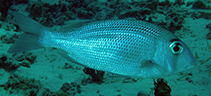
Etymology: Gymnocranius: Greek, gymnos = naked + Greek, kranion = skull (Ref. 45335); superciliosus: Named for the conspicuous dark patch above eye, which evokes an eyebrow.
Environment: milieu / climate zone / نطاق العمق / distribution range
البيئة
بحري pelagic-neritic; نطاق العمق 5 - 20 m (Ref. 107926). Tropical
Southwest Pacific: New Caledonia, Chesterfield Is., and Fiji
الحجم / وزن / العمر
النضج: Lm ? range ? - ? cm
Max length : 43.0 cm SL ذكر/ مختلط الجنس; (Ref. 107926)
وصف مختصر
مفاتيح التعريف | الوصف الخارجي | قياسات المظهر الخارجي
This species is distinguished by the following: a slender species with ratio of standard length to body depth between 2.65-3.06; forehead bumpy and lower edge of eye well above axis of body; moderately forked caudal fin with lobes slightly rounded; scales rows above lateral line 6; pored
scales on lateral line 48-49; colour of flanks silvery; scales above lateral line with a dark-grey basal patch forming longitudinal rows; scales with similar dark-grey basal patch on a more or less
extended portion of flank below lateral line; up to 24 or more pale-blue speckles against bronze background on snout and cheeks, distinctive on fresh and larger individuals but faint on smaller individuals; a pale-blue band joining the nostrils on forehead and reaching the eyes, bright in freshly captured larger individuals; the area immediately above eye (supraorbital shelf) forming a distinctive blackish eyebrow; more or less conspicuous vertical dark bar crossing the eye; upper lip is reddish to red while lower lip is white; the dorsal, pectoral, anal and caudal fins reddish to red (Ref. 107926).
Body shape (shape guide): fusiform / normal; Cross section: compressed.
Occurs on coral-sand bottom and collected using handlines; in lagoons and large pools. Stomach contents include broken bivalve shells and scraps of urchin shell (Ref. 107926).
Life cycle and mating behavior
النضج | التكاثر | وضع البيض | بيض | الخصوبة | Larvae
Borsa, P., P. Béarez, S. Paijo and W.-J. Chen, 2013. Gymnocranius superciliosus and Gymnocranius satoi, two new large-eye breams (Sparoidea: Lethrinidae) from the Coral Sea and adjacent regions. Comptes Rendus Biologies 336: 233-240. (Ref. 107926)
IUCN Red List Status (Ref. 130435: Version 2025-1)
استخدامات بشرية
مصائد: مصائد تستهلك محلينا
أدوات
تقارير خاصة
Download XML
مصادر علي الأنترنت
Estimates based on models
Phylogenetic diversity index (مرجع
82804): PD
50 = 0.5005 [Uniqueness, from 0.5 = low to 2.0 = high].
Bayesian length-weight: a=0.01698 (0.00734 - 0.03932), b=2.98 (2.79 - 3.17), in cm total length, based on LWR estimates for this (Sub)family-body shape (Ref.
93245).
مستوى غذائي (مرجع
69278): 3.4 ±0.6 se; based on size and trophs of closest relatives
المرونه (مرجع
120179): وسيط, الحد الزمني الأدني لتضاعف عدد أفراد المجتمع 1.4-4.4 سنة (Preliminary K or Fecundity.).
Fishing Vulnerability (Ref.
59153): Moderate vulnerability (41 of 100).
🛈
Nutrients (Ref.
124155): Calcium = 109 [48, 216] mg/100g; Iron = 1.1 [0.5, 1.9] mg/100g; Protein = 19.2 [17.1, 21.2] %; Omega3 = 0.199 [0.103, 0.359] g/100g; Selenium = 32.5 [16.4, 69.3] μg/100g; VitaminA = 24.2 [6.5, 79.9] μg/100g; Zinc = 1.25 [0.86, 1.84] mg/100g (wet weight);