


Melanotaenia albimarginata Allen, Hadiaty, Unmack & Erdmann, 2015
Whitetip rainbowfish
Envoyez vos Photos et vidéos
Images Google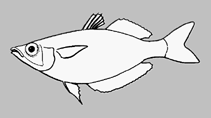 No image available for this species;
drawing shows typical species in Melanotaeniidae.
Images Google
drawing shows typical species in Melanotaeniidae.
Classification / Noms Noms communs | Synonymes | Catalog of Fishes(Genre, Espèce) | ITIS | CoL | WoRMS | Cloffa
> Atheriniformes (Silversides) > Melanotaeniidae (Rainbowfishes, blue eyes)
Etymology: Melanotaenia: Greek, melan, -anos = black + latin, taenia = stripe (Ref. 45335); albimarginata: From the Latin albimarginata, meaning white-margin, in reference to the prominent white markings on the caudal fin lobes.
Etymology: Melanotaenia: Greek, melan, -anos = black + latin, taenia = stripe (Ref. 45335); albimarginata: From the Latin albimarginata, meaning white-margin, in reference to the prominent white markings on the caudal fin lobes.
Environnement : milieu / zone climatique / profondeur / gamme de distribution Écologie
; eau douce benthopélagique; pH range: 8.0 - 8.6. Tropical; 27°C - ? (Ref. 110723)
Distribution Territoires | Zones FAO | Écosystèmes | Occurrences | Carte par point | Introductions | Faunafri
Asia: Alur Warnafa, a triburary of Sungai Unmar in Indonesia.
Taille / Poids / Âge
Maturité: Lm ? range ? - ? cm
Max length : 9.1 cm SL mâle / non sexé; (Ref. 110723); 7.1 cm SL (female)
Max length : 9.1 cm SL mâle / non sexé; (Ref. 110723); 7.1 cm SL (female)
Description synthétique Clés d'identification | Morphologie | Morphométrie
Épines dorsales (Total) : 5 - 7; Rayons mous dorsaux (Total) : 11 - 12; Épines anales: 1; Rayons mous anaux: 19 - 22. Melanotaenia albimarginata is distinguished by the following combination of characters: V or VI-I,11 or 12 dorsal-fin rays; I,19-22 anal-fin rays; 14-15 pectoral-fin rays; 35-36 scales on lateral line, 16-18 predorsal scales; 12-19 cheek scales; 16-18 total gill rakers on first arch; greatest body depth of adult male 36.2 % SL; least depth of caudal peduncle 9.6-10.9 % SL; color in life dappled grey on upper side, dark grey midlateral stripe (1-2 scales wide) with equally broad yellow stripe immediately below; dorsal and anal fins with greyish membranes and whitish to pale yellow fin rays; caudal semitranslucent grey with prominent white marking at tip of upper and lower lobes (Ref. 110723).
Body shape (shape guide): fusiform / normal.
Body shape (shape guide): fusiform / normal.
The type locality during January 2013 visit had very clear and slow flowing water with depths
ranging from about 1-3 m while during December 2013 visit it had water levels generally higher with stronger current, and reduced visibility due to the onset of monsoonal rains. The bottom was composed of relatively smooth limestone pavement with few aquatic plants (Cryptocoryne cilliata), littered with leaf and log debris. Repeatedly took refuge among the dead branches of fallen trees when pursued. Found syntopic with Melanotaenia senckenbergianus, Craterocephalus cf. randi, Ambassis interrupta, Glossamia aprion, Awous acritosus, Glossogobius concavifrons, Redigobius bikolanusStiphodon atratus, Eleotris fusca, and Oxyeleotris mertoni (Ref. 110723).
Cycle de vie et comportement reproducteur Maturité | Reproduction | Frai | Œufs | Fécondité | Larves
Référence principale
Téléchargez vos références | Références | Coordinateur | Collaborateurs
Allen, G.R., R.K. Hadiaty, P.J. Unmack and M.V. Erdmann, 2015. Rainbowfishes (Melanotaenia: Melanotaeniidae) of the Aru Islands, Indonesia with descriptions of five new species and redescription of M. patoti Weber and M. senckenbergianus Weber. aqua, Int. J. Ichthyol. 21(2):66-108. (Ref. 110723)
Statut dans la liste rouge de l'IUCN (Ref. 130435: Version 2025-2 (Global))
Préoccupation mineure (LC) ; Date assessed: 03 December 2019
CITES
Not Evaluated
Menace pour l'homme
Harmless
Utilisations par l'homme
Pêcheries: d'intérêt potentiel; Aquarium: potentiel
FAO - Publication: search | FishSource |
Plus d'informations
Écologie trophique
Aliments (proies)
Composition du régime alimentaire
Consommation alimentaire
Rations alimentaires
Prédateurs
Aliments (proies)
Composition du régime alimentaire
Consommation alimentaire
Rations alimentaires
Prédateurs
Dynamique des populations
Paramètres de croissance
Âges / tailles maximales
Longueur-poids rel.
Rel. longueur-longueur.
Fréquences de longueurs
Conversion de masse
Recrutement
Abondance
Paramètres de croissance
Âges / tailles maximales
Longueur-poids rel.
Rel. longueur-longueur.
Fréquences de longueurs
Conversion de masse
Recrutement
Abondance
Cycle de vie
Reproduction
Maturité
Maturité/épines rel.
Fécondité
Frai
Agrégats de frai
Œufs
Développement de l'œuf
Larves
Dynamique des populations larvaires
Reproduction
Maturité
Maturité/épines rel.
Fécondité
Frai
Agrégats de frai
Œufs
Développement de l'œuf
Larves
Dynamique des populations larvaires
Anatomie
Surface branchiale
Cerveau
Otolithe
Surface branchiale
Cerveau
Otolithe
Physiologie
Composition corporelle
Nutriments
Consommation d'oxygène
Type de natation
Vitesse de nage
Pigments visuels
Son de poisson
Maladies et parasites
Toxicité (CL50)
Composition corporelle
Nutriments
Consommation d'oxygène
Type de natation
Vitesse de nage
Pigments visuels
Son de poisson
Maladies et parasites
Toxicité (CL50)
Génétique
génôme
Génétique
Hétérozygotie
Héritabilité
Diversité génétique
génôme
Génétique
Hétérozygotie
Héritabilité
Diversité génétique
Liées à l'homme
Systèmes d'aquaculture
Profils d'aquaculture
Souches
Cas de ciguatera
Timbres, pièces de monnaie, divers
Systèmes d'aquaculture
Profils d'aquaculture
Souches
Cas de ciguatera
Timbres, pièces de monnaie, divers
Outils
E-book | Guide de terrain | Générateur de fréquences de longueur | Outil de dynamique de population | Carte par point |
Capture-MSY |
Articles particuliers
Télécharger en XML
Sources Internet
AFORO (otoliths) | Aquatic Commons | BHL | Cloffa | Websites from users | FishWatcher | CISTI | Catalog of Fishes: Genre, Espèce | DiscoverLife | ECOTOX | FAO - Publication: search | Faunafri | Fishipedia | Fishtrace | GloBI | Google Books | Google Scholar | Google | IGFA World Record | OneZoom | Open Tree of Life | Otolith Atlas of Taiwan Fishes | PubMed | Reef Life Survey | Socotra Atlas | TreeBase | Arbre de Vie | Wikipedia: aller à, chercher | World Records Freshwater Fishing | Zoobank | Zoological Record
Estimations basées sur des modèles
Indice de diversité phylogénétique (Réf. 82804): PD50 = 0.5000 [Uniqueness, from 0.5 = low to 2.0 = high].
Bayesian length-weight: a=0.01122 (0.00514 - 0.02450), b=3.04 (2.87 - 3.21), in cm total length, based on all LWR estimates for this body shape (Ref. 93245).
Niveau trophique (Réf. 69278): 2.9 ±0.4 se; based on size and trophs of closest relatives
Résilience (Réf. 120179): Milieu, temps minimum de doublement de population : 1,4 à 4,4 années (Preliminary K or Fecundity.).