>
Cichliformes (Cichlids, convict blennies) >
Cichlidae (Cichlids) > Pseudocrenilabrinae
Etymology: Haplochromis: Greek, Haploos = single + Greek, chromis = a fish, perhaps a perch (Ref. 45335); pappenheimi: Specific name in honour of Paul Pappenheim (1878-1945), at that time curator of fishes at the Museum für Naturkunde in Berlin, who co-authored the book in which the description appeared (Ref. 128938).
Eponymy: Professor Dr Eugen Julius Adolph Paul Pappenheim (1878–1945) was a German zoologist who was Curator of Fishes, Königliche Zoologische Museum, Berlin. [...] (Ref. 128868), visit book page.
More on author: Boulenger.
Environment: milieu / climate zone / rango de profundidad / distribution range
Ecología
; agua dulce pelágico; no migratorio. Tropical; 0° - 1°S
Africa: only known from Lake Edward (Ref. 128938). Published information about Haplochromis pappenheimi from Lake George and the Kazinga Channel most likely refers to Haplochromis pelagicus (Ref. 128938).
Tamaño / Peso / Age
Madurez: Lm ? range ? - ? cm
Max length : 8.8 cm SL macho / no sexado; (Ref. 128938)
Short description
Claves de identificación | Morfología | Morfometría
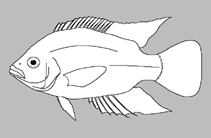
Espinas dorsales (total) : 15 - 17; Radios blandos dorsales (total) : 9 - 10; Espinas anales: 3; Radios blandos anales: 8 - 9; Vértebra: 30 - 32. Diagnosis: Haplochromis pappenheimi is a species with a shallow body, body depth 27.2-31.0% of standard length; long and shallow caudal peduncle, caudal peduncle length 17.4-19.6% of standard length, caudal peduncle depth 55.0-69.1% of caudal peduncle length; short upper jaw compared to lower jaw, upper jaw length 64.2-73.2% of lower jaw length; posterior 1/4-1/5 of premaxillary dentigerous arm sometimes edentulous; many gill rakers, 13-17 (Ref. 128938). It differs from H. aureus by a shallower body, 27.2-31.0% of standard length vs. 30.7-33.5%; shorter upper jaw, upper jaw length 26.8-29.4% of head length vs. 29.3-35.6%; more gill rakers, 13-17 vs. 12-14; dominant males with dark grey vs. yellow snout and cheeks (Ref. 128938). It is similar to H. oregosoma in body shape and dominant male colour pattern, differs by deeper lacrimals, lacrimal depth 16.1-18.1% of head length vs. 10.5-15.2%, and a broader interorbital area, interorbital width 54.0-63.5% of head width vs. 45.9-48.8% (Ref. 128938). It is very similar to H. pelagicus and differs by anal fin dark-dusky vs. hyaline to rarely faintly dusky; major cusps of outer oral teeth acutely vs. bluntly pointed, and with no to a small flange, rarely a large flange, vs. with a small to large flange; anterior outer oral teeth including often several vs. rarely some tricuspid teeth; dominant males differ further from those of H. pelagicus by anal and caudal fins crimson vs. hyaline; belly and chest dark-coloured vs. light-coloured belly and speckled-black chest; cheek dark-coloured with a well-defined lacrimal stripe vs. light-coloured with a very well-defined lacrimal stripe; pelvic fins slightly longer, pelvic fin length of male 25.2-33.5% of standard length vs. 23.3-27.0% (Ref. 128938).
Body shape (shape guide): fusiform / normal.
Found in upper water levels in offshore regions (Ref. 4983); abundant in and near sublittoral regions and present in deepwater regions (Ref. 128938). It feeds on zooplankton, particularly copepods and cladocerans (Ref. 558, 128938) and larvae, pupae and emerging adults of chaoborids (Ref. 128938).
Life cycle and mating behavior
Madurez | Reproducción | Puesta | Huevos | Fecundidad | Larva
Mouthbrooding by females.
Vranken, N., M. Van Steenberge, M. Mbalassa and J. Snoeks, 2023. Just below the surface, the pelagic haplochromine cichlids from the Lake Edward system. Hydrobiologia 850:3173-3195. (Ref. 128938)
IUCN Red List Status (Ref. 130435: Version 2025-1)
Threat to humans
Harmless
Human uses
Pesquerías: sin interés
Herramientas
Special reports
Download XML
Fuentes de Internet
Estimates based on models
Phylogenetic diversity index (Referencia
82804): PD
50 = 0.5000 [Uniqueness, from 0.5 = low to 2.0 = high].
Bayesian length-weight: a=0.01445 (0.00674 - 0.03099), b=2.99 (2.82 - 3.16), in cm total length, based on LWR estimates for this (Sub)family-body shape (Ref.
93245).
Nivel trófico (Referencia
69278): 3.2 ±0.30 se; based on food items.
Resiliencia (Referencia
120179): Alto, población duplicada en un tiempo mínimo inferior a 15 meses (Preliminary K or Fecundity.).
Fishing Vulnerability (Ref.
59153): Low vulnerability (10 of 100).
🛈