Klassifizierung / Names
Namen | Synonyme | Catalog of Fishes(Gattung, Arten) | ITIS | CoL | WoRMS | Cloffa
>
Characiformes (Characins) >
Hepsetidae (African pikes)
Etymology: Hepsetus: Greek, epsetas, -e, -on = boiled, but there is the following sentence: "oí epsetoi" = certain fishes, and also could be related to "psetta" = grouper (Ref. 45335).
Environment: milieu / climate zone / Tiefenbereich / distribution range
Ökologie
; süßwasser benthopelagisch. Tropical
Africa: widespread in the lower and middle Congo River basin, excluding the southern part of the Kasai and the Dja; and just upstream of Wagenia rapids in Kisangani (Ref. 108775). Also in the Gribingui River (Lake Chad basin) in Central African Republic (Ref. 108775).
Size / Gewicht / Alter
Geschlechtsreife: Lm ? range ? - ? cm
Max length : 30.5 cm SL Männchen/unbestimmt; (Ref. 124477)
Kurzbeschreibung
Bestimmungsschlüssel | Morphologie | Morphometrie
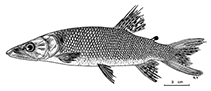
Wirbelzahl: 39 - 40. Diagnosis: Hepsetus microlepis is distinguished from H. occidentalis by a larger internasal distance, 23-31% of head length vs. 20-25%, and smaller nostril-lower jaw distance, 35-44% of head length vs. 40-48%, both positively allometric characters; it is distinguished from H. odoe by a generally higher number of lateral line scales, 47-60 vs. 43-51, and by a uniform body colour vs. a vague stripe pattern from the adipose fin to the caudal fin; it is distinguished from H. kingsleyae by a greater internasal distance, 23-31% of head length vs. 16-23%, and a greater head width, 32-46% of head length vs. 26-36%, which are both positively allometric; it is distinguished from H. lineatus by a combination of characters: a higher number of epibranchial gill rakers on the first gill arch, 4-9, exceptionally 13, vs. 0-6, and a smaller distance between dorsal and adipose fin, 9.2-12.8% of standard length vs. 12.6-16.4%; Hepsetus microlepis also has a uniform body colour, whereas H. lineatus has a prominent stripe on its flanks; Hepsetus microlepis is distinguished from H. cuvieri by a higher number of gill rakers on the first arch, 13-14 vs. 8-13, and by a greater head width, 32-46% of head length vs. 29-40%, and also a greater internasal distance, 23-31% of head length vs. 19-26%, with the latter two being positively allometric (Ref. 108775).
Body shape (shape guide): elongated.
Life cycle and mating behavior
Geschlechtsreife | Fortpflanzung | Ablaichen | Eier | Fecundity | Larven
Decru, E., J. Snoeks and E. Vreven, 2015. Taxonomic evaluation of the Hepsetus from the Congo basin with the revalidation of H. microlepis (Teleostei: Hepsetidae). Ichthyol. Explor. Freshwat. 26(3):273-287. (Ref. 108775)
IUCN Rote Liste Status (Ref. 130435: Version 2025-1)
Bedrohung für Menschen
Harmless
Nutzung durch Menschen
Tools
Zusatzinformationen
Download XML
Internet Quellen
Estimates based on models
Phylogenetic diversity index (Ref.
82804): PD
50 = 0.5312 [Uniqueness, from 0.5 = low to 2.0 = high].
Bayesian length-weight: a=0.00708 (0.00370 - 0.01356), b=3.18 (3.00 - 3.36), in cm total length, based on LWR estimates for this species & (Sub)family-body (Ref.
93245).
Trophic level (Ref.
69278): 3.0 ±0.3 se; based on size and trophs of closest relatives
Widerstandsfähigkeit (Ref.
120179): mittel, Verdopplung der Population dauert 1,4 - 4,4 Jahre. (Preliminary K or Fecundity.).
Fishing Vulnerability (Ref.
59153): Low to moderate vulnerability (27 of 100).
🛈