


Julidochromis marksmithi Burgess, 2014
Ladda upp din foton och Videor
Google image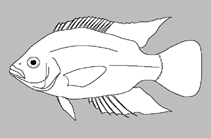 No image available for this species;
drawing shows typical species in Cichlidae.
Google image
drawing shows typical species in Cichlidae.
Klassificering / Namn Populärnamn | synonymer | Catalog of Fishes(Släkte, Arter) | ITIS | CoL | WoRMS | Cloffa
> Cichliformes (Cichlids, convict blennies) > Cichlidae (Cichlids) > Pseudocrenilabrinae
Etymology: Julidochromis: Taken from marine wrasse "julidini"; also from Greek, ioulis = a fish dealing with genera Coris or Thalassoma (Ref. 45335); marksmithi: Named for Mark Smith, who was instrumental in obtaining the specimens used in this description and providing the photograph of the living species of Julidochromis (Ref. 115482).
Eponymy: Mark Smith is an American aquarist who specialises in Rift Valley cichlids. He is also a photographer of aquatic wildlife, an explorer and a writer. Among his books is: Lake Malawi Cichlids (2001). (Ref. 128868), visit book page.
Etymology: Julidochromis: Taken from marine wrasse "julidini"; also from Greek, ioulis = a fish dealing with genera Coris or Thalassoma (Ref. 45335); marksmithi: Named for Mark Smith, who was instrumental in obtaining the specimens used in this description and providing the photograph of the living species of Julidochromis (Ref. 115482).
Eponymy: Mark Smith is an American aquarist who specialises in Rift Valley cichlids. He is also a photographer of aquatic wildlife, an explorer and a writer. Among his books is: Lake Malawi Cichlids (2001). (Ref. 128868), visit book page.
Miljö: miljö / Klimatzon / djupintervall / distributionsområde Ekologi
; sötvatten pelagiska. Tropical
Utbredning Territorier | FAO områden | Ekosystem | Förekomster | Prickkarta | Utplanteringar | Faunafri
Africa: endemic to the Tanzanian coast of Lake Tanganyika in the area around Kipili (Ref. 115482).
Storlek / Vikt / Ålder
Kort beskrivning Bestämningsnycklar | Morfologi | Morfometri
Taggstrålar i ryggfenan (totalt) : 21 - 23; Mjukstrålar i ryggfenan (totalt) : 5 - 7; Taggstrålar i analfenan: 6 - 8; Mjukstrålar i analfenan: 5 - 7. Diagnosis: Julidochromis marksmithi is a typical Julidochromis that differs mainly in its colouration and pattern from the other species of the genus: it is bright yellow and decorated by two major horizontal dark brown to blackish bands on the body with a third stripe extending from the nape only about halfway along the back at the dorsal fin base; an additional dark somewhat irregular stripe (cheek stripe) runs from the corner of the mouth across the cheek as far as the pectoral fin base , but the posterior segments beyond the preopercle are often faded or lacking; this stripe is lacking in the ornatus-transcriptus-dickfeldi group; a broad dark band, bordered by a narrow blackish edge and a submarginal light blue stripe, extends along the upper part of the dorsal fin to its angle where it may spread throughout the soft portion of the fin (Ref. 115482). It differs from the larger J. regani and J. marlieri by lacking the lower body band of those species, and all their forms; Julidochromis ornatus has a blackish band, often quite broad, running along the entire base of the dorsal fin with the remainder of the fin yellow, no black band is present along the upper part of the fin; Julidochromis dickfeldi also lacks the cheek stripe as well as the band in the dorsal fin; it is white below the central body band as opposed to the yellow in J. marksmithi; Julidochromis marlieri and J. transcriptus have vertical bars, which are absent in J. marksmithi (Ref. 115482).
Body shape (shape guide): elongated.
Body shape (shape guide): elongated.
It is found in a rocky habitat but where there are sandy areas close by (Ref. 115482).
Livscykel och parningsbeteende Könsmognad | Reproduktion | Lek | Ägg | Fekunditet | Larver
Huvudreferens
Ladda upp dina referenser | referenser | Koordinator : Kullander, Sven O. | Medarbetare
Burgess, W.E., 2014. Julidochromis marksmithi a new species of Julidochromis from the Tanzanian coast of Lake Tanganyika. Tanganika Mag. 15:40-49. (Ref. 115482)
Status på IUCN:s rödlista (Ref. 130435: Version 2025-2 (Global))
Near Threatened (NT) (B1a); Date assessed: 13 March 2025
CITES
Not Evaluated
Hot mot människor
Harmless
Mänskliga användningsområden
FAO - Publication: search | FishSource |
Ytterligare information
Trofisk ekologi
Livsmedelsartiklar (preys)
Födosammansättning
Födointag
Matransoner
Predatorer
Livsmedelsartiklar (preys)
Födosammansättning
Födointag
Matransoner
Predatorer
Populationsdynamik
Tillväxtparametrar
Max. åldrar / storlekar
Längd-vikt rel.
Längd-längd rel.
Längd-frekvenser
Massakonvertering
Rekrytering
Abundans
Tillväxtparametrar
Max. åldrar / storlekar
Längd-vikt rel.
Längd-längd rel.
Längd-frekvenser
Massakonvertering
Rekrytering
Abundans
Livscykel
Reproduktion
Könsmognad
Mognad/Gills rel.
Fekunditet
Lek
Lekande aggregat
Ägg
Utveckling av ägg
Larver
Larvdynamik
Reproduktion
Könsmognad
Mognad/Gills rel.
Fekunditet
Lek
Lekande aggregat
Ägg
Utveckling av ägg
Larver
Larvdynamik
Anatomi
Gälyta
Hjärna
Otolit
Gälyta
Hjärna
Otolit
Fysiologi
Kroppssammansättning
Näringsämnen
Syreförbrukning
Typ av simning
Simhastighet
Visuella pigment
Ljud från fisk
Sjukdomar & Parasiter
Toxicitet (LC50)
Kroppssammansättning
Näringsämnen
Syreförbrukning
Typ av simning
Simhastighet
Visuella pigment
Ljud från fisk
Sjukdomar & Parasiter
Toxicitet (LC50)
Genetik
Genom
Genetik
Heterozygositet
Ärftlighet
Genetisk mångfald
Genom
Genetik
Heterozygositet
Ärftlighet
Genetisk mångfald
Människorelaterad
Vattenbrukssystem
Vattenbruksprofiler
Avelslinjer
Ciguatera-fall
Frimärken, mynt, diverse.
Vattenbrukssystem
Vattenbruksprofiler
Avelslinjer
Ciguatera-fall
Frimärken, mynt, diverse.
Verktyg
Särskilda rapporter
Kontrollera för underhåll av akvarium | Kontrollera om det finns faktablad om arter | Kontrollera om det finns faktablad om vattenbruk
Ladda ner XML
Internet-källor
AFORO (otoliths) | Aquatic Commons | BHL | Cloffa | Websites from users | Check FishWatcher | CISTI | Catalog of Fishes: Släkte, Arter | DiscoverLife | ECOTOX | FAO - Publication: search | Faunafri | Fishipedia | Fishtrace | GloBI | Google Books | Google Scholar | Google | IGFA World Record | OneZoom | Open Tree of Life | Otolith Atlas of Taiwan Fishes | Offentliga akvarier | PubMed | Reef Life Survey | Socotra Atlas | TreeBase | Tree of Life | Wikipedia: Go, sök | World Records Freshwater Fishing | Zoobank | Zoologiskt register
Uppskattningar baserade på modeller
Index för fylogenetisk mångfald (Ref. 82804): PD50 = 0.5156 [Uniqueness, from 0.5 = low to 2.0 = high].
Bayesian length-weight: a=0.00389 (0.00180 - 0.00842), b=3.12 (2.94 - 3.30), in cm total length, based on all LWR estimates for this body shape (Ref. 93245).
Trofisk nivå (Ref. 69278): 3.4 ±0.4 se; based on size and trophs of closest relatives
Resiliens (Ref. 120179): Hög, lägsta populationsfördubblingstid mindre än 15 månader (Preliminary K or Fecundity.).