>
Perciformes/Uranoscopoidei (Sand dwellers) >
Pinguipedidae (Sandperches)
Etymology: Parapercis: Greek, para = the side of + Greek, perke = perch (Ref. 45335); binotata: Name from Latin ' binotata' meaning 'two markings', referring to the diagnostic dark bands
on the cheek and pectoral fins of males; treated as a feminine singular compound adjective.
Environment: milieu / Zona climática / intervalo de profundidade / distribution range
Ecologia
marinhas pelagic-neritic, usually 4 - 8 m (Ref. 116121). Tropical
Western Pacific: Solomon Islands.
Tamanho / Peso / Idade
Maturidade: Lm ? range ? - ? cm
Max length : 5.7 cm SL macho/indeterminado; (Ref. 116121)
Descrição suscinta
Chaves de identificação | Morfologia | Morfometria
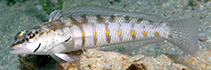
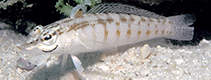
Espinhos dorsais (total) : 5; Raios dorsais (total) : 21; Espinhos anais: 1; Raios anais : 16 - 17. This species is distinguished by the following characters: D V,21; A I,16-17; pectoral-fin rays 14-16; lateral-line scales 46-48; 4 progressively larger, recurved canine teeth on each side at front of lower jaw; ctenoid scales on body except prepelvic area with cycloid scales; opercle and cheek are covered with ctenoid scales; body depth 4.7-5.5 in SL; caudal fin is truncate to slightly rounded; pelvic fins reaching beyond the anal-fin origin; colour of head and body generally white with 7-8 short brown bars on back, above lateral line and lower side with corresponding narrow yellow-orange to brown bars; adult has conspicuous black band on rear edge of cheek and short black band on lower pectoral-fin rays; females have a curved black band under eye along lower edge of suborbital (Ref. 116121).
Body shape (shape guide): elongated; Cross section: oval.
This species lives in a relatively unusual habitat, consisting of a nearly enclosed, narrow, dead-end lagoon, with a gradually sloping, white sand bottom with scattered, mainly low-profile, coral formations, occurring as solitary individuals (Ref. 116121).
Ciclo de vida ou comportamento de acasalamento
Maturidade | Reprodução | Desova | Ovos | Fecundidade | Larvas
Allen, G.R. and M.V. Erdmann, 2017. A new species of Parapercis (Teleostei: Pinguipedidae) from the Solomon Islands. J. Ocean Sci. Found. 27:8-19. (Ref. 116121)
Status na Lista Vermelha da UICN (Ref. 130435: Version 2025-1)
Ameaça para os humanos
Harmless
Uso pelos humanos
Ferramentas
Relatórios especiais
Baixar XML
Fontes da internet
Estimates based on models
Índice de diversidade filogenética (Ref.
82804): PD
50 = 0.5000 [Uniqueness, from 0.5 = low to 2.0 = high].
Bayesian length-weight: a=0.00692 (0.00314 - 0.01524), b=3.06 (2.88 - 3.24), in cm total length, based on LWR estimates for this Genus-body shape (Ref.
93245).
Nível Trófico (Ref.
69278): 3.3 ±0.4 se; based on size and trophs of closest relatives
Resiliência (Ref.
120179): Elevada, tempo mínimo de duplicação da população menor que 15 meses (Preliminary K or Fecundity.).
Fishing Vulnerability (Ref.
59153): Low vulnerability (10 of 100).
🛈