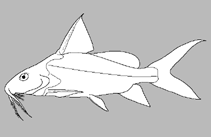
Classification / Names
Populärnamn | synonymer | Catalog of Fishes(Släkte, Arter) | ITIS | CoL | WoRMS | Cloffa
>
Siluriformes (Catfishes) >
Mochokidae (Squeakers or upside-down catfishes) > Chiloglanidinae
Etymology: Chiloglanis: Greek, cheilos = lip + Greek, glanis = a fish that can eat the bait without touching the hook; a cat fish (Ref. 45335); longibarbis: The specific epithet is a combination of 'longis' and 'barbis', and refers to the long maxillary and mandibular barbels (Ref. 116018).
Environment: milieu / climate zone / djupintervall / distribution range
Ekologi
; sötvatten bentopelagisk. Tropical
Africa: Moa River drainage in Guinea (Ref. 116018).
Size / Vikt / Age
Könsmognad: Lm ? range ? - ? cm
Max length : 4.1 cm SL hane/ej könsbestämd; (Ref. 116018)
Short description
Bestämningsnycklar | Morfologi | Morfometri
Taggstrålar i ryggfenan (totalt) : 2; Mjukstrålar i ryggfenan (totalt) : 5; Taggstrålar i analfenan: 0; Mjukstrålar i analfenan: 9. Diagnosis: Chiloglanis longibarbis is distinguished from all other West African congeners, with the exception of C. waterloti, in having eight or fewer mandibular teeth in the functional row; it is distinguished from C. waterloti in having longer maxillary and mandibular barbels (Ref. 116018).
Body shape (shape guide): elongated.
Found in a medium-sized river with moderate canopy coverage; the substrate mostly sand, except for two rocky runs created by a bridge structure (Ref. 116018).
Life cycle and mating behavior
Könsmognad | Reproduktion | Lek | Ägg | Fecundity | Larver
Schmidt, R.C., H.L. Bart, F. Pezold and J.P. Friel, 2017. A biodiversity hotspot heats up: Nine new species of suckermouth catfishes (Mochokidae: Chiloglanis) from Upper Guinean forest steams in West Africa. Copeia 105(2):301-338. (Ref. 116018)
IUCN Red List Status (Ref. 130435: Version 2025-1)
Threat to humans
Harmless
Human uses
Fiskeri: saknar intresse
Verktyg
Special reports
Download XML
Internet-källor
Estimates based on models
Phylogenetic diversity index (Ref.
82804): PD
50 = 0.5000 [Uniqueness, from 0.5 = low to 2.0 = high].
Bayesian length-weight: a=0.00389 (0.00180 - 0.00842), b=3.12 (2.94 - 3.30), in cm total length, based on all LWR estimates for this body shape (Ref.
93245).
Trofisk nivå (Ref.
69278): 3.1 ±0.4 se; based on size and trophs of closest relatives
Resiliens (Ref.
120179): Hög, lägsta populationsfördubblingstid mindre än 15 månader (Preliminary K or Fecundity.).
Fishing Vulnerability (Ref.
59153): Low vulnerability (10 of 100).
🛈