>
Acanthuriformes (Surgeonfishes) >
Chaetodontidae (Butterflyfishes)
Etymology: Prognathodes: Greek, pro = first, in front of + Greek, gnathos = jaw (Ref. 45335); basabei: Named in honor of Peter, K. Basabe, long-time diver, aquarium fish collector, both for his role in the collection of the first specimen of this new species in 1998 and more generally for his extensive contributions and assistance to many researchers (especially the authors) in the ichthyological community.
Eponymy: Peter K Basabe was a veteran local diver from Kona who, over the years, has assisted with the collection of reef fishes for numerous scientific studies and educational displays. [...] (Ref. 128868), visit book page.
Environment: milieu / climate zone / profondeur / distribution range
Écologie
marin démersal; profondeur 45 - 187 m (Ref. 116690). Tropical
Distribution
Pays | Zones FAO | Écosystèmes | Occurrences | Carte par point | Introductions | Faunafri
Eastern Central Pacific: Hawaii.
Taille / Poids / Âge
Maturité: Lm ? range ? - ? cm
Max length : 10.6 cm SL mâle / non sexé; (Ref. 116690); 9.3 cm SL (female)
Description synthétique
Clés d'identification | Morphologie | Morphométrie
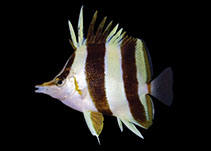
Épines dorsales (Total) : 12 - 13; Rayons mous dorsaux (Total) : 21 - 22; Épines anales: 3; Rayons mous anaux: 16 - 17. This species is distinguished by the following set of characters: D XII-XIII,21-22; A III,16-17; head 2.63-2.80 in SL; body depth 1.58-1.69 in SL; pelvic-fin spine length 3.63-4.07 in SL; colour in life is pale yellow dorsally, fading to white ventrally (sometimes it is entirely white), 3 black bands with narrow white margins on each side of the body, with the first band originating at and including the first dorsal-fin spine, extending diagonally to the eye and continuing horizontally as an orangish brown stripe from the eye to the tip of the snout, while the second band originate at and including the fourth to sixth dorsal-fin spines, extending vertically at a slightly posterior angle to the ventral surface of the abdomen just anterior to the anus, tapering slightly and curving slightly posteriorly below the pectoral fin, and the last or third band originating at and including the last four to five dorsal-fin spines and first four to five dorsal-fin soft rays, extending vertically at a slightly posterior angle to and including the first several anal-fin soft rays, with a narrow orange band on the dorso-posterior margin of the operculum, extending ventrally the posterior angle of the operculum, an oblong orange spot with some dark pigmentation on the upper one-third of the pectoral-fin axis, pelvic fins white on the spine and anterior one-third of fin, and bright orange on the posterior two-thirds of fin, a bright orange submarginal band with narrow white posterior margin extending along the posterior margins of the soft portions of the dorsal and anal fins, and continuing across the caudal peduncle (Ref. 116690).
Body shape (shape guide): short and / or deep; Cross section: compressed.
This species was observed in areas of basalt substrata (e.g., basalt talus, blocky lava, lava tubes and pillows, basalt boulders) and in limestone habitats (primarily limestone holes and ledges). Observed also in the vicinity of an unidentified antipatharian coral, near Cirrhipathes spiralis (Linnaeus), and Antipathes dichotoma Pallas. This species in association with limestone ledges and discontinuities representing ancient shorelines, almost in all cases, the fish were found underneath, inside of, or in close proximity to small undercut overhangs or caves, often swimming upside-down in association with the roof of the overhangs and caves. However, there are no obvious associations with other species, such as antipatharian corals, other corals and sessile invertebrates, or particular fish species; although certain species, such as Odontanthias fuscipinnis (Jenkins, 1901) and the wrasse Bodianus sanguineus (Jordan & Evermann, 1903), these species tend to occupy the same depth and habitat. Collected with hand nets during deep dives using mixed-gas, closedcircuit rebreathers (Ref. 116690). FishBase common name agreed by authors.
Life cycle and mating behavior
Maturité | Reproduction | Frai | Œufs | Fécondité | Larves
Pyle, R.L. and R.K. Kosaki, 2016. Prognathodes basabei, a new species of butterflyfish (Perciformes, Chaetodontidae) from the Hawaiian Archipelago. ZooKeys 614:137-152.. (Ref. 116690)
Statut dans la liste rouge de l'IUCN (Ref. 130435: Version 2025-1)
Menace pour l'homme
Harmless
Utilisations par l'homme
Outils
Articles particuliers
Télécharger en XML
Sources Internet
Estimates based on models
Phylogenetic diversity index (Réf.
82804): PD
50 = 0.5001 [Uniqueness, from 0.5 = low to 2.0 = high].
Bayesian length-weight: a=0.02239 (0.01097 - 0.04568), b=3.01 (2.84 - 3.18), in cm total length, based on LWR estimates for this (Sub)family-body shape (Ref.
93245).
Niveau trophique (Réf.
69278): 3.4 ±0.3 se; based on size and trophs of closest relatives
Résilience (Réf.
120179): Haut, temps minimum de doublement de population inférieur à 15 mois (Preliminary K or Fecundity.).
Fishing Vulnerability (Ref.
59153): Low vulnerability (10 of 100).
🛈