


Schistura wanlainensis Kottelat, 2017
Uploaden van uw Foto's en video's
Google afbeelding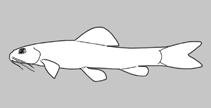 No image available for this species;
drawing shows typical species in Nemacheilidae.
Google afbeelding
drawing shows typical species in Nemacheilidae.
Classificatie / Namen Lokale namen | Synoniemen | Catalog of Fishes(Genus, Soort(en)) | ITIS | CoL | WoRMS | Cloffa
> Cypriniformes (Carps) > Nemacheilidae (Brook loaches)
Etymology: Schistura: Greek, schizein = to divide + Greek, oura = tail; an allusion to forked caudal fins (Ref. 45335); wanlainensis: Named after Wan Lain Dam village where the fish were collected, and whose inhabitants have established a fish conservation zone. An adjective.
Etymology: Schistura: Greek, schizein = to divide + Greek, oura = tail; an allusion to forked caudal fins (Ref. 45335); wanlainensis: Named after Wan Lain Dam village where the fish were collected, and whose inhabitants have established a fish conservation zone. An adjective.
Milieu: milieu / Klimaatzone / Diepte / verspreidingsgebied Ecologie
; zoet water demersaal. Tropical
Verspreiding Gebieden | FAO regio's | Ecosystemen | Voorkomen | Verspreidingskaart | Introducties | Faunafri
Asia: Mon Lan Chaung, a tributary of Mali Hka, in Myanmar.
Grootte / Gewicht / Leeftijd
Korte beschrijving Determinatiesleutels | Morfologie | Morfometrie
Dorsale zachte stralen (totaal) : 12; Anale zachte stralen: 8. Schistura wanlainensis is distinguished from all its congeners in Southeast Asia by its unique color pattern consisting of a pale yellowish to pale grey background with 18-32 narrow, regularly shaped black bars, extending from dorsal midline and reaching downwards to below level of pectoral fin, continuous over back with contralaterals in most specimens, wider than interspaces
anteriorly, narrower than interspaces on caudal peduncle; some of anterior bars fused at their dorsal extremity. Other useful but non-unique diagnostic characters include the following: base of caudal fin with black pattern made of a vertically elongated blotch at middle of base, and a
smaller blotch at its dorsal and ventral extremities (blotches contiguous in one specimen); dorsal fin with 8½ branched rays; caudal fin forked; caudal peduncle depth 1.2-1.5 times in its length; very low dorsal and ventral crests on caudal peduncle; lips thick, fleshy; upper lip with median notch; lower lip with narrow median interruption, with numerous furrows; processus dentiformis present, feebly marked, very wide (more than half of mouth gape); and a suborbital slit present in females (males unknown but expected to have a suborbital flap) (Ref. 116725).
Body shape (shape guide): elongated.
Body shape (shape guide): elongated.
Inhabits Mon Lan Chaung, a large river with approximately 50 m width and very fast water flowing over a stone and boulders bottom. Syntopic with Garra cf. dulongensis, Garra sp., Neolissochilus compressus, Oreinus meridionalis, Semiplotus cirrhosus (Cyprinidae), Acanthocobitis sp., Schistura malaisei (Nemacheilidae), Amblyceps murraystuarti (Amblycipitidae), Glyptothorax sp., Oreoglanis sp. (Sisoridae) and Mastacembelus armatus (Mastacembelidae) (Ref. 116725).
Levenscyclus en paargedrag Maturiteit | Voortplanting | Paaien | Eieren | Fecunditeit | Larven
Hoofdreferentie
Upload uw referenties | Referenties | Coördinator | Medewerkers
Kottelat, M., 2017. A new genus and three new species of nemacheilid loaches from northern Irrawaddy drainage, Myanmar (Teleostei: Cypriniformes). Raffles Bull. Zool. 65:80-99. (Ref. 116725)
CITES
Not Evaluated
Gevaar voor de mens
Harmless
Gebruik door de mens
FAO - Publication: search | FishSource |
Meer informatie
Trofische ecologie
Voedsel (prooien)
Dieetsamenstelling
Voedselconsumptie
Voedselrantsoenen
Predatoren
Voedsel (prooien)
Dieetsamenstelling
Voedselconsumptie
Voedselrantsoenen
Predatoren
Populatiedynamica
Groeiparameters
Max. leeftijden / maten
Lengte-gewicht rel.
Lengte-lengte rel.
Lengtefrequenties
Massaconversie
Rekrutering
Abundantie
Groeiparameters
Max. leeftijden / maten
Lengte-gewicht rel.
Lengte-lengte rel.
Lengtefrequenties
Massaconversie
Rekrutering
Abundantie
Levenscyclus
Voortplanting
Maturiteit
Rijpheid/kieuwen rel.
Fecunditeit
Paaien
Paaibestanden
Eieren
Ontwikkeling van de eieren
Larven
Larvale populatiedynamiek
Voortplanting
Maturiteit
Rijpheid/kieuwen rel.
Fecunditeit
Paaien
Paaibestanden
Eieren
Ontwikkeling van de eieren
Larven
Larvale populatiedynamiek
Anatomie
Kieuwoppervlak
Hersenen
Otoliet
Kieuwoppervlak
Hersenen
Otoliet
Fysiologie
Lichaamssamenstelling
Voedingsstoffen
Zuurstofverbruik
Type zwemmen
Zwemsnelheid
Visuele pigmenten
Vis geluid
Ziekten en parasieten
Toxiciteit (LC50)
Lichaamssamenstelling
Voedingsstoffen
Zuurstofverbruik
Type zwemmen
Zwemsnelheid
Visuele pigmenten
Vis geluid
Ziekten en parasieten
Toxiciteit (LC50)
Genetica
genoom
Genetica
Heterozygositeit
Erfelijkheid
Genetische diversiteit
genoom
Genetica
Heterozygositeit
Erfelijkheid
Genetische diversiteit
Menselijk gerelateerd
Aquacultuursystemen
Aquacultuurprofielen
Kweeklijnen
Ciguatera gevallen
Postzegels, munten, diversen.
Aquacultuursystemen
Aquacultuurprofielen
Kweeklijnen
Ciguatera gevallen
Postzegels, munten, diversen.
Tools
Speciale rapporten
Bekijk gegevens voor het houden in een aquarium | Bekijk Fact Sheets voor de soort | Bekijk Aquacultuur Fact Sheets
Download XML
Internetbronnen
AFORO (otoliths) | Aquatic Commons | BHL | Cloffa | Websites from users | Bekijk FishWatcher | CISTI | Catalog of Fishes: Genus, Soort(en) | DiscoverLife | ECOTOX | FAO - Publication: search | Faunafri | Fishipedia | Fishtrace | GloBI | Google Books | Google Scholar | Google | IGFA World Record | OneZoom | Open Tree of Life | Otolith Atlas of Taiwan Fishes | PubMed | Reef Life Survey | Socotra Atlas | TreeBase | Tree of Life | Wikipedia: ga naar, zoek | World Records Freshwater Fishing | Zoobank | Zoological Record
Schattingen op basis van modellen
Fylogenetische diversiteitsindex (Ref. 82804): PD50 = 0.5000 [Uniqueness, from 0.5 = low to 2.0 = high].
Bayesian length-weight: a=0.00708 (0.00323 - 0.01553), b=3.03 (2.86 - 3.20), in cm total length, based on LWR estimates for this Genus-body shape (Ref. 93245).
Trofisch niveau (Ref. 69278): 3.0 ±0.3 se; based on size and trophs of closest relatives
Weerstandsvermogen (Ref. 120179): Gemiddeld, minimale populatieverdubbelingstijd 1,4-4,4 jaar (Preliminary K or Fecundity.).