Classification / Names
ชื่อสามัญ | ชื่อพ้อง | Catalog of Fishes(สกุล, ชนิด) | ITIS | CoL | WoRMS | Cloffa
sub class Elasmobranchii (ฉลามและกระเบน) (sharks and rays) >
Torpediniformes (Electric rays) >
Narcinidae (Numbfishes)
Etymology: Narcine: Greek, narke = numbness (Ref. 45335); baliensis: Named for the nearby island of Bali, close to the type locality between the islands of Bali and Lombok, Indonesia.
Environment: milieu / climate zone / ระดับความลึก / distribution range
นิเวศวิทยา
เกี่ยวกับทะเล,น้ำเค็ม กลุ่มสัตว์หน้าดิน,กลุ่มสัตว์พื้นท้องน้ำ; ระดับความลึก ? - 60 m (Ref. 114953). Tropical; 8°S - 10°S, 108°E - 116°E (Ref. 114953)
Eastern Indian Ocean: off eastern Indonesia.
ขนาด / น้ำหนัก / Age
วัยเจริญพันธุ์: Lm ? range ? - ? cm
Max length : 16.0 cm TL เพศผู้/กระเทย; (Ref. 116737); 30.6 cm TL (female)
Short description
เครื่องมือที่ใช้ในการแยกชนิดสัตว์,สิ่งมีชีวิตออกจากกัน | สัณฐานวิทยา | ความยาวต่างๆ
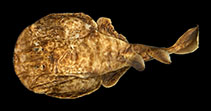
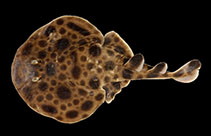
This species of is distinguished from its congeners by the following characters: dorsal color pattern unique, composed of large, circular, ovoid or elongate dark brown blotches on dorsal disc, interspersed with more numerous small (about eye-sized or greater) brownish, circular to ovoid spots, with large and small spots and blotches surrounded by a very slender creamy-white pattern, on a light brown to tan background color; differs from N. brevilabiata and N. atzi (which also possess few large brownish spots or blotches and numerous smaller spots) by having much fewer small spots or blotches and having the creamy-white, slender outline surrounding large and smaller spots and blotches on dorsal mid-disc; differs from N. brevilabiata by having much fewer small dark spots (vs. many small dark spots) and having tooth bands of subequal width that are broadly circular in outline (vs. strongly subtriangular tooth bands, with upper tooth band clearly wider than lower tooth); differs from N. antzi by having fewer smaller spots (vs. more numerous small spots, smaller than eye-diameter) and with dorsal fins subequal in height and length of base or first dorsal fin just slightly greater than second (vs. first dorsal fin conspicuously greater and with longer base than second dorsal fin).
Narcine baliensis is also distinguished from the Indo-West Pacific and Indian Ocean species N. maculata, N. lingula and N. prodorsalis, by having the preoral distance greater than preorbital distance (about equal in former three species); and from the western Indian Ocean N. oculifera and N. insolita, N. baliensis is further distinct in having dorsal fins of subequal size (first dorsal fin much larger than second in N. oculifera and N. insolita) (Ref. 116737).
Body shape (shape guide): other (see remarks); Cross section: flattened.
The biology of this species is largely unknown, but presumed to feed on small benthic invertebrates as do other numbfishes. Females are presumed to be sexually mature at 30.6 cm TL; max length of 16.0 cm TL is that of an adolescent male (Ref. 116737).
Life cycle and mating behavior
วัยเจริญพันธุ์ | การสืบพันธุ์ | การวางไข่ | เซลสืบพันธ์ของเพศเมีย(ไข่) | ความดกของไข่ | ตัวอ่อน
Carvalho, M.R. and W.T. White, 2016. Narcine baliensis, a new species of electric ray from southeast Asia (Chondrichthyes: Torpediniformes). Zootaxa 4127(1):149-160. (Ref. 116737)
IUCN Red List Status (Ref. 130435: Version 2025-1)
Threat to humans
Harmless
Human uses
การประมง: ไม่มีผลประโยชน์
เครื่องมือ
Special reports
Download XML
แหล่งที่มาจากอินเตอร์เน็ต
Estimates based on models
Phylogenetic diversity index (อ้างอิง
82804): PD
50 = 0.5000 [Uniqueness, from 0.5 = low to 2.0 = high].
Bayesian length-weight: a=0.01175 (0.00470 - 0.02937), b=2.88 (2.66 - 3.10), in cm total length, based on LWR estimates for this (Sub)family-body shape (Ref.
93245).
ระดับชั้นอาหาร (อ้างอิง
69278): 3.1 ±0.3 se; based on size and trophs of closest relatives
Fishing Vulnerability (Ref.
59153): Low vulnerability (21 of 100).
🛈