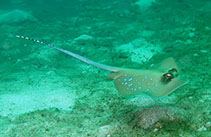
Ελασμοβράγχιοι (καρχαρίες και σαλάχια) (sharks and rays) >
Myliobatiformes (Stingrays) >
Dasyatidae (Stingrays) > Neotrygoninae
Etymology: orientalis: Named for its distribution in South-East Asia.
Environment: milieu / climate zone / εύρος βάθους / distribution range
Οικολογία
Θαλασσινό(ά) Υφαλόφιλο(α). Tropical
Western Central Pacific: Indonesia, Malaysia (Borneo), and the Philippines.
Length at first maturity / Μέγεθος / Βάρος / Age
Γεννητική Ωρίμανση: Lm ? range ? - 37.9 cm
Max length : 38.0 cm WD αρσενικό/απροσδιόριστο; (Ref. 114953)
Short description
Κλείδες προσδιορισμού | Μορφολογία | Μορφομετρία
This small Neotrygon species of the kuhlii-complex (reaching at least 38 cm DW; males maturing at 22 cm DW) is distinguished by the following set of characters: disc is much broader than long, width 1.2-1.3 times length; pectoral apices are abruptly angular; snout fleshy, broadly rounded to weakly angular, with an angle 124-129°, length 1.9-2.5 times interorbital width; the maximum width relatively well forward on disc, length from snout tip to pectoral-fin insertion 1.8-2 times and disc width 2.7-2.9 times horizontal distance from snout tip to maximum disc width; preoral length 1.8-.2 times the mouth width; internasal distance is 1.3-1.6 in prenasal length; interspiracular distance 13-16% DW; nostril length 3.1-3.8% DW; nasal curtain width 8.9-10% DW; mouth small, its width 7-7.5% DW; the horizontal distance from cloaca to caudal sting base is 48-56% of disc length; presence of thornlets in nuchal region and weakly developed in the lumbar regions in adults, none from tail in all sizes; minute, widely-spaced dermal denticles present on mid-disc of large adults; pectoral-fin radials 105-110; total vertebral centra (including synarcual) 125-141, trunk centra (including synarcual) 36-42; with moderately large blue spots on disc, largest 0.5-0.9 in eye width, few on medial belt, 0-6 (mean 0.4), largest 2.8-3.3% DW; mask-like marking is rather pronounced, covered with dark peppery spots; the ventral surface of disc with diffuse greyish submarginal bands; ventral tail fold is dusky with darker edge (Ref. 116741).
Body shape (shape guide): other; Cross section: flattened.
This species found demersal, inshore to mid-continental and on insular shelves. Accurate depth range is not available but probably found usually inshore at depths less than 100 meters. Reported pregnant females contained only a single pup with size at birth of ca.12.0 cm (Ref. 114953).
Life cycle and mating behavior
Γεννητική Ωρίμανση | Αναπαραγωγή | Γεννοβολία | Αβγά | Γονιμότητα | Προνύμφες
Last, P.R., White, W.T. and B. Séret, 2016. Taxonomic status of maskrays of the Neotrygon kuhlii species complex (Myliobatoidei: Dasyatidae) with the description of three new species from the Indo-West Pacific. Zootaxa 4083(4):533-561. (Ref. 116741)
IUCN Red List Status (Ref. 130435: Version 2025-1)
Threat to humans
Harmless
Human uses
Εργαλεία
Special reports
Download XML
Διαδικτυακές πηγές
Estimates based on models
Phylogenetic diversity index (Αναφ.
82804): PD
50 = 0.5000 [Uniqueness, from 0.5 = low to 2.0 = high].
Bayesian length-weight: a=0.01096 (0.00350 - 0.03435), b=3.12 (2.87 - 3.37), in cm total length, based on LWR estimates for this (Sub)family-body shape (Ref.
93245).
Τροφικό Επίπεδο (Αναφ.
69278): 3.4 ±0.3 se; based on size and trophs of closest relatives
Fishing Vulnerability (Ref.
59153): Moderate vulnerability (40 of 100).
🛈