>
Cichliformes (Cichlids, convict blennies) >
Cichlidae (Cichlids) > Pseudocrenilabrinae
Etymology: Haplochromis: Greek, Haploos = single + Greek, chromis = a fish, perhaps a perch (Ref. 45335); squamipinnis: Specific name not explained in original description, from the Latin 'squamus' for 'scale', and 'pinnis' for 'fin'; probably referring to minute scales on basal parts of dorsal and anal fins (Ref. 126312).
More on author: Regan.
Milieu: milieu / Klimaatzone / Diepte / verspreidingsgebied
Ecologie
; zoet water benthopelagisch; standvastig. Tropical; 1°N - 1°S
Africa: Lake Edward system, including Lake Edward, Kazinga Channel and Lake George (Ref. 126312). Introduced into Lake Kachira, Lake Victoria drainage, Uganda (Ref. 126312).
Grootte / Gewicht / Leeftijd
Maturiteit: Lm ? range ? - ? cm
Max length : 20.2 cm SL mannelijk / geslacht onbekend; (Ref. 4983)
Korte beschrijving
Determinatiesleutels | Morfologie | Morfometrie
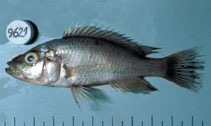
Dorsale stekels (totaal) : 15 - 16; Dorsale zachte stralen (totaal) : 8 - 10; Anale stekels: 3; Anale zachte stralen: 9 - 11; Wervels: 29 - 30. Diagnosis: Species with a piscivorous morphology; body rather deep, body depth 32.4-39.3% of standard length; oral jaws very long, lower jaw length 47.8-58.6% of head length, narrow, lower jaw width 32.6-44.7% of lower jaw length, and steep, gape inclination 30-45°; outer oral teeth many and small, 39-79; dominant males slate blue (Ref. 126312). Amongst piscivorous species from the Lake Edward system, Haplochromis squamipinnis differs from all by presence vs. absence of minute scales on proximal part of dorsal fin, rarely few scales present in H. quasimodo (Ref. 126312). It further differs from H. latifrons and H. mentatus by the combination of small vs. large outer oral teeth, a larger number of outer uppr jaw teeth, 39-79 vs. 22-47; a steeper gape, 30-45° vs. 15-30°; and a deeper body, body depth 32.4-39.3% of standard length vs. 27.2-32.3%; from H. mentatus by dominant males uniformly slate blue vs. yellow-green with a red anterior part of flank (Ref. 126312). It further differs from H. rex, H. simba, H. glaucus and H. aquila by the combination of small vs. large outer oral teeth, a larger number of outer upper jaw teeth, 39-79 vs. 22-47; and dominant males uniformly slate blue vs. cream-coloured with an orange operculum, yellow with an orange anterior part of flank, light blue with a dusky to black head, or light grey with a black head, respectively; further from H. rex, H. simba and H. glaucus by a steeper gape, 30-45° vs. 15-30°; further from H. aquila by a smaller eye, eye diameter 23.1-29.7% of head length vs. 30.0-31.5% (Ref. 126312). It further differs from H. kimondo by a concave to straight vs. convex dorsal outline of head, a gentler snout inclination, 30-40° vs. 40-50°, and dominant males slate blue vs. grey dorsally and yellow ventrally; further from H. falcatus by a shorter head, head length 35.1-36.9% of standard length vs. 36.6-39.6%, and dominant males slate blue vs. olve-green with an orange-red anterior part of flank; further from H. curvidens and H. pardus by a deeper cheek, cheek depth 24.9-36.0% of head length vs. 20.8-24.9%; further from H. pardus by a larger adult size, maximum size 211 mm standard length vs. 96 mm, and colour pattern of small specimens less than 100 mm standard length light coloured vs. speckled to uniformly black (Ref. 126312). It differs from H. quasimodo by the combination of a broader interorbital area, interorbital width 48.6-55.6% of head width vs. 40.5-48.7%; a longer lower jaw, lower jaw length 47.8-58.6% of head length vs. 44.2-49.6%; a steeper gape inclination, 30-45° vs. 20-35°; and dominant males slate blue vs. light grey dorsally and blue-black ventrally (Ref. 126312).
Found in offshore benthic areas in mostly shallow and deep waters over muddy substrates (Ref. 4983, 126312). With a piscivorous diet (Ref. 558, 126312); insects contribute substantially to the diet of small Haplochromis squamipinnis (Ref. 558).
Levenscyclus en paargedrag
Maturiteit | Voortplanting | Paaien | Eieren | Fecunditeit | Larven
Mouthbrooding by females.
van Oijen, M.J.P., J. Snoeks, P.H. Skelton, C. Maréchal and G.G. Teugels, 1991. Haplochromis. p. 100-184. In J. Daget, J.-P. Gosse, G.G. Teugels and D.F.E. Thys van den Audenaerde (eds.) Check-list of the freshwater fishes of Africa (CLOFFA). ISNB, Brussels; MRAC, Tervuren; and ORSTOM, Paris. Vol. 4. (Ref. 4983)
Status op de Rode Lijst van het IUCN (Ref. 130435: Version 2025-2)
Gevaar voor de mens
Harmless
Gebruik door de mens
Visserij: van geen belang
Tools
Speciale rapporten
Download XML
Internetbronnen
Schattingen op basis van modellen
Fylogenetische diversiteitsindex (Ref.
82804): PD
50 = 0.5000 [Uniqueness, from 0.5 = low to 2.0 = high].
Bayesian length-weight: a=0.01445 (0.00674 - 0.03099), b=2.99 (2.82 - 3.16), in cm total length, based on LWR estimates for this (Sub)family-body shape (Ref.
93245).
Trofisch niveau (Ref.
69278): 3.2 ±0.40 se; based on food items.
Weerstandsvermogen (Ref.
120179): Hoog, minimale populatieverdubbelingstijd minder dan 15 maanden (Preliminary K or Fecundity.).
Kwetsbaarheid van de visserij (Ref.
59153): Low vulnerability (15 of 100).
🛈