>
Eupercaria/misc (Various families in series Eupercaria) >
Labridae (Wrasses) > Bodianinae
Etymology: Choerodon: Greek, choiros = a pig + odous = teeth (Ref. 45335); referrring to the prominent anterior canines of the species in this genus (Ref. 116605); skaiopygmaeus: Name from Greek adjectives 'skaios' for western and 'pygmaios' for pygmy, referring to the distribution of this dwarf tuskfish in the western Indian Ocean off Somalia.
Environment: milieu / climate zone / rango de profundidad / distribution range
Ecología
marino demersal; rango de profundidad 25 - 60 m (Ref. 116605). Tropical
Western Indian Ocean, Somalia.
Tamaño / Peso / Age
Madurez: Lm ? range ? - ? cm
Max length : 13.8 cm SL macho / no sexado; (Ref. 116605)
Short description
Claves de identificación | Morfología | Morfometría
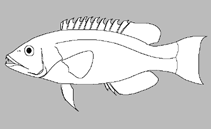
Espinas dorsales (total) : 12; Radios blandos dorsales (total) : 8; Espinas anales: 3; Radios blandos anales: 10; Vértebra: 27. This species is distinguished by the following characters: D XII,8; A III,10; pectoral fin rays ii,13, the dorsalmost ray very short, 9.5-14.1% pectoral fin length and the ventralmost ray distinctly longer than those immediately above, posterior edge of fin falcate, dorsoposterior corner bluntly pointed, posteroventral corner sharply pointed; shallow body, 31.0-34.3% SL, head depth 24.3-28.5% SL, caudal peduncle depth 11.7-13.0% SL; bluntly pointed head, dorsal profile of snout is moderately steep, snout length 10.3-13.1% SL; predorsal scales approximately 6, reaching forward on dorsal midline almost to above posterior edge of preopercle; cheek has small partially embedded scales in about 3 or 4 diagonal rows, posteriormost with about 7 or 8 scales to upper extent of free preopercular edge, reaching ventrally to the level of posterior corner of upper jaw and forward little if at all beyond posterior extent of orbit, with very broad naked margin ventrally on preopercle; 1-3 rows of about 6-8 small scales (only 1 or 2 scales in second of 2 rows when present) on subopercle adjacent preopercular edge extending forward to about midpoint of ventral preopercular margin; each lateral line scale has a single pore on laterosensory canal tube; scales above lateral line about 2½-3; numerous cephalic sensory canal pores are scattered on top of head and anteroventral to eye and apparently not confined to lines or short branches associated with major canals; second pair of canines in lower jaw is directed dorsolaterally and curved laterally; dorsal and anal fins without basal sheath, additional small scale at top the of some oblique rows; posterior lobe of dorsal and anal fins not reaching hypural crease; caudal fin is truncate, often with posterior margin slightly convex medially; pelvic fin reaching to or just short of the anus, length 19.6-22.8% SL; colour uniformly pale in preservation except for the dusky horizontal stripe from just below lateral line under 8th dorsal fin spine to just beyond posterior end of dorsal fin near top of caudal peduncle (Ref. 116605).
Body shape (shape guide): fusiform / normal; Cross section: compressed.
Life cycle and mating behavior
Madurez | Reproducción | Puesta | Huevos | Fecundidad | Larva
Gomon, M.F., 2017. A review of the tuskfishes, genus Choerodon (Labridae, Perciformes), with descriptions of three new species. Memoirs of Museum Victoria 76:1-111. (Ref. 116605)
IUCN Red List Status (Ref. 130435: Version 2025-1)
Threat to humans
Harmless
Human uses
Herramientas
Special reports
Download XML
Fuentes de Internet
Estimates based on models
Phylogenetic diversity index (Referencia
82804): PD
50 = 0.5000 [Uniqueness, from 0.5 = low to 2.0 = high].
Bayesian length-weight: a=0.01288 (0.00577 - 0.02877), b=3.05 (2.85 - 3.25), in cm total length, based on LWR estimates for this (Sub)family-body shape (Ref.
93245).
Nivel trófico (Referencia
69278): 3.4 ±0.4 se; based on size and trophs of closest relatives
Resiliencia (Referencia
120179): Alto, población duplicada en un tiempo mínimo inferior a 15 meses (Preliminary K or Fecundity.).
Fishing Vulnerability (Ref.
59153): Low vulnerability (10 of 100).
🛈