


Heptapterus mandimbusu Aguilera, Benitez, Terán, Alonso & Mirande, 2017
Uploaden van uw Foto's en video's
Google afbeelding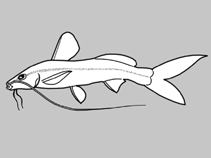 No image available for this species;
drawing shows typical species in Heptapteridae.
Google afbeelding
drawing shows typical species in Heptapteridae.
Classificatie / Namen Lokale namen | Synoniemen | Catalog of Fishes(Genus, Soort(en)) | ITIS | CoL | WoRMS | Cloffa
> Siluriformes (Catfishes) > Heptapteridae (Three-barbeled catfishes)
Etymology: Heptapterus: Greek, epta = seven + Greek, pteron = wing, fin (Ref. 45335); mandimbusu: From two words of the Guaraní language, mandí, meaning catfish and mbusu, meaning eel, in reference to its body form and the vernacular name used in Argentina to refer to Heptapterus (bagre anguila). Apposition of two nouns.
Etymology: Heptapterus: Greek, epta = seven + Greek, pteron = wing, fin (Ref. 45335); mandimbusu: From two words of the Guaraní language, mandí, meaning catfish and mbusu, meaning eel, in reference to its body form and the vernacular name used in Argentina to refer to Heptapterus (bagre anguila). Apposition of two nouns.
Milieu: milieu / Klimaatzone / Diepte / verspreidingsgebied Ecologie
; zoet water demersaal. Subtropical
Verspreiding Gebieden | FAO regio's | Ecosystemen | Voorkomen | Verspreidingskaart | Introducties | Faunafri
South America: Melo stream, Uruguay River basin in northeastern Argentina.
Grootte / Gewicht / Leeftijd
Maturiteit: Lm ? range ? - ? cm
Max length : 17.6 cm SL mannelijk / geslacht onbekend; (Ref. 116411)
Max length : 17.6 cm SL mannelijk / geslacht onbekend; (Ref. 116411)
Korte beschrijving Determinatiesleutels | Morfologie | Morfometrie
Dorsale zachte stralen (totaal) : 7; Anale zachte stralen: 14 - 18; Wervels: 47. Heptapterus mandimbusu can be diagnosed from its congeners by having a unique coloration pattern consisting of aggregated melanophores scattered on dorsal and lateral surfaces of body, forming conspicuous blotches of variable size (vs. this color pattern absent in other congeners). Heptapterus bleekeri, H. fissipinnis, H. multiradiatus, H. mustelinus, H. qenqo, H. stewarti, H. sympterigium and H. tapanahoniensis possess a uniform earth-brown coloration pattern (with some irregular markings on head and sometimes indistinct on back in H. bleekeri); while H. mbya has grayish and H. ornaticeps has blackish uniform coloration pattern. It differs from other congeners in Argentinean basins by having longer interdorsal distance (13.8-18.9 % SL vs. 3.1-5.0 % SL in H. mustelinus, 9.5-13.2 % SL in H. qenqo, and 5.8-8.3 % SL in H. mbya), 47 free vertebrae (vs. 51- 52 in H. qenqo; 51-53 in H. mbya), caudal peduncle depth is shallower than in H. qenqo (13.8-19.3 % SL vs. 19.8-25.4 % SL), and the adipose-fin base is shorter than in H. mbya (33.8-41.5 % SL vs. 47.4-58.55 % SL). It can be further distinguished from H. mustelinus by having shorter distance between the anal-fin origin and hypural plate (32.9-39.1 % SL vs. 39.6-45.7 % SL), a longer distance between the origins of pelvic and pectoral fins (24.5-28.1 % SL vs. 20.4-24.2 % SL), a shorter adipose-fin base (33.8-41.5 % SL vs. 51.5-59.6 % SL), a shorter anal-fin base (15.7-20.9 % SL vs. 20.9-28.0 % SL), a smaller orbital diameter (10.3-14.1 % HL vs. 15.0-19.9 % HL), and a lower number of anal-fin rays (14-18 vs 18-22). It differs from H. stewarti and H. sympterygium by its dorsal fin never reaching the adipose fin; from H. bleekeri, H. fissipinnis, H. multiradiatus, H. ornaticeps, H. stewarti, and H. sympterygium by having lower number of anal-fin rays (14-18 vs. 20-22 in H. bleekeri; 23 in H. fissipinnis; 38-46 in H. multiradiatus; 19; 30 in H. ornaticeps, and 22-29 in H. stewarti); from H. bleekeri, H. fissipinnis, H. multiradiatus, H. stewarti, H. sympterigium, and H. ornaticeps by the shorter maxillary barbel length that never reaches the pectoral fin, even in small juveniles; and from H. tapanahoniensis by the higher number of vertebrae (47 vs. 43) and branchiostegal rays (8-9 vs. 7) and the adipose fin confluent with the caudal fin (vs. separated). The monospecific genus Acentronichthys Eigenmann & Eigenmann, probably allied to Heptapterus due to the share of an elongated body and the adipose fin confluent to caudal fin, can be differentiated from Heptapterus mandimbusu by having caudal fin deeply forked (vs. distal profile of caudal fin slanted) (Ref. 116411).
Body shape (shape guide): elongated.
Body shape (shape guide): elongated.
At the type locality, this species occurs in stream with clear water, current velocity, and structure consisting of sequences of pools of 1 to 1.5 meters and shallow riffles, surrounded by native vegetation (Ref. 116411).
Levenscyclus en paargedrag Maturiteit | Voortplanting | Paaien | Eieren | Fecunditeit | Larven
Hoofdreferentie
Upload uw referenties | Referenties | Coördinator : Bockmann, Flavio | Medewerkers
Aguilera, G., M. Benitez, G.E. Terán, F. Alonso and J.M. Mirande, 2017. A new species of Heptapterus Bleeker 1858 (Siluriformes, Heptapteridae) from the Uruguay River Basin in Misiones, Northeastern Argentina. Zootaxa 4299(4):572-580. (Ref. 116411)
CITES
Not Evaluated
Gevaar voor de mens
Harmless
Gebruik door de mens
Visserij: van geen belang
FAO - Publication: search | FishSource |
Meer informatie
Trofische ecologie
Voedsel (prooien)
Dieetsamenstelling
Voedselconsumptie
Voedselrantsoenen
Predatoren
Voedsel (prooien)
Dieetsamenstelling
Voedselconsumptie
Voedselrantsoenen
Predatoren
Populatiedynamica
Groeiparameters
Max. leeftijden / maten
Lengte-gewicht rel.
Lengte-lengte rel.
Lengtefrequenties
Massaconversie
Rekrutering
Abundantie
Groeiparameters
Max. leeftijden / maten
Lengte-gewicht rel.
Lengte-lengte rel.
Lengtefrequenties
Massaconversie
Rekrutering
Abundantie
Levenscyclus
Voortplanting
Maturiteit
Rijpheid/kieuwen rel.
Fecunditeit
Paaien
Paaibestanden
Eieren
Ontwikkeling van de eieren
Larven
Larvale populatiedynamiek
Voortplanting
Maturiteit
Rijpheid/kieuwen rel.
Fecunditeit
Paaien
Paaibestanden
Eieren
Ontwikkeling van de eieren
Larven
Larvale populatiedynamiek
Anatomie
Kieuwoppervlak
Hersenen
Otoliet
Kieuwoppervlak
Hersenen
Otoliet
Fysiologie
Lichaamssamenstelling
Voedingsstoffen
Zuurstofverbruik
Type zwemmen
Zwemsnelheid
Visuele pigmenten
Vis geluid
Ziekten en parasieten
Toxiciteit (LC50)
Lichaamssamenstelling
Voedingsstoffen
Zuurstofverbruik
Type zwemmen
Zwemsnelheid
Visuele pigmenten
Vis geluid
Ziekten en parasieten
Toxiciteit (LC50)
Genetica
genoom
Genetica
Heterozygositeit
Erfelijkheid
Genetische diversiteit
genoom
Genetica
Heterozygositeit
Erfelijkheid
Genetische diversiteit
Menselijk gerelateerd
Aquacultuursystemen
Aquacultuurprofielen
Kweeklijnen
Ciguatera gevallen
Postzegels, munten, diversen.
Aquacultuursystemen
Aquacultuurprofielen
Kweeklijnen
Ciguatera gevallen
Postzegels, munten, diversen.
Tools
Speciale rapporten
Bekijk gegevens voor het houden in een aquarium | Bekijk Fact Sheets voor de soort | Bekijk Aquacultuur Fact Sheets
Download XML
Internetbronnen
AFORO (otoliths) | Aquatic Commons | BHL | Cloffa | Websites from users | Bekijk FishWatcher | CISTI | Catalog of Fishes: Genus, Soort(en) | DiscoverLife | ECOTOX | FAO - Publication: search | Faunafri | Fishipedia | Fishtrace | GloBI | Google Books | Google Scholar | Google | IGFA World Record | OneZoom | Open Tree of Life | Otolith Atlas of Taiwan Fishes | PubMed | Reef Life Survey | Socotra Atlas | TreeBase | Tree of Life | Wikipedia: ga naar, zoek | World Records Freshwater Fishing | Zoobank | Zoological Record
Schattingen op basis van modellen
Fylogenetische diversiteitsindex (Ref. 82804): PD50 = 0.5002 [Uniqueness, from 0.5 = low to 2.0 = high].
Bayesian length-weight: a=0.00813 (0.00379 - 0.01743), b=2.97 (2.79 - 3.15), in cm total length, based on LWR estimates for this (Sub)family-body shape (Ref. 93245).
Trofisch niveau (Ref. 69278): 3.6 ±0.4 se; based on size and trophs of closest relatives
Weerstandsvermogen (Ref. 120179): laag, minimale populatieverdubbelingstijd 4,5-14 jaar (Preliminary K or Fecundity.).