>
Cypriniformes (Carps) >
Cobitidae (Spined loaches)
Etymology: Lepidocephalichthys: Greek, lepas = limpet + Greek, ichtys = fish (Ref. 45335); eleios: From the classical Greek έλειος heleios, el eleios, which h means 'of the marsh', 'dwelling in the marsh'. A noun in apposition.
Môi trường: môi trường / vùng khí hậu / Mức độ sâu / phạm vi phân phối
Sinh thái học
; nước ngọt gần đáy. Tropical
Asia: Lake Indawgyi basin, Kachin State, Myanmar.
Bộ gần gũi / Khối lượng (Trọng lượng) / Tuổi
Chín muồi sinh dục: Lm ? range ? - ? cm
Max length : 2.3 cm SL con đực/không giới tính; (Ref. 117200)
Mô tả ngắn gọn
Khóa để định loại | Hình thái học | Sinh trắc học
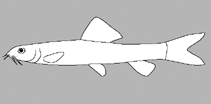
Các vây lưng mềm (tổng cộng) : 10; Tia mềm vây hậu môn: 8. Lepidocephalichthys eleios differs from all its congeners by lacking any modifications of the pectoral-fin rays in males. Pectoral fin has 7-8 rays which are adjacent with narrow or without membrane between them and in males, these are separate, not fused and have no dorsal or ventral projections. This species is also distinguished from congeners by the following characters, but not unique to it: body with irregular midlateral row of irregularly set small spots, sometimes forming a stripe; body with middorsal row of 9-12 saddles, reaching downwards to about ¼ of body depth, sometimes regular, sometimes irregularly shaped and of unequal density, wider than interspaces; arched black band at base of principal caudal-fin rays (no ocellus or black spot at caudal-fin base); caudal fin with pigments on rays and membranes forming 2-3 very irregular bars, posterior one along distal margin, bars irregularly in contact or fused, leaving variously shaped unpigmented patches; postlabial flange very long and narrow; head scaleless; caudal fin truncate to slightly emarginate (Ref. 117200).
Body shape (shape guide): elongated.
Facultative air-breathing in the genus (Ref. 126274); Three sampling sites of this species are characterized by deep water, very slow current, dense shore vegetation, large extents of floating mats of plants, and bottom composed of mud or clay covered with a layer of vegetal debris. Collected from leaf litter, from among the dense vegetation or by scraping the underside of the 'floating' vegetation using a tray net . The following fish species were collected in the same micro-habitat: Oreichthys sp., Pethia erythromycter, Heteropneustes fossilis, Chaudhuria sp., Mastacembelus pantherinus, Monopterus cuchia, Indostomus paradoxus, Badis corycaeus, Dario hysginon (Ref. 117200).
Vòng đời và hành vi giao phối
Chín muồi sinh dục | Sự tái sinh sản | Đẻ trứng | Các trứng | Sự sinh sản | Ấu trùng
Kottelat, M., 2017. Lepidocephalichthys eleios, a new loach from Lake Indawgyi basin, Kachin State, Myanmar (Teleostei: Cobitidae). Raffles Bulletin of Zoology 65:707-714. (Ref. 117200)
Tình trạng Sách đỏ IUCN (Ref. 130435: Version 2025-2)
Mối đe dọa đối với con người
Harmless
Sử dụng của con người
Các công cụ
Báo cáo đặc biệt
Tải xuống XML
Các nguồn internet
Ước tính dựa trên mô hình
Chỉ số đa dạng phát sinh loài (Tài liệu tham khảo
82804): PD
50 = 0.5000 [Uniqueness, from 0.5 = low to 2.0 = high].
Bayesian length-weight: a=0.00617 (0.00284 - 0.01340), b=3.08 (2.91 - 3.25), in cm total length, based on LWR estimates for this Genus-body shape (Ref.
93245).
Mức dinh dưỡng (Tài liệu tham khảo
69278): 3.0 ±0.3 se; based on size and trophs of closest relatives
Thích nghi nhanh (Tài liệu tham khảo
120179): Chiêù cao, thời gian nhân đôi của chủng quần tối thiểu là dưới 15 tháng (Preliminary K or Fecundity.).
Sự dễ bị tổn thương của nghề đánh cá (Ref.
59153): Low vulnerability (10 of 100).
🛈