Classification / Names
Nomi Comuni | Sinonimi | Catalog of Fishes(Genere, Specie) | ITIS | CoL | WoRMS | Cloffa
>
Gobiiformes (Gobies) >
Gobiidae (Gobies) > Gobiinae
Etymology: Glossogobius: Greek, glossa = tongue + Latin, gobius = gudgeon (Ref. 45335); multipapillus: Referring to the multiple papillae rows on the cheek, a noun in apposition (Ref. 103536).
Environment: milieu / climate zone / distribuzione batimetrica / distribution range
Ecologia
; acqua dolce benthopelagico. Tropical
Oceania, Papua New Guinea
Size / Peso / Age
Maturità: Lm ? range ? - ? cm
Max length : 5.6 cm SL maschio/sesso non determinato; (Ref. 103536); 5.4 cm SL (female)
Short description
Chiavi di identificazione | Morfologia | Morfometria
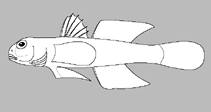
Spine dorsali (totale) : 5 - 6; Raggi dorsali molli (totale) : 8; Spine anali: 1; Raggi anali molli: 7; Vertebre: 11 - 16. Diagnosis: preoperculum with a blunt triangular projection at angle of preoperculum, covered by skin; mental fraenum bilobed, with short lateral lobes; mouth small, reaching to below anterior quarter of eye, upper jaw 12.0-15.5% SL (12-14% SL in specimens less than 50 mm SL, 13-15% in larger specimens); jaws forming an angle of 45° with body axis; upper margin of upper jaw in line with mideye; cheeks tapering; interorbital narrow, less than eye length; predorsal area scaled forward to just behind eyes; cheek naked; operculum naked; pectoral base covered with small cycloid scales; prepelvic area with moderate sized cycloid scales in about 6 rows covering all
but small anterior triangular patch; belly fully scaled; 1st dorsal fin spines 4-5 (usually 4) extending beyond other spines when fin depressed; 1st dorsal fin with basal half black, sometimes with a light area posteriorly; pelvic fin, length greater than width; reaching to or slightly beyond anus; 2nd dorsal rays usually I,8; anal rays usually I,7; pectoral rays usually 17-18; longitudinal scale count 25-28; predorsal scale count 12-16; transverse scale count (TRB) 8.5; gill rakers on outer face of 1st arch 0-1+1+6-8, raker on upper part of arch rarely present; lower gill rakers on outer face of 2nd arch 6-7; branched caudal rays usually 13-14 (13 in specimens less than 20 mm SL, usually 14 in specimens greater than 40 mm SL); vertebrae 11+16=27; papillae: line 1 (before nasal pore) composed on 3-4 rows of papillae; line 2 (between nasal pores) composed of 3 rows of papillae, not connecting to line 2 on opposite side of head; line 5 (suborbital) composed of 2-3 rows of papillae; line 6 (suborbital branch) composed of 1-3 pairs of papillae in very short line; lines 7, 9, 10 (LL cheek rows) composed on 2, 3 and 3 rows of papillae respectively, papillae in 3 lines lining up vertically to produce vertical rows, similar to VT lines; lines 8 and 11 (LT row) ending before posterior preopercular margin; line 12 (Outer POP-mandibular) composed of single row of papillae, without gap behind lips; line 13 (Inner POP-mandibular) composed of 2-3 rows of papillae; line 20 (opercular VT) composed of single row of papillae dorsally, becoming double ventrally; line 21 (Upper opercular OT) composed of single row of papillae, curved, extending along posterior margin of operculum and joining line 22; line 22 (Lower opercular OT) composed of single row of papillae, without any branches; several vertical papillae rows on belly; a single curved line anteriorly on most body scales (often obscure dorsally and posteriorly (Ref. 103536).
Body shape (shape guide): elongated.
Life cycle and mating behavior
Maturità | Riproduzione | Deposizione | Uova | Fecundity | Larve
Hoese, D.F. and G.R. Allen, 2015. Descriptions of three new species of Glossogobius (Teleostei: Gobiidae) from New Guinea. Zootaxa 3986(2):201-216. (Ref. 103536)
IUCN Red List Status (Ref. 130435: Version 2025-1)
Threat to humans
Harmless
Human uses
Strumenti
Special reports
Download XML
Fonti Internet
Estimates based on models
Phylogenetic diversity index (Fonte Biblio.
82804): PD
50 = 0.5000 [Uniqueness, from 0.5 = low to 2.0 = high].
Bayesian length-weight: a=0.00724 (0.00339 - 0.01546), b=3.10 (2.92 - 3.28), in cm total length, based on LWR estimates for this (Sub)family-body shape (Ref.
93245).
Trophic level (Fonte Biblio.
69278): 3.3 ±0.4 se; based on size and trophs of closest relatives
Resilienza (Fonte Biblio.
120179): Alto, tempo minimo di raddoppiamento della popolazione meno di 15 mesi (Preliminary K or Fecundity.).
Fishing Vulnerability (Ref.
59153): Low vulnerability (10 of 100).
🛈