分類 / Names
俗名 | 同種異名 | Catalog of Fishes(屬, 種) | ITIS | CoL | WoRMS | Cloffa
Teleostei >
Cyprinodontiformes (Rivulines, killifishes and live bearers)
鱂形目 (Rivulines, killifishes and live bearers) >
Rivulidae (Rivulines)
溪鱂科 (Rivulines) > Rivulinae
Etymology: mabura: Name refer to the Mabura Hill area in Guyana, where the new species occurs. A noun in apposition.
Environment: milieu / climate zone / 深度上下限 / distribution range
生態學
; 淡水 底中水層性.
分布
國家 | FAO區域 | 生態系 | 發現紀錄 | 分布圖 | 簡介 | Faunafri
South America: currently known only from the type locality in central Guyana; a small stream belonging to the Essequibo River drainage at an altitude of 177 m asl, on the main track to Mahdia at the "10 miles" point from Mabura Hill, on the opposite side to the logging camp (Ref. 119333).
大小 / 重量 / 年齡
成熟度: Lm ? range ? - ? cm
Max length : 3.4 cm SL 雄魚/尚未辨別雌雄; (Ref. 119333)
簡短描述
檢索表 | 型態特徵 | 形態測量圖
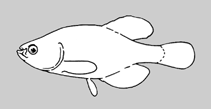
背的軟條 (總數) : 8 - 10; 臀鰭軟條: 11 - 12. Diagnosis: Male individuals of Laimosemion mabura are similar to those of L. dibaphus, and can be distinguished from all other congeners by possession of bluish black pigmentation on the caudal peduncle (vs. never this coloration); L. mabura is distinguished from L. dibaphus by possession of a yellowish (vs. light blue) pigmentation in the dorsal- and caudal-fin and dorsal-fin pattern having broad defined stripes (vs. dots); Laimosemion mabura further differs from L. dibaphus by pelvic fin short, posterior tip not reaching urogenital papilla (vs. long, tip reaching between base of 2nd and 3rd anal-fin rays in male, between urogenital papilla and base of 2nd anal-fin ray in female) and 25-27 (vs. 28-31) caudal-fin rays (Ref. 119333).
Body shape (shape guide): elongated.
Life cycle and mating behavior
成熟度 | 繁殖 | 產卵場 | 卵 | 孕卵數 | 仔魚
Valdesalici, S. and J.R. Gil-García, 2015. Laimosemion mabura, a new killifish from the Essequibo River drainage, Guyana (Cyprinodontiformes: Rivulidae). aqua, Int. J. Ichthyol. 21(4):166-171 (Ref. 119333)
IUCN 瀕危狀態 (Ref. 130435: Version 2025-1)
人類使用
工具
特別的報告
下載 XML
網路資源
Estimates based on models
Phylogenetic diversity index (參考文獻
82804): PD
50 = 0.5000 [Uniqueness, from 0.5 = low to 2.0 = high].
Bayesian length-weight: a=0.00661 (0.00305 - 0.01429), b=3.10 (2.91 - 3.29), in cm total length, based on LWR estimates for this (Sub)family-body shape (Ref.
93245).
營養階層 (參考文獻
69278): 3.2 ±0.4 se; based on size and trophs of closest relatives
回復力 (參考文獻
120179): 高度, 族群倍增時間少於 15個月 (Preliminary K or Fecundity.).
Fishing Vulnerability (Ref.
59153): Low vulnerability (10 of 100).
🛈