


Hochladen Photos und videos
Google Bild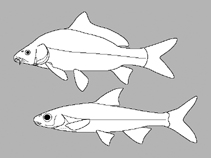 No image available for this species;
drawing shows typical species in Cyprinidae.
Google Bild
drawing shows typical species in Cyprinidae.
Klassifizierung / Names Namen | Synonyme | Catalog of Fishes(Gattung, Arten) | ITIS | CoL | WoRMS | Cloffa
> Cypriniformes (Carps) > Cyprinidae (Minnows or carps) > Labeoninae
Etymology: Garra: Name based on a vernacular Indian name (Hamilton, 1822:343, Ref. 1813); a fish living in mud (Ref. 128817); napata: Named after "Napata", the capital of the ancient Kush kingdom, which is very close to the type locality of this species; a noun in apposition (Ref. 122047).
Etymology: Garra: Name based on a vernacular Indian name (Hamilton, 1822:343, Ref. 1813); a fish living in mud (Ref. 128817); napata: Named after "Napata", the capital of the ancient Kush kingdom, which is very close to the type locality of this species; a noun in apposition (Ref. 122047).
Umwelt: Milieu / Klimazone / Tiefenbereich / Verbreitungsgebiet Ökologie
; süßwasser benthopelagisch. Tropical
Verbreitung Territorien | FAO Gebiete | Ökosysteme | Vorkommen | Punkt Karte | Einführungen | Faunafri
Africa: Main Nile River in Sudan and Egypt (Ref. 122047).
Größe / Gewicht / Alter
Kurzbeschreibung Bestimmungsschlüssel | Morphologie | Morphometrie
Rückenflossenstacheln (insgesamt) : 0; Rückenflossenweichstrahlen (insgesamt) : 9 - 10; Afterflossenstacheln: 0; Afterflossenweichstrahlen: 7 - 8; Wirbelzahl: 34 - 36. Diagnosis: Garra napata differs from all other African Garra species, except G. jamila and G. ethelwynnae, in a scaleless area on the dorsal body area clearly exceeding beyond dorsal fin origin and thus in an incomplete count of only 1 to 2.5 scale rows between the origin of the dorsal fin and lateral line series vs. 3 or more (Ref. 122047). It is distinguished from G. ethelwynnae from the Damas River basin in Eritrea by: its intermediate, type B, developed disc and only minute free posterior flap vs. prominent disc of type C with well-developed posterior flap; and an asquamate postpelvic area vs. squamate (Ref. 122047). It is distinguished from G. jamila of the Atbara by: its intermediate type B developed disc with a very small free posterior flap vs. prominent disc type C with well-developed posterior flap; a smoother upper lip vs. crenate; and, in live specimens, an uncoloured anal fin vs. red anal fin; dark humeral spot large and nearly twice as big as red postopercular spot vs. equally sized small humeral and postopercular spots; fixed specimens usually display a pronounced lateral band and pale back vs. dark back strongly and contrasting light belly (Ref. 122047). It is distinguished from Garra vinciguerrae and G. sannarensis by: its narrow disc, width much smaller than mouth vs. as large as mouth width; virtually absent lateroposterior flap of the disc vs. clearly developed; and a relatively broad head, i.e. cheeks visible when viewed from dorsal vs. cheeks not visible; from G. vinciguerrae by its prominent dark colour markings in the centre of the dorsal-fin membrane near its base vs. no such pattern; from G. sp. "White Nile" by its visible cheeks when viewed from dorsal vs. not visible from above, and by its short barbels barely reaching margin of lower-lip pad vs. almost reaching each other (Ref. 122047).
Body shape (shape guide): elongated.
Body shape (shape guide): elongated.
Rheophilic and collected from swift water in strong current, likely prefers habitats with high velocity; occurs syntopically with other rheophilic species like Garra vinciguerrae, Chiloglanis niloticus, Andersonia leptura and Labeo forskalii (Ref. 122047).
Lebenszyklus und Paarungsverhalten Geschlechtsreife | Fortpflanzung | Ablaichen | Eier | Fruchtbarkeit | Larven
Hauptreferenz
Laden Sie Ihre Referenzen hoch | Referenzen | Koordinator | Partner
Moritz, T., N. Straube and D. Neumann, 2019. The Garra species (Cyprinidae) of the Main Nile basin with description of three new species. Cybium 43(4):311-329. (Ref. 122047)
CITES
Not Evaluated
Bedrohung für Menschen
Harmless
Nutzung durch Menschen
Fischereien: nicht kommerziell
FAO - Publication: search | FishSource |
Mehr Information
Trophische Ökologie
Lebensmittel (Beutetiere)
Nahrungszusammensetzung
Nahrungsaufnahme
Lebensmittelrationen
Räuber
Lebensmittel (Beutetiere)
Nahrungszusammensetzung
Nahrungsaufnahme
Lebensmittelrationen
Räuber
Populationsdynamik
Wachstumsparameter
Max. Alter/Größen
Länge-Gewicht-Rel.
Länge-Länge-Verhältnis.
Längenhäufigkeiten
Massenkonvertierung
Rekrutierung
Dichte
Wachstumsparameter
Max. Alter/Größen
Länge-Gewicht-Rel.
Länge-Länge-Verhältnis.
Längenhäufigkeiten
Massenkonvertierung
Rekrutierung
Dichte
Lebenszyklus
Fortpflanzung
Geschlechtsreife
Reifung/Kiemen rel.
Fruchtbarkeit
Ablaichen
Laichaggregationen
Eier
Eientwicklung
Larven
Larven Pop.Dyn.
Fortpflanzung
Geschlechtsreife
Reifung/Kiemen rel.
Fruchtbarkeit
Ablaichen
Laichaggregationen
Eier
Eientwicklung
Larven
Larven Pop.Dyn.
Anatomie
Kiemenoberfläche
Gehirn
Otolith
Kiemenoberfläche
Gehirn
Otolith
Physiologie
Körperliche Zusammensetzung
Nährstoffe
Sauerstoffverbrauch
Schwimmart
Schwimmgeschwindigkeit
Visuelle Pigmente
Fischgeräusche
Krankheiten und Parasiten
Toxizität (LC50s)
Körperliche Zusammensetzung
Nährstoffe
Sauerstoffverbrauch
Schwimmart
Schwimmgeschwindigkeit
Visuelle Pigmente
Fischgeräusche
Krankheiten und Parasiten
Toxizität (LC50s)
Genetik
Genom
Genetik
Heterozygotie
Vererbbarkeit
Genetische Vielfalt
Genom
Genetik
Heterozygotie
Vererbbarkeit
Genetische Vielfalt
Menschenbezogen
Aquakultur-Systeme
Aquakultur Profile
Zuchtlinien
Ciguatera-Fälle
Briefmarken, Münzen, Verschiedenes.
Aquakultur-Systeme
Aquakultur Profile
Zuchtlinien
Ciguatera-Fälle
Briefmarken, Münzen, Verschiedenes.
Tools
Zusatzinformationen
Download XML
Zusammenfassung | Punktdaten | Namen | Photos
Internet Quellen
AFORO (otoliths) | Aquatic Commons | BHL | Cloffa | Websites from users | FishWatcher Einträge suchen | CISTI | Catalog of Fishes: Gattung, Arten | DiscoverLife | ECOTOX | FAO - Publication: search | Faunafri | Fishipedia | Fishtrace | GloBI | Google Books | Google Scholar | Google | IGFA World Record | OneZoom | Open Tree of Life | Otolith Atlas of Taiwan Fishes | PubMed | Reef Life Survey | Socotra Atlas | TreeBase | Tree of Life | Wikipedia: Gehe zu, Suchen | World Records Freshwater Fishing | Zoobank | Zoologischer Rekord
Schätzungen auf der Grundlage von Modellen
Phylogenetischer Diversitätsindex (Ref. 82804): PD50 = 0.5000 [Uniqueness, from 0.5 = low to 2.0 = high].
Bayesian length-weight: a=0.00794 (0.00359 - 0.01758), b=3.04 (2.87 - 3.21), in cm total length, based on LWR estimates for this Genus-body shape (Ref. 93245).
Widerstandsfähigkeit (Ref. 120179): hoch, Verdopplung der Population dauert weniger als 15 Monate. (Preliminary K or Fecundity.).