Classification / Names
Κοινά ονόματα | Συνώνυμα | Catalog of Fishes(Γένος, Είδη) | ITIS | CoL | WoRMS | Cloffa
>
Cyprinodontiformes (Rivulines, killifishes and live bearers) >
Nothobranchiidae (African rivulines)
Etymology: Nothobranchius: Greek, nothos = false + Greek, brangchia = gill (Ref. 45335); insularis: From the Latin insularis, meaning pertaining to an island and referring to the occurrence of this species on Mafia Island (Ref. 122074).
Environment: milieu / climate zone / εύρος βάθους / distribution range
Οικολογία
; Γλυκού νερού βενθοπελαγικό. Tropical
Africa: northern part of Mafia Island in Tanzania (Ref. 122074).
Μέγεθος / Βάρος / Age
Γεννητική Ωρίμανση: Lm ? range ? - ? cm
Max length : 5.3 cm SL αρσενικό/απροσδιόριστο; (Ref. 122074); 5.0 cm SL (female)
Short description
Κλείδες προσδιορισμού | Μορφολογία | Μορφομετρία
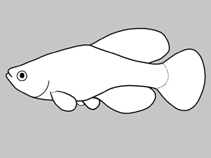
Ραχιαίες άκανθες (συνολικά) : 0; Μαλακές ραχιαίες ακτίνες (συνολικά) : 15 - 16; Εδρικές άκανθες: 0; Μαλακές εδρικές ακτίνες: 16 - 18. Diagnosis: Nothobranchius insularis is distinguished from all species of the N. melanospilus group, except N. lucius, in possessing snout pointed in lateral view, jaws moderately long vs. snout blunt to weakly pointed, jaws short; caudal fin, in males, with broad dark grey to black band on the posterior margin vs. narrow; presence, in females, of dark dots over the whole flank vs. dark dots when present restricted to the posterior portion of the flank (Ref. 122074). It differs from N. lucius by having inner premaxillary teeth smaller than teeth of the outer premaxillary tooth row vs. larger; caudal fin subtruncate in males vs. rounded; in females, flank dark dots are vertically elongated and often arranged in oblique rows vs. dots rounded, arranged in horizontal rows; unpaired fins, in females, with dark grey dots when present restricted to their basal portion vs. extending over most fin; caudal, pectoral and pelvic fins shorter, caudal fin length 26.9-29.6% of standard length in males and 22.8-27.4% of standard length in females of N. insularis, vs. 31.3-34.9% of standard length in males and 30.3-32.9% of standard length in females of N. lucius; pectoral-fin length 17.1-21.8% of standard length in males and 14.2-19.3% of standard length in females, vs. 22.2-24.5% of standard length and 20.2-24.6% of standard length, respectively; pelvic-fin length 8.6-11.0% of standard length in males and 9.6-11.0% of standard length in females, vs. 11.6-13.1% of standard length and 11.5-13.0% of standard length, respectively; and three neuromasts in the posterior section of the anterior supraorbital series vs. two (Ref. 122074).
Body shape (shape guide): fusiform / normal; Cross section: compressed.
Life cycle and mating behavior
Γεννητική Ωρίμανση | Αναπαραγωγή | Γεννοβολία | Αβγά | Γονιμότητα | Προνύμφες
Costa, W.J.E.M., 2017. Redescription of Nothobranchius lucius and description of a new species from Mafia Island, eastern Tanzania (Cyprinodontiformes, Aplocheilidae). Zoosyst. Evol. 93(1):35-44. (Ref. 122074)
IUCN Red List Status (Ref. 130435: Version 2025-1)
Threat to humans
Harmless
Human uses
Εργαλεία
Special reports
Download XML
Διαδικτυακές πηγές
Estimates based on models
Phylogenetic diversity index (Αναφ.
82804): PD
50 = 0.5000 [Uniqueness, from 0.5 = low to 2.0 = high].
Bayesian length-weight: a=0.01000 (0.00244 - 0.04107), b=3.04 (2.81 - 3.27), in cm total length, based on all LWR estimates for this body shape (Ref.
93245).
Τροφικό Επίπεδο (Αναφ.
69278): 3.2 ±0.4 se; based on size and trophs of closest relatives
Fishing Vulnerability (Ref.
59153): Low vulnerability (10 of 100).
🛈