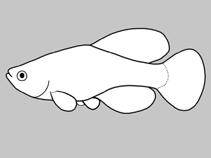
Classification / Names
Nombres comunes | Sinónimos | Catalog of Fishes(Género, Especie) | ITIS | CoL | WoRMS | Cloffa
>
Cyprinodontiformes (Rivulines, killifishes and live bearers) >
Nothobranchiidae (African rivulines)
Etymology: Nothobranchius: Greek, nothos = false + Greek, brangchia = gill (Ref. 45335); ottoschmidti: The specific name is given in honour of Otto Schmidt, a keen birder and fish enthusiast, for his long-time and significant contributions to the study of fishes of the genus Nothobranchius; a noun in genitive (Ref. 122068).
Eponymy: Otto Schmidt is a “keen birder and fish enthusiast”, who was honoured for “…his long-time and significant contributions to the study of fishes of the genus Nothobranchius.” He was co-collector of the type with EB Watters and B Cooper. (Ref. 128868), visit book page.
Environment: milieu / climate zone / rango de profundidad / distribution range
Ecología
; agua dulce bentopelágico. Tropical
Africa: seasonal pools and marshes associated with Wembere and Manonga river systems, Igombe and Kigosa rivers of the Gombe/Malagarasi system, and smaller streams draining into Lake Victoria, in north-central Tanzania (Ref. 122068).
Tamaño / Peso / Age
Madurez: Lm ? range ? - ? cm
Max length : 5.5 cm SL macho / no sexado; (Ref. 122068)
Short description
Claves de identificación | Morfología | Morfometría
Espinas dorsales (total) : 0; Radios blandos dorsales (total) : 16 - 18; Espinas anales: 0; Radios blandos anales: 15 - 18. Diagnosis: Nothobranchius ottoschmidti is distinguished from all other species of the genus by the following characters in males: body colouration light blue to blue-green with red-brown to grey-brown scale margins; anal fin light brown to yellow-grey with irregular red-brown to brown spots proximally, followed by a narrow brown to red-brown submedial band, a slender cream, yellow or light brown medial band with red-brown spots on the membrane, and a broad black distal band; caudal fin light grey or brown with small red-brown spots proximally, a slender semi-translucent grey subdistal band and a narrow irregular dark grey to black dstal band; pelvic fin light blue-grey in basal zone, with broad yellow medial band and narrow black distal band (Ref. 122068). Furthermore, it differs from the other members of the Nothobranchius taeniopygus species group in central and western Tanzania by a head width 67-73% of head length vs. 54-66%; and caudal peduncle length 121-130% of its depth vs. 119% and 132-169% (Ref. 122068).
Body shape (shape guide): fusiform / normal; Cross section: compressed.
Found in seasonal pools and marshes (Ref. 122068).
Life cycle and mating behavior
Madurez | Reproducción | Puesta | Huevos | Fecundidad | Larva
Watters, B.R., B. Nagy, P.D.W. van der Merwe, F.P.D. Cotteril and D.U. Bellstedt, 2019. Review of the Nothobranchius taeniopygus species group from central and western Tanzania with descriptions of five new species and redescription of Nothobranchius taeniopygus (Teleostei: Nothobranchiidae). Ichthyol. Explor. Freshwat. 29(3):239-278. (Ref. 122068)
IUCN Red List Status (Ref. 130435: Version 2025-1)
Threat to humans
Harmless
Human uses
Herramientas
Special reports
Download XML
Fuentes de Internet
Estimates based on models
Phylogenetic diversity index (Referencia
82804): PD
50 = 0.5000 [Uniqueness, from 0.5 = low to 2.0 = high].
Bayesian length-weight: a=0.01000 (0.00244 - 0.04107), b=3.04 (2.81 - 3.27), in cm total length, based on all LWR estimates for this body shape (Ref.
93245).
Nivel trófico (Referencia
69278): 3.2 ±0.4 se; based on size and trophs of closest relatives
Fishing Vulnerability (Ref.
59153): Low vulnerability (10 of 100).
🛈