>
Siluriformes (Catfishes) >
Clariidae (Airbreathing catfishes)
Etymology: Pseudotanganikallabes: From the Greek pseudo (ψευδής), meaning lying or false and the genus Tanganikallabes, in reference to the superficial resemblance between these two genera; prognatha: The specific epithet is derived from the prefix pro, in this case meaning anterior to and the Greek gnathos (γνάθος), meaning jaw, in reference to the distinctive protrusion of the lower jaw of this species; gender: feminine (Ref. 116742).
Environment: milieu / climate zone / Mức độ sâu / distribution range
Sinh thái học
; Nước ngọt gần đáy. Tropical
Africa: southeastern coast of Lake Tanganyika in Zambia (Ref. 116742).
Bộ gần gũi / Khối lượng (Trọng lượng) / Age
Chín muồi sinh dục: Lm ? range ? - ? cm
Max length : 6.0 cm SL con đực/không giới tính; (Ref. 116742)
Short description
Khóa để định loại | Hình thái học | Sinh trắc học
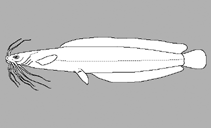
Các tia vây lưng cứng (tổng cộng) : 0; Các vây lưng mềm (tổng cộng) : 61 - 67; Tia cứng vây hậu môn: 0; Tia mềm vây hậu môn: 53 - 58. Diagnosis: Among clariids, Pseudotanganikallabes prognatha most closely resembles young Tanganikallabes specimens in external appearance, but can be easily distinguished from members of this genus by a number of characters: the number of post-Weberian vertebral elements in P. prognatha is lower than that of Tanganikallabes, 50-51 vs. 53-61; it further differs from T. mortiauxi by its relative shorter prepelvic length, 35.8-39.7% of standard length vs. 39.7-44.4%, and pre-anal length, 43.2-46.7% of standard length vs. 47.1-51.7%, shallower body, body depth at anus 9.1-10.3% of standard length vs. 12.3-17.2%, shorter snout, 4.1-5.5% of standard length vs. 5.7-8.2%, and lower total number of dorsal and anal-fin rays, 61-67 vs. 72-81 dorsal rays and 53-58 vs. 58-65 anal rays; it can be further separated from T. alboperca by its relative shallower body, body depth at anus 9.1-10.3% of standard length vs. 11.7-14.6%, and from T. stewarti by its relatively greater predorsal length, 31.4-34.4% of standard length vs. 28.0-31.2%, shorter dorsal fin, 66.7-69.7% of standard length vs. 70.3-75.4%, and lower total number of dorsal and anal-fin rays, 61-67 vs. 72-79 dorsal rays and 53-58 vs. 63-69 anal rays (Ref. 116742).
Body shape (shape guide): eel-like; Cross section: compressed.
Life cycle and mating behavior
Chín muồi sinh dục | Sự tái sinh sản | Đẻ trứng | Các trứng | Sự sinh sản | Ấu trùng
Wright, J.J., 2017. A new diminutive genus and species of catfish from Lake Tanganyika (Siluriformes: Clariidae). J. Fish Biol. 91(3):789-805. (Ref. 116742)
IUCN Red List Status (Ref. 130435: Version 2025-1)
Threat to humans
Harmless
Human uses
Các công cụ
Special reports
Download XML
Các nguồn internet
Estimates based on models
Phylogenetic diversity index (Tài liệu tham khảo
82804): PD
50 = 1.0000 [Uniqueness, from 0.5 = low to 2.0 = high].
Bayesian length-weight: a=0.01000 (0.00244 - 0.04107), b=3.04 (2.81 - 3.27), in cm total length, based on all LWR estimates for this body shape (Ref.
93245).
Mức dinh dưỡng (Tài liệu tham khảo
69278): 3.2 ±0.6 se; based on size and trophs of closest relatives
Thích nghi nhanh (Tài liệu tham khảo
120179): Chiêù cao, thời gian nhân đôi của chủng quần tối thiểu là dưới 15 tháng (Preliminary K or Fecundity.).
Fishing Vulnerability (Ref.
59153): Low vulnerability (10 of 100).
🛈