การจำแนกประเภท / ชื่อ
ชื่อสามัญ | ชื่อพ้อง | Catalog of Fishes(สกุล, ชนิด) | ITIS | CoL | WoRMS | Cloffa
>
Cichliformes (Cichlids, convict blennies) >
Cichlidae (Cichlids) > Geophaginae
Etymology: Geophagus: Greek, gea = the earth + Greek, phagein = to eat (Ref. 45335); santosi: Named for Alexandre Clistenes Alcântara Santos, anichthyologist and a friend, who is dedicated to the study of aquatic ecosystems of northeast Brazil.
Eponymy: Dr Alexandre Clistenes Alcântara Santos is a Brazilian ichthyologist who is Professor at the Feira de Santana State University (UEFS) and a master’s and doctoral advisor in the Postgraduate Programs in Zoology at UEFS and in Ecology and [...] (Ref. 128868), visit book page.
สิ่งแวดล้อม : สิ่งแวดล้อม / เขตภูมิอากาศ / ระดับความลึก / ระยะการกระจายสินค้า
นิเวศวิทยา
; น้ำจืด กลุ่มสัตว์หน้าดิน,กลุ่มสัตว์พื้นท้องน้ำ. Tropical
South Amercia: Brazil.
ขนาด / น้ำหนัก / อายุ
วัยเจริญพันธุ์: Lm ? range ? - ? cm
Max length : 15.3 cm SL เพศผู้/กระเทย; (Ref. 119412)
คำอธิบายสั้นๆ
เครื่องมือที่ใช้ในการแยกชนิดสัตว์,สิ่งมีชีวิตออกจากกัน | สัณฐานวิทยา | ความยาวต่างๆ
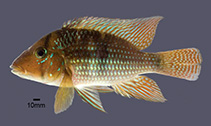
This species is distinguished from all other species of G. brasiliensis group by having by having dorsal and anal fins with blue stripes parallel to fin rays on their longest portion (vs. transverse blue bands crossing rays or fins with dots) and the basal portion of caudal-fin with short, longitudinal bluish-white lines (vs. dots or bars); further distinguished except for G. rufomarginatus, G. obscurus, by the presence of an oblique iridescent blue zone between the humeral region and the anterior portion of the dorsal-fin base (vs. no iridescent blue zone); differs from G. obscurus by having having an oblique suborbital row of aligned, small iridescent blue marks, not extending to cheek (vs. suborbital iridescent blue marks irregularly arranged extending to the cheek) and with chest profile straight in lateral view (vs. convex); differs from G. rufomarginatus by having dorsal-fin lappets with grey or dark brown edges (vs. red), with denticles on gill-rakers of the first branchial arch (vs. absent); differs from G. itapicuruensis by having D XIV (vs. D XIII) and lateral spot rounded (vs. elliptical); differs from G. diamantinensis by the absence of a dark brown mark on the humeral region (vs. presence), no horizontal dark brown band on the snout (vs. present), and urohyal bone with strong constriction (vs. with gentle anterior constriction); differs from G. brasiliensis by having a terminal mouth (vs. sub-dorsal) (Ref. 119412).
Cross section: compressed.
วงจรชีวิตและพฤติกรรมการผสมพันธุ์
วัยเจริญพันธุ์ | การสืบพันธุ์ | การวางไข่ | เซลสืบพันธ์ของเพศเมีย(ไข่) | ความดกของไข่ | ตัวอ่อน
Mattos, J.L. and W.J.E.M. Costa, 2018. Three new species of the 'Geophagus' brasiliensis species group from the northeast Brazil (Cichlidae, Geophagini). OrinoZoosyst. Evol. 94(2):325-337. (Ref. 119412)
สถานะบัญชีแดงของ IUCN (Ref. 130435: Version 2025-2)
ภัยคุกคามต่อมนุษย์
Harmless
การใช้ของมนุษย์
เครื่องมือ
รายงานพิเศษ
ดาวน์โหลด XML
แหล่งที่มาจากอินเตอร์เน็ต
การประมาณค่าตามแบบจำลอง
ดัชนีความหลากหลายทางวิวัฒนาการ (อ้างอิง
82804): PD
50 = 0.5000 [Uniqueness, from 0.5 = low to 2.0 = high].
Bayesian length-weight: a=0.02512 (0.01198 - 0.05266), b=2.99 (2.81 - 3.17), in cm total length, based on LWR estimates for this (Sub)family-body shape (Ref.
93245).
ระดับชั้นอาหาร (อ้างอิง
69278): 2.3 ±0.1 se; based on size and trophs of closest relatives
ความสามารถในการกลับคืนสู่ปกติ (อ้างอิง
120179): ความสูง, เวลาต่ำสุดที่จะทำให้ประชากรเพิ่มขึ้นเป็น 2 เท่าใช้เวลาน้อยกว่า 15 เดือน (Preliminary K or Fecundity.).
ความเสี่ยงต่อการตกปลา (Ref.
59153): Low vulnerability (10 of 100).
🛈