


Nothobranchius hoermanni Nagy, Watters & Bellstedt, 2020
Envoyez vos Photos et vidéos
Images Google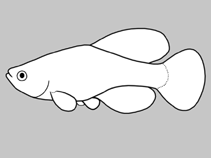 No image available for this species;
drawing shows typical species in Nothobranchiidae.
Images Google
drawing shows typical species in Nothobranchiidae.
Classification / Noms Noms communs | Synonymes | Catalog of Fishes(Genre, Espèce) | ITIS | CoL | WoRMS | Cloffa
> Cyprinodontiformes (Rivulines, killifishes and live bearers) > Nothobranchiidae (African rivulines)
Etymology: Nothobranchius: Greek, nothos = false + Greek, brangchia = gill (Ref. 45335); hoermanni: The specific name is given in honour of Alwin Hörmann from Kühnhausen in Germany, a well-known aquarist and breeder of Nothobranchius fishes; he maintained and propagated the wild specimens collected in the field by Werner Krammer, during the field trip organized by Sonja and Holger Hengstler; without his dedication and expertise, the population from the type locality would not have been available for researchers and others; a noun in genitive case (Ref. 123150).
Eponymy: Alwin Hörmann is, according to the etymology a well-known German aquarist and breeder of Nothobranchius fishes, who maintained and propagated the type specimens. [...] (Ref. 128868), visit book page.
Etymology: Nothobranchius: Greek, nothos = false + Greek, brangchia = gill (Ref. 45335); hoermanni: The specific name is given in honour of Alwin Hörmann from Kühnhausen in Germany, a well-known aquarist and breeder of Nothobranchius fishes; he maintained and propagated the wild specimens collected in the field by Werner Krammer, during the field trip organized by Sonja and Holger Hengstler; without his dedication and expertise, the population from the type locality would not have been available for researchers and others; a noun in genitive case (Ref. 123150).
Eponymy: Alwin Hörmann is, according to the etymology a well-known German aquarist and breeder of Nothobranchius fishes, who maintained and propagated the type specimens. [...] (Ref. 128868), visit book page.
Environnement : milieu / zone climatique / profondeur / gamme de distribution Écologie
; eau douce benthopélagique; pH range: 6.5 - 8.6. Tropical; 23°C - 23°C (Ref. 123150)
Distribution Territoires | Zones FAO | Écosystèmes | Occurrences | Carte par point | Introductions | Faunafri
Africa: Mhlawa system of upper Wembere drainage and Wala system of Malagarasi drainage, in Tanzania (Ref. 123150).
Taille / Poids / Âge
Description synthétique Clés d'identification | Morphologie | Morphométrie
Épines dorsales (Total) : 0; Rayons mous dorsaux (Total) : 16 - 17; Épines anales: 0; Rayons mous anaux: 15 - 16. Diagnosis: Nothobranchius hoermanni belongs to the N. ugandensis species group presenting the following combination of characters in males: body colouration light blue with red to red-brown scale margins; frontal part of head red-brown and throat light blue or red; caudal fin uniform red; anal fin light blue or yellow with red-brown spotted pattern (Ref. 123150). Nothobranchius hoermanni differs from all other members of the N. ugandensis species group by a red throat; light blue anal fin with red-brown spots and stripes proximally and medially, and broad light blue distal zone without markings; pectoral fin hyaline with red-brown stripes parallel to fin rays; exposed branchiostegal membrane red-brown, with cream distal margin; suborbital depth 28% of head length vs. 19-27% (Ref. 123150).
Body shape (shape guide): fusiform / normal; Cross section: compressed.
Body shape (shape guide): fusiform / normal; Cross section: compressed.
The type locality is a shallow ephemeral pool with a diameter of about 10 m and about 50 cm at the deepest point; the water was turbid, the bottom of the pool not visible (Ref. 123150).
Cycle de vie et comportement reproducteur Maturité | Reproduction | Frai | Œufs | Fécondité | Larves
Référence principale
Téléchargez vos références | Références | Coordinateur | Collaborateurs
Nagy, B., B.R. Watters, P.D.W. van der Merwe, F.P.D. Cotterill and D.U. Bellstedt, 2020. Review of the Nothobranchius ugandensis species group from the inland plateau of eastern Africa with descriptions of six new species (Teleostei: Nothobranchiidae). Ichthyol. Explor. Freshwat. 30(1):21-73. (Ref. 123150)
Statut dans la liste rouge de l'IUCN (Ref. 130435: Version 2025-2 (Global))
Vulnérable (VU) (B1ab(iii)+2ab(iii)); Date assessed: 18 May 2020
CITES
Not Evaluated
Menace pour l'homme
Harmless
Utilisations par l'homme
Pêcheries: sans intérêt
FAO - Publication: search | FishSource |
Plus d'informations
Écologie trophique
Aliments (proies)
Composition du régime alimentaire
Consommation alimentaire
Rations alimentaires
Prédateurs
Aliments (proies)
Composition du régime alimentaire
Consommation alimentaire
Rations alimentaires
Prédateurs
Dynamique des populations
Paramètres de croissance
Âges / tailles maximales
Longueur-poids rel.
Rel. longueur-longueur.
Fréquences de longueurs
Conversion de masse
Recrutement
Abondance
Paramètres de croissance
Âges / tailles maximales
Longueur-poids rel.
Rel. longueur-longueur.
Fréquences de longueurs
Conversion de masse
Recrutement
Abondance
Cycle de vie
Reproduction
Maturité
Maturité/épines rel.
Fécondité
Frai
Agrégats de frai
Œufs
Développement de l'œuf
Larves
Dynamique des populations larvaires
Reproduction
Maturité
Maturité/épines rel.
Fécondité
Frai
Agrégats de frai
Œufs
Développement de l'œuf
Larves
Dynamique des populations larvaires
Anatomie
Surface branchiale
Cerveau
Otolithe
Surface branchiale
Cerveau
Otolithe
Physiologie
Composition corporelle
Nutriments
Consommation d'oxygène
Type de natation
Vitesse de nage
Pigments visuels
Son de poisson
Maladies et parasites
Toxicité (CL50)
Composition corporelle
Nutriments
Consommation d'oxygène
Type de natation
Vitesse de nage
Pigments visuels
Son de poisson
Maladies et parasites
Toxicité (CL50)
Génétique
génôme
Génétique
Hétérozygotie
Héritabilité
Diversité génétique
génôme
Génétique
Hétérozygotie
Héritabilité
Diversité génétique
Liées à l'homme
Systèmes d'aquaculture
Profils d'aquaculture
Souches
Cas de ciguatera
Timbres, pièces de monnaie, divers
Systèmes d'aquaculture
Profils d'aquaculture
Souches
Cas de ciguatera
Timbres, pièces de monnaie, divers
Outils
E-book | Guide de terrain | Générateur de fréquences de longueur | Outil de dynamique de population | Carte par point |
Capture-MSY |
Articles particuliers
Télécharger en XML
Sources Internet
AFORO (otoliths) | Aquatic Commons | BHL | Cloffa | Websites from users | FishWatcher | CISTI | Catalog of Fishes: Genre, Espèce | DiscoverLife | ECOTOX | FAO - Publication: search | Faunafri | Fishipedia | Fishtrace | GloBI | Google Books | Google Scholar | Google | IGFA World Record | OneZoom | Open Tree of Life | Otolith Atlas of Taiwan Fishes | PubMed | Reef Life Survey | Socotra Atlas | TreeBase | Arbre de Vie | Wikipedia: aller à, chercher | World Records Freshwater Fishing | Zoobank | Zoological Record
Estimations basées sur des modèles
Indice de diversité phylogénétique (Réf. 82804): PD50 = 0.5000 [Uniqueness, from 0.5 = low to 2.0 = high].
Bayesian length-weight: a=0.00603 (0.00250 - 0.01453), b=3.13 (2.93 - 3.33), in cm total length, based on LWR estimates for this (Sub)family-body shape (Ref. 93245).
Niveau trophique (Réf. 69278): 3.2 ±0.4 se; based on size and trophs of closest relatives