Classification / Names
Nomi Comuni | Sinonimi | Catalog of Fishes(Genere, Specie) | ITIS | CoL | WoRMS | Cloffa
>
Cypriniformes (Carps) >
Cyprinidae (Minnows or carps) > Barbinae
Etymology: Barbus: Latin, barbus = barbel (Ref. 45335); samniticus: Named for Samnites, ancient Italic people who settled in the type locality.
Eponymy: Sir Charles Alfred Payton (1843–1926) was a British adventurer, writer, fisherman and diplomat who was British Consul to Morocco, where this barb is found. [...] (Ref. 128868), visit book page.
Environment: milieu / climate zone / distribuzione batimetrica / distribution range
Ecologia
; acqua dolce benthopelagico. Subtropical
Europe: Italy.
Size / Peso / Age
Maturità: Lm ? range ? - ? cm
Max length : 18.8 cm SL maschio/sesso non determinato; (Ref. 123793)
Short description
Chiavi di identificazione | Morfologia | Morfometria
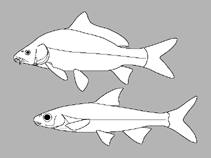
This species is distinguished by the following characters: last unbranched dorsal-fin ray weakly ossified; superior margin of the dorsal fin is straight or slightly concave like other Italian fluviolacustrine barbels (some profile slightly convex); numerous small irregular-shaped black or dark-brown dots, smaller than scales that often form large, black or dark-brown spots on the back and flanks in juveniles and adults and this pigmentation is more evident in specimens living in clear water, whereas it tends to disappear in turbid environments; differs from all the other species by its greatest maximum height 20.4-25.1% SL (vs. 18.8%-24.9% SL in B. fucini, 19.0%-22.7% SL in B. tyberinus, 17.9%-22.7% SL in B. plebejus); differs from B. fucini by the shorter pre-orbital distance 8.2%-9.7% SL (vs. 7.9%-11.0% SL); differs from B. tyberinus and B. plebejus by having longer pectoral fins 17.1% - 20.6% (vs. 16.7%-19.8% and 15.7%-20.4% SL, respectively); longer ventral fin 12.4%-16.8% (vs. 11.0%-15.7% and 11.6%-15.3% SL) and caudal fins 12.5%16.4% (vs. 12.1%-14.7% and 12.1%-15.1% SL); differs from B. tyberinus in that it has longer lobes of the caudal fin upper: 21.2%-26.2% (vs. 19.1%-23.7% SL) and lower:19.8%-26.1% (vs. 19.5%-23.4% SL), a greater dorsal fin 14.6%-19.0% (vs. 13.7%-16.3% SL), a major presence of pigmentation and dots on scales and fins and a different dominant (orange) colour of the anal, dorsal and ventral fins; differs from B. plebejus by having fewer scales on 51-67 (vs. 58-71), above 10-13 (vs. 11-15) and under 7-9 (vs. 8-11) the lateral line, greater minimum height 10.2%-12.5% (vs. 9.3%-11.1%% SL), smaller fork depth 8.8% - 11.3% (vs. 9.1%-12.5% SL) and greater amount of body spots (Ref. 123793),
Cross section: compressed.
This species populates intermediate and hilly stretches of Apennine rivers together with other Italian species typical of the barbel zone: Sarmarutilus rubilio, Telestes muticellus and Squalius squalus (Ref. 123793).
Life cycle and mating behavior
Maturità | Riproduzione | Deposizione | Uova | Fecundity | Larve
Lorenzoni, M., A. Carosi, S. Quadroni, V. De Santis, I. Vanetti, G.B. Delmastro and S. Zaccara, 2021. Cryptic diversity within endemic Italian barbels: revalidation and description of new Barbus species (Teleostei: Cyprinidae). J. Fish Biol. 98(5):1433-1449. (Ref. 123793)
IUCN Red List Status (Ref. 130435: Version 2025-1)
Threat to humans
Harmless
Human uses
Strumenti
Special reports
Download XML
Fonti Internet
Estimates based on models
Phylogenetic diversity index (Fonte Biblio.
82804): PD
50 = 0.5000 [Uniqueness, from 0.5 = low to 2.0 = high].
Bayesian length-weight: a=0.00631 (0.00304 - 0.01311), b=3.08 (2.90 - 3.26), in cm total length, based on LWR estimates for this (Sub)family-body shape (Ref.
93245).
Trophic level (Fonte Biblio.
69278): 3.1 ±0.4 se; based on size and trophs of closest relatives
Resilienza (Fonte Biblio.
120179): Medio, tempo minimo di raddoppiamento della popolazione 1.4 - 4.4 anni (Preliminary K or Fecundity.).
Fishing Vulnerability (Ref.
59153): Low vulnerability (13 of 100).
🛈