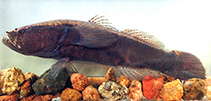
Classification / Names
Nomi Comuni | Sinonimi | Catalog of Fishes(Genere, Specie) | ITIS | CoL | WoRMS | Cloffa
>
Gobiiformes (Gobies) >
Eleotridae (Bully sleepers)
Etymology: Eleotris: The name of a Nile fish, eleotris (Ref. 45335); valadei: The name of the species honours Pierre Valade, who collected several specimens of this species in Reunion Island and Mayotte (Ref. 123271).
Eponymy: Pierre Valade is a hydrobiologist at Association Réunionnaise de Développement de l’Aquaculture (ARDA) and OCEA based on the island of Réunion (Indian Ocean). [...] (Ref. 128868), visit book page.
Environment: milieu / climate zone / distribuzione batimetrica / distribution range
Ecologia
; acqua dolce demersale; amfidromo (Ref. 123271); distribuzione batimetrica 0 - 5 m (Ref. 123271). Tropical
Africa: Madagascar, Reunion Island, Mayotte and the Seychelles islands (Ref. 123271).
Size / Peso / Age
Maturità: Lm ? range ? - ? cm
Max length : 9.9 cm SL maschio/sesso non determinato; (Ref. 123271)
Short description
Chiavi di identificazione | Morfologia | Morfometria
Spine dorsali (totale) : 7; Raggi dorsali molli (totale) : 8 - 9; Spine anali: 1; Raggi anali molli: 8 - 9. Diagnosis: Eleotris valadei is distinguished by second, third and fourth suborbital free neuromast rows on cheek extending ventrally past horizontal row 'd' ('2.3.4' pattern), row 'os' connected with row 'oi' at ventro-posterior margin of operculum ('closed' pattern); 18 pectoral fin rays; 59-64 scales in lateral series and 27-30 scales in transverse forward series (Ref. 123271). Eleotris valadei differs from the other species of the Indian Ocean with a '2.3.4' pattern by several characters; it differs from E. soaresi in having more scales in lateral series, 59-64 vs. 50-56, more scales in transverse forward series, 27-30 vs. 22-24, in predorsal series, 45-50 vs. 39-43, and in zigzag series, 13-15 vs. 12-13; it differs from E. diamsoi in having 18 pectoral fin rays vs. 16, more scales in transverse forward series, 27-30 vs. 17-23, in predorsal series, 45-50 vs. 36-38, and a higher body depth at dorsal fin origin, 19-24 vs. 15-18 (Ref. 123271).
The species is supposed to be amphidromous (Ref. 123271). It is found in the lower part of the river, near the estuary; it lives in muddy to clear rivers with sandy to gravel bottom between 0 to 5 meters in altitude (Ref. 123271). It is carnivorous (Ref. 123271).
Life cycle and mating behavior
Maturità | Riproduzione | Deposizione | Uova | Fecundity | Larve
Mennesson, M.I. and P. Keith, 2020. Eleotris (Teleostei: Eleotridae) of the Indian Ocean: an overview with the description of three new species. Cybium 44(3):185-203. (Ref. 123271)
IUCN Red List Status (Ref. 130435: Version 2025-1)
Threat to humans
Harmless
Human uses
Strumenti
Special reports
Download XML
Fonti Internet
Estimates based on models
Phylogenetic diversity index (Fonte Biblio.
82804): PD
50 = 0.5000 [Uniqueness, from 0.5 = low to 2.0 = high].
Bayesian length-weight: a=0.00832 (0.00345 - 0.02005), b=3.10 (2.91 - 3.29), in cm total length, based on LWR estimates for this Genus-body shape (Ref.
93245).
Trophic level (Fonte Biblio.
69278): 3.6 ±0.3 se; based on size and trophs of closest relatives
Resilienza (Fonte Biblio.
120179): Alto, tempo minimo di raddoppiamento della popolazione meno di 15 mesi (Preliminary K or Fecundity.).
Fishing Vulnerability (Ref.
59153): Low vulnerability (10 of 100).
🛈