分類 / Names
共通名の | 類義語 | Catalog of Fishes(部類, 種) | ITIS | CoL | WoRMS | Cloffa
>
Cichliformes (Cichlids, convict blennies) >
Cichlidae (Cichlids) > Pseudocrenilabrinae
Etymology: Haplochromis: Greek, Haploos = single + Greek, chromis = a fish, perhaps a perch (Ref. 45335); curvidens: Specific name from the Latin 'curvus' for 'curvature', and 'dentatus' for 'tooth'; referring to strongly recurved oral teeth (Ref. 126312).
Environment: milieu / climate zone / 深さの範囲 / distribution range
生態学
; 新鮮な水 外洋の. Tropical
Africa: Lake Edward (Ref. 126312).
サイズ / 重さ / 年齢
成熟: Lm ? range ? - ? cm
Max length : 11.2 cm SL オス/雌雄の選別がない; (Ref. 126312)
簡単な記述
検索表 | 形態学 | 形態計測学
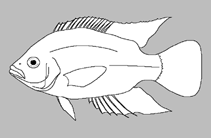
背面の脊椎 (合計) : 15 - 16; 背鰭 (合計) : 8 - 10; 肛門の骨: 3; 臀鰭: 8 - 9; 脊つい: 29 - 31. Diagnosis: Species with a piscivorous morphology; outer oral teeth many, small, and (strongly) recurved, 45-60; non-dominant males dusky green with a blue sheen and 5-7, faint, vertical stripes (Ref. 126312). Amongst piscivorous species from the Lake Edward system, Haplochromis curvidens differs from H. latifrons, H. mentatus, H. rex, H. simba, H. glaucus, and H. aquila by small vs. large outer oral teeth and a larger number of outer upper jaw teeth, 45-60 vs; 22-47; further from H. latifrons, H. mentatus, H. rex, H. simba and H. glaucus by a shallower lacrimal, lacrimal depth 16.0-17.8% of head length vs. 18.0-23.0%; further from H. rex, H. simba, H. glaucus and H. aquila by a shallower cheek, cheek depth 22.4-24.9% of head length vs. 26.2-33.5% (Ref. 126312). It differs from H. kimondo, H. falcatus and H. quasimodo by the combination of a shallower cheek, cheek depth 22.4-24.9% of head length vs. 24.8-35.2%; and absence vs. presence of a well-defined mid-lateral band; further from H. kimondo by narrower jaws, lower jaw width 38.5-43.2% of lower jaw length vs. 44.7-53.3%; further from H. falcatus by a shorter pre-dorsal distance, 34.5-37.9% of standard length vs. 38.2-41.1%; further from H. quasimodo by a shallower body, body depth 29.0-32.0% of standard length vs. 33.5-41.7% (Ref. 126312).It differs from H. pardus by the combination of a shorter anal fin base, 17.9-18.6% of standard length vs. 19.2-22.2%; a slightly broader interorbital area, interorbital width 46.4-52.5% of head width vs. 39.3-48.4%; and all specimens faint yellow to dusky green vs. speckled to uniformly black (Ref. 126312). It differs from H. squamipinnis by the combination of a shallower body, body depth 29.0-32.0% of standard length vs. 32.4-39.3%; a shallower cheek, cheek depth 22.4-24.9% of head length vs. 24.9-36.0%; and absence vs. presence of minute scales on proximal parts of dorsal and anal fins (Ref. 126312).
Found over muddy substrates (Ref. 126312). Based on its morphology, most probably a piscivorous species (Ref. 126312).
Life cycle and mating behavior
成熟 | 繁殖 | 放精 | 卵 | 生産力 | 幼生
Vranken, N., M. Van Steenberge, A. Heylen, E. Decru and J. Snoeks, 2022. From a pair to a dozen: the piscivorous species of Haplochromis (Cichlidae) from the Lake Edward system. Eur. J. Taxon. 815:1-94. (Ref. 126312)
IUCNのレッドリストの状況は (Ref. 130435: Version 2025-1)
Human uses
用具
特記事項
XMLをダウンロードして下さい
インターネットの情報源
Estimates based on models
Phylogenetic diversity index (参照
82804): PD
50 = 0.5000 [Uniqueness, from 0.5 = low to 2.0 = high].
Bayesian length-weight: a=0.01445 (0.00674 - 0.03099), b=2.99 (2.82 - 3.16), in cm total length, based on LWR estimates for this (Sub)family-body shape (Ref.
93245).
栄養段階 (参照
69278): 3.4 ±0.4 se; based on size and trophs of closest relatives
回復力 (参照
120179): 高い, 15か月以下の倍増期間の最小個体群 (Preliminary K or Fecundity.).
Fishing Vulnerability (Ref.
59153): Low vulnerability (10 of 100).
🛈