


Haplochromis quasimodo Vranken, Van Steenberge, Heyle, Decru & Snoeks, 2022
Загрузить свой Фото и Видео
Изображение на Google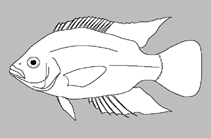 No image available for this species;
drawing shows typical species in Cichlidae.
Изображение на Google
drawing shows typical species in Cichlidae.
Классификация / Имена народные названия | синонимы | Catalog of Fishes(род, виды) | ITIS | CoL | WoRMS | Cloffa
> Cichliformes (Cichlids, convict blennies) > Cichlidae (Cichlids) > Pseudocrenilabrinae
Etymology: Haplochromis: Greek, Haploos = single + Greek, chromis = a fish, perhaps a perch (Ref. 45335); quasimodo: Specific name from Quasimodo, hunchbacked character in Victor Hugo's novel 'Notre-Dame de Paris' (1831); referring to rather shallow head and deep and rhomboid bodies of large specimens (Ref. 126312).
Eponymy: Not a true eponym but the name of the title character in Victor Hugo’s: The Hunchback of Notre Dame, referring to the prominent dorsal profile of these species. (Ref. 128868), visit book page.
Etymology: Haplochromis: Greek, Haploos = single + Greek, chromis = a fish, perhaps a perch (Ref. 45335); quasimodo: Specific name from Quasimodo, hunchbacked character in Victor Hugo's novel 'Notre-Dame de Paris' (1831); referring to rather shallow head and deep and rhomboid bodies of large specimens (Ref. 126312).
Eponymy: Not a true eponym but the name of the title character in Victor Hugo’s: The Hunchback of Notre Dame, referring to the prominent dorsal profile of these species. (Ref. 128868), visit book page.
Окружающая среда: среда / климатическая зона / пределы глубины / диапазон распространения экология
; пресноводный пелагический. Tropical
распространение Территории | регионы FAO | Экосистемы | места находок | карта точек | интродукции | Faunafri
Africa: Lake Edward (Ref. 126312).
Размер / Вес / Возраст
Краткое описание определительные ключи | морфология | морфометрия
колючие лучи спинного плавника (общее число) : 15 - 17; членистые (мягкие) лучи спинного плавника (общее число) : 9 - 11; колючие лучи анального плавника: 3; членистые (мягкие) лучи анального плавника: 8 - 10; позвонки: 29 - 31. Diagnosis: Species with a piscivorous morphology; body rather deep, body depth 33.5-41.7% of standard length; interorbital area narrow, interorbital width 40.5-48.7% of head length; outer oral teeth many and small, 46-71; dominant males light grey dorsally and blue-black ventrally (Ref. 126312). Amongst piscivorous species from the Lake Edward system, H. quasimodo differs from H. latifrons, H. mentatus, H. simba, H. glaucus, and H. aquila by the combination of small vs. large outer oral teeth and a larger number of outer upper jaw teeth, 46-71 vs. 22-47; further from H. mentatus, H. rex, H. simba, H. glaucus and H. aquila by presence vs. absence of a well-defined mid-lateral band; it further differs from H. latifrons and H. mentatus by a deeper body, body depth 33.5-41.7% of standard length vs. 27.2-32.3%; further from H. rex, H. simba, and H. glaucus by a broader head, head width 42.0-48.1% of head length vs. 36.8-41.6% (Ref. 126312). It differs from H. kimondo and H. squamipinnis by a narrower interorbital area, interorbital width 40.5-48.7% of head width vs. 48.6-58.5%; further from H. kimondo by the combination of a rhomboid vs. pyriform body, a concave to weakly convex vs. convex dorsal outline of head, a gentler sloping snout, 30-40° vs. 40-50°, and dominant males light grey dorsally and blue-black ventrally vs. grey dorsally and yellow ventrally; further from H. squamipinnis by a gentler gape inclination, 20-35° vs. 30-45°; a shorter lower jaw, lower jaw length 44.2-49.6% of head length vs. 47.8-58.6%; mostly absence vs. presence of minute scales on proximal part of dorsal fin, rarely few rows of 1-4 scales present on dorsal fin in H. quasimodo; and dominant males light grey dorsally and blue-black ventrally vs. slate blue (Ref. 126312). It differs from H. falcatus by the combination of a shorter head, head length 33.9-37.2% of standard length vs. 36.6-39.6%; a longer pelvic fin, pelvic fin length 26.2-33.7% of standard length vs. 21.6-25.7%; weakly recurved vs. strongly recurved outer oral teeth; and dominant males light grey dorsally and blue-black ventrally vs. olive-green with an orange-red anterior part of flank (Ref. 126312). It differs from H. curvidens and H. pardus by a deeper cheek, cheek depth 24.8-32.9% of head length vs. 20.8-24.9%; further from H. curvidens by a deeper body, body depth 33.5-41.7% of standard length vs. 29.0-32.0%; and presence vs. absence of a well-defined mid-lateral band; further from H. pardus by a larger number of caudal peduncle scales, 17-20 vs. 16, rarely 17; a larger adult size, maximum size 165 mm standard length vs. 96 mm; and colour pattern of small specimens lees than 100 mm standard length light coloured vs. speckled to uniformly black (Ref. 126312). Small specimens of less than 90 mm standard length resemble H. schubotziellus in overall habitus and colour pattern; it differs from the holotype of H. schubotziellus by a smaller eye, eye diameter 26.2-31.8% of head length vs. 33.7%; a longer lower jaw, lower jaw length 44.2-49.6% of head length vs. 42.6%; a deeper cheek, cheek depth 23.7-32.9% of head length vs. 24.0%; outer oral teeth with no to a small minor cusps vs. a well-defined minor cusp; and inner oral teeth set in 1-2 weakly defined rows vs. 2 well-defined rows in both jaws (Ref. 126312).
Found in offshore, benthic areas in shallow and deep waters (Ref. 126312). Based on its morphology, most probably a piscivorous species (Ref. 126312).
Жизненный цикл и брачное поведение половая зрелость | размножение | нерест | икра | Плодовитость | личинки
Основная ссылка
Загрузите свои рекомендации | ссылки | координатор : Kullander, Sven O. | соавторы
Vranken, N., M. Van Steenberge, A. Heylen, E. Decru and J. Snoeks, 2022. From a pair to a dozen: the piscivorous species of Haplochromis (Cichlidae) from the Lake Edward system. Eur. J. Taxon. 815:1-94. (Ref. 126312)
CITES
Not Evaluated
Угроза для людей
Harmless
Использование человеком
FAO - Publication: search | FishSource |
дополнительная информация
Трофическая экология
Пищевые предметы (добыча)
состав пищи
потребление пищи
Продовольственные пайки
хищники
Пищевые предметы (добыча)
состав пищи
потребление пищи
Продовольственные пайки
хищники
Динамика численности населения
Параметры роста
Макс. возраст / размер
Отношение длины к весу.
Отношение длины к длине.
Размерный состав
Преобразование массы
пополнение
численность
Параметры роста
Макс. возраст / размер
Отношение длины к весу.
Отношение длины к длине.
Размерный состав
Преобразование массы
пополнение
численность
Жизненный цикл
размножение
половая зрелость
Зрелость/Жиры относительно.
Плодовитость
нерест
Нерестовые скопления
икра
Развитие икры
личинки
динамика численности личинок
размножение
половая зрелость
Зрелость/Жиры относительно.
Плодовитость
нерест
Нерестовые скопления
икра
Развитие икры
личинки
динамика численности личинок
Анатомия
жаберная область
Мозг
Отолит
жаберная область
Мозг
Отолит
Физиология
Состав тела
Питательные вещества
Потребление кислорода
Тип плавания
Скорость плавания
Зрительные пигменты
Звук рыбы
Болезни и паразиты
Токсичность (LC50s)
Состав тела
Питательные вещества
Потребление кислорода
Тип плавания
Скорость плавания
Зрительные пигменты
Звук рыбы
Болезни и паразиты
Токсичность (LC50s)
генетика
Геном
генетика
Гетерозиготность
наследуемость
Генетическое разнообразие
Геном
генетика
Гетерозиготность
наследуемость
Генетическое разнообразие
Связанные с человеком
Системы аквакультуры
особенности рыбоводства
степень растяжения
Случаи заболевания сигуатерой
Марки, монеты и прочее.
Системы аквакультуры
особенности рыбоводства
степень растяжения
Случаи заболевания сигуатерой
Марки, монеты и прочее.
инструменты
Специальные отчеты
Проверить содержание в аквариумах | Проверить опубликованные видовые данные | Проверить опубликованные данные по аквакультуре
Скачать в формате XML
ресурсы в Интернет
AFORO (otoliths) | Aquatic Commons | BHL | Cloffa | Websites from users | Проверить FishWatcher | CISTI | Catalog of Fishes: род, виды | DiscoverLife | ECOTOX | FAO - Publication: search | Faunafri | Fishipedia | Fishtrace | GloBI | Google Books | Google Scholar | Google | IGFA World Record | OneZoom | Open Tree of Life | Otolith Atlas of Taiwan Fishes | PubMed | Reef Life Survey | Socotra Atlas | TreeBase | Tree of Life | Wikipedia: Вперёд, поиск | World Records Freshwater Fishing | Zoobank | Зоологическая летопись
Оценки, основанные на моделях
Индекс филогенетического разнообразия (ссылка 82804): PD50 = 0.5000 [Uniqueness, from 0.5 = low to 2.0 = high].
Bayesian length-weight: a=0.01445 (0.00671 - 0.03113), b=2.99 (2.82 - 3.16), in cm total length, based on LWR estimates for this (Sub)family-body shape (Ref. 93245).
Трофический уровень (ссылка 69278): 3.5 ±0.5 se; based on size and trophs of closest relatives
устойчивость к внешним воздействиям (ссылка 120179): высокий, минимальное время удвоения популяции до 15 месяцев (Preliminary K or Fecundity.).