


Ctenochromis scatebra Genner, Ngatunga & Turner, 2022
Envoyez vos Photos et vidéos
Images Google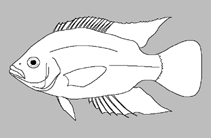 No image available for this species;
drawing shows typical species in Cichlidae.
Images Google
drawing shows typical species in Cichlidae.
Classification / Noms Noms communs | Synonymes | Catalog of Fishes(Genre, Espèce) | ITIS | CoL | WoRMS | Cloffa
> Cichliformes (Cichlids, convict blennies) > Cichlidae (Cichlids) > Pseudocrenilabrinae
Etymology: Ctenochromis: Greek, kteis, ktenos = comb + Greek, chromis = a fish, perhaps a perch (Ref. 45335); scatebra: The species is named from the Latin noun 'scatebra', meaning 'spring' or ' a gush of water from the ground', referring to the type locality which is a spring in northern Tanzania (Ref. 127080).
Etymology: Ctenochromis: Greek, kteis, ktenos = comb + Greek, chromis = a fish, perhaps a perch (Ref. 45335); scatebra: The species is named from the Latin noun 'scatebra', meaning 'spring' or ' a gush of water from the ground', referring to the type locality which is a spring in northern Tanzania (Ref. 127080).
Environnement : milieu / zone climatique / profondeur / gamme de distribution Écologie
; eau douce benthopélagique. Tropical; 28°C - 28°C (Ref. 127080)
Distribution Territoires | Zones FAO | Écosystèmes | Occurrences | Carte par point | Introductions | Faunafri
Africa: restricted to Chemka Springs and the surrounding water bodies immediately adjacent to the Springs, in Tanzania (Ref. 127080).
Taille / Poids / Âge
Description synthétique Clés d'identification | Morphologie | Morphométrie
Épines dorsales (Total) : 14 - 15; Rayons mous dorsaux (Total) : 8 - 9; Épines anales: 3; Rayons mous anaux: 7 - 8. Diagnosis: Ctenochromis scatebra is recognised as a member of Ctenochromis because it possesses the diagnostic feature of a sharp break from small anterior scales to large posterior scales between the pectoral and pelvic fins, and it possesses scaleless areas on either side of the chest (Ref. 127080). In C. scatebra squamation is absent from the ventral part of the cheek, which is characteristic of the genus Ctenochromis; mature adult male of C. scatebra possess at least one clear non-ocellate egg spot on the anal fin (Ref. 127080). Ctenochromis scatebra can be distinguished from C. pectoralis based on two aspects of trophic morphology: it has front teeth in the outer row on both jaws that are primarily unicuspid, widened, shovel shaped, and often slanted, while side teeth in the outer row are unequally bicuspid and pointed; by contrast all front and side teeth in the outer row of C. pectoralis are all unequally bicuspid and pointed; Ctenochromis scatebra has a retrognathous jaw, while C. pectoralis has a marginally prognathous jaw (Ref. 127080).
This species has been observed feeding upon epilithic and epiphytic algae in Chemka Springs, as well as sifting soft sediment, and pecking on skin of swimmers; it is therefore most likely an omnivorous generalist (Ref. 127080).
Cycle de vie et comportement reproducteur Maturité | Reproduction | Frai | Œufs | Fécondité | Larves
Référence principale
Téléchargez vos références | Références | Coordinateur : Kullander, Sven O. | Collaborateurs
Genner, M.J., L.-L. Hsu, R.A. Collins, A.M. Smith, A.D. Saxon, A.H. Shechonge, B.P. Ngatunga and G.F. Turner, 2022. Revision of the African cichlid fish genus Ctenochromis (Teleostei, Cichliformes), including a description of the new genus Shuja from Lake Tanganyika and the new species Ctenochromis scatebra from northern Tanzania. European Journal of Taxonomy 819:23-54. (Ref. 127080)
CITES
Not Evaluated
Menace pour l'homme
Harmless
Utilisations par l'homme
FAO - Publication: search | FishSource |
Plus d'informations
Écologie trophique
Aliments (proies)
Composition du régime alimentaire
Consommation alimentaire
Rations alimentaires
Prédateurs
Aliments (proies)
Composition du régime alimentaire
Consommation alimentaire
Rations alimentaires
Prédateurs
Écologie
Écologie
Écologie
Dynamique des populations
Paramètres de croissance
Âges / tailles maximales
Longueur-poids rel.
Rel. longueur-longueur.
Fréquences de longueurs
Conversion de masse
Recrutement
Abondance
Paramètres de croissance
Âges / tailles maximales
Longueur-poids rel.
Rel. longueur-longueur.
Fréquences de longueurs
Conversion de masse
Recrutement
Abondance
Cycle de vie
Reproduction
Maturité
Maturité/épines rel.
Fécondité
Frai
Agrégats de frai
Œufs
Développement de l'œuf
Larves
Dynamique des populations larvaires
Reproduction
Maturité
Maturité/épines rel.
Fécondité
Frai
Agrégats de frai
Œufs
Développement de l'œuf
Larves
Dynamique des populations larvaires
Anatomie
Surface branchiale
Cerveau
Otolithe
Surface branchiale
Cerveau
Otolithe
Physiologie
Composition corporelle
Nutriments
Consommation d'oxygène
Type de natation
Vitesse de nage
Pigments visuels
Son de poisson
Maladies et parasites
Toxicité (CL50)
Composition corporelle
Nutriments
Consommation d'oxygène
Type de natation
Vitesse de nage
Pigments visuels
Son de poisson
Maladies et parasites
Toxicité (CL50)
Génétique
génôme
Génétique
Hétérozygotie
Héritabilité
Diversité génétique
génôme
Génétique
Hétérozygotie
Héritabilité
Diversité génétique
Liées à l'homme
Systèmes d'aquaculture
Profils d'aquaculture
Souches
Cas de ciguatera
Timbres, pièces de monnaie, divers
Systèmes d'aquaculture
Profils d'aquaculture
Souches
Cas de ciguatera
Timbres, pièces de monnaie, divers
Outils
E-book | Guide de terrain | Générateur de fréquences de longueur | Outil de dynamique de population | Carte par point |
Capture-MSY |
Articles particuliers
Télécharger en XML
Sources Internet
AFORO (otoliths) | Aquatic Commons | BHL | Cloffa | Websites from users | FishWatcher | CISTI | Catalog of Fishes: Genre, Espèce | DiscoverLife | ECOTOX | FAO - Publication: search | Faunafri | Fishipedia | Fishtrace | GloBI | Google Books | Google Scholar | Google | IGFA World Record | OneZoom | Open Tree of Life | Otolith Atlas of Taiwan Fishes | PubMed | Reef Life Survey | Socotra Atlas | TreeBase | Arbre de Vie | Wikipedia: aller à, chercher | World Records Freshwater Fishing | Zoobank | Zoological Record
Estimations basées sur des modèles
Indice de diversité phylogénétique (Réf. 82804): PD50 = 0.7500 [Uniqueness, from 0.5 = low to 2.0 = high].
Bayesian length-weight: a=0.01445 (0.00671 - 0.03113), b=2.99 (2.82 - 3.16), in cm total length, based on LWR estimates for this (Sub)family-body shape (Ref. 93245).
Niveau trophique (Réf. 69278): 3.2 ±0.4 se; based on size and trophs of closest relatives
Résilience (Réf. 120179): Haut, temps minimum de doublement de population inférieur à 15 mois (Preliminary K or Fecundity.).