


Carica il tuo foto e Video
Google image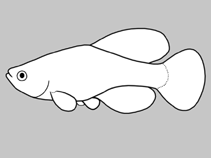 No image available for this species;
drawing shows typical species in Nothobranchiidae.
Google image
drawing shows typical species in Nothobranchiidae.
Classificazione / Nomi Nomi Comuni | Sinonimi | Catalog of Fishes(Genere, Specie) | ITIS | CoL | WoRMS | Cloffa
> Cyprinodontiformes (Rivulines, killifishes and live bearers) > Nothobranchiidae (African rivulines)
Etymology: Epiplatys: Greek, epi = over, in front + Greek, platys = flat (Ref. 45335); cashneri: The species is named after the late Robert Charles Cashner, a mentor and teacher to the first author and a friend to many; a recognized authority on North American freshwater fishes, his legacy also includes descriptions of two killifish species from North America and at least two students of African fishes who in turn have mentored another, the third author (Ref. 123813).
Eponymy: Robert Charles Cashner (1942–2018) was an American fish biologist whose career was spent at the University of New Orleans, Louisiana. [...] (Ref. 128868), visit book page.
Etymology: Epiplatys: Greek, epi = over, in front + Greek, platys = flat (Ref. 45335); cashneri: The species is named after the late Robert Charles Cashner, a mentor and teacher to the first author and a friend to many; a recognized authority on North American freshwater fishes, his legacy also includes descriptions of two killifish species from North America and at least two students of African fishes who in turn have mentored another, the third author (Ref. 123813).
Eponymy: Robert Charles Cashner (1942–2018) was an American fish biologist whose career was spent at the University of New Orleans, Louisiana. [...] (Ref. 128868), visit book page.
Ambiente: milieu / zona climatica / distribuzione batimetrica / gamma di distribuzione Ecologia
; acqua dolce pelagico. Tropical
Distribuzione Territories | Aree FAO | Ecosistemi | Presenze | Mappa dei ritrovamenti | Introduzioni | Faunafri
Africa: Upper Dugbe-Geebo watershed in Sinoe County in southern Liberia (Ref. 123813).
Dimensione / Peso / Età
Breve descrizione Chiavi di identificazione | Morfologia | Morfometria
Spine dorsali (totale) : 0; Raggi dorsali molli (totale) : 8 - 11; Spine anali: 0; Raggi anali molli: 14 - 17. Diagnosis: This species is distinguished from other Epiplatys species by its distinctive colouration: an orange body with red spots in males, body yellow with red spots in females; no longitudinal dark band or broad dark crossbars on the trunk, metallic blue highlights limited to head, nape and trunk above pectoral fins in males; yellow median fins with red spots in females, reddish orange median fins in males with dark red spots and dark red margins; preopercular canal with five pores; anterior supraocular sensory canals open grooves, closely approaching frontal canal, but not contiguous (Ref. 123813).
Found over a range of substrates (sand, gravel, bedrock, silt and clay) and most common in small headwater streams four meters or less in width; presence of woody debris, leaf litter and instream vegetation varied among sites (Ref. 123813).
Ciclo vitale e comportamento di accoppiamento Maturità | Riproduzione | Deposizione | Uova | Fecondità | Larve
Riferimento principale
Caricare le referenze | Bibliografia | Coordinatore | Collaboratori
Pezold, F., K. Ford and R.C. Schmidt, 2021. Epiplatys cashneri, a new species of killifish (Cyprinodontiformes: Nothobranchidae) from Liberia, West Africa. Aqua, Int. J. Ichthyol. 26(3-4):77-86. (Ref. 123813)
CITES
Not Evaluated
Minaccia per l'uomo
Harmless
Usi umani
FAO - Publication: search | FishSource |
Informazioni ulteriori
Ecologia trofica
Articoli alimentari (prede)
Alimentazione
Consumo di cibo
Razioni alimentari
Predatori
Articoli alimentari (prede)
Alimentazione
Consumo di cibo
Razioni alimentari
Predatori
Dinamica della popolazione
Parametri di crescita
Età massima / dimensioni massime
Rapporto lunghezza-peso.
Lunghezza-lunghezza rel.
Lunghezza-frequenze
Conversione di massa
Reclutamento
Abbondanza
Parametri di crescita
Età massima / dimensioni massime
Rapporto lunghezza-peso.
Lunghezza-lunghezza rel.
Lunghezza-frequenze
Conversione di massa
Reclutamento
Abbondanza
Ciclo di vita
Riproduzione
Maturità
Maturità/Gli occhielli sono relativi.
Fecondità
Deposizione
Aggregazioni riproduttive
Uova
Sviluppo delle uova
Larve
Dinamica popolazioni larvali
Riproduzione
Maturità
Maturità/Gli occhielli sono relativi.
Fecondità
Deposizione
Aggregazioni riproduttive
Uova
Sviluppo delle uova
Larve
Dinamica popolazioni larvali
Anatomia
Area branchiale
Cervello
Otolite
Area branchiale
Cervello
Otolite
Fisiologia
Composizione corporea
Nutrienti
Consumo di ossigeno
Tipo di nuoto
Velocità di nuoto
Pigmenti visivi
Suono del pesce
Malattie e parassiti
Tossicità (LC50)
Composizione corporea
Nutrienti
Consumo di ossigeno
Tipo di nuoto
Velocità di nuoto
Pigmenti visivi
Suono del pesce
Malattie e parassiti
Tossicità (LC50)
Genetica
Genome
Genetica
Eterozigosi
Ereditarietà
Diversità genetica
Genome
Genetica
Eterozigosi
Ereditarietà
Diversità genetica
Legato all'uomo
Sistemi di acquacoltura
Profili di acquacoltura
Varietà
Casi di Ciguatera
Francobolli, monete, materiale vario.
Sistemi di acquacoltura
Profili di acquacoltura
Varietà
Casi di Ciguatera
Francobolli, monete, materiale vario.
Strumenti
Libro elettronico | Giuda pratica | Generatore frequenze di lunghezza | Strumento Parametri Biologici | Mappa dei ritrovamenti |
Cattura-MSY |
Rapporti speciali
Controllo della manutenzione dell'acquario | Verificare la presenza di schede informative sulle specie | Verifica delle schede informative sull'acquacoltura
Scarica XML
Fonti Internet
AFORO (otoliths) | Aquatic Commons | BHL | Cloffa | Websites from users | Check FishWatcher | CISTI | Catalog of Fishes: Genere, Specie | DiscoverLife | ECOTOX | FAO - Publication: search | Faunafri | Fishipedia | Fishtrace | GloBI | Google Books | Google Scholar | Google | IGFA World Record | OneZoom | Open Tree of Life | Otolith Atlas of Taiwan Fishes | PubMed | Reef Life Survey | Socotra Atlas | TreeBase | Tree of Life | Wikipedia: Go, ricerca | World Records Freshwater Fishing | Zoobank | Record zoologico
Stime basate su modelli
Indice di diversità filogenetica (Fonte Biblio. 82804): PD50 = 0.5000 [Uniqueness, from 0.5 = low to 2.0 = high].
Bayesian length-weight: a=0.01096 (0.00461 - 0.02608), b=2.94 (2.74 - 3.14), in cm total length, based on LWR estimates for this (Sub)family-body shape (Ref. 93245).
Livello trofico (Fonte Biblio. 69278): 3.2 ±0.5 se; based on size and trophs of closest relatives