>
Cichliformes (Cichlids, convict blennies) >
Cichlidae (Cichlids) > Pseudocrenilabrinae
Etymology: Serranochromis: Latin, serra = saw + Greek, chromis = a fish, perhaps a perch (Ref. 45335); swartzi: The specific name swartzi is named after the primary collector Dr. Ernst Swartz, ichthyologist at SAIAB and primary explorer on the Cuanza River programme (2005-2009) (Ref. 123822).
Eponymy: Dr Ernst Roelof Swartz was an Aquatic Biologist (2005–2010) and is now Senior Aquatic Biologist (2010–present) at the South African Institute for Aquatic Biodiversity, Grahamstown. [...] (Ref. 128868), visit book page.
Miljö: miljö / Klimatzon / djupintervall / distributionsområde
Ekologi
; sötvatten bentopelagisk. Tropical
Africa: Cuanza River in Angola (Ref. 123822).
Storlek / Vikt / Ålder
Könsmognad: Lm ? range ? - ? cm
Max length : 14.0 cm SL hane/ej könsbestämd; (Ref. 123822)
Kort beskrivning
Bestämningsnycklar | Morfologi | Morfometri
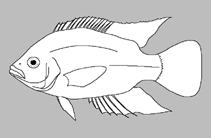
Taggstrålar i ryggfenan (totalt) : 14 - 15; Mjukstrålar i ryggfenan (totalt) : 13 - 15; Taggstrålar i analfenan: 3; Mjukstrålar i analfenan: 10. Diagnosis: The presence of ocelli throughout the anal fin of breeding males distinguishes Serranochromis swartzi from S. robustus and S. jallae in which the ocelli in breeding males are restricted to the posterior 4-5 membranes of the anal fin (Ref. 123822). The exposed teeth of S. swartzi differs from those of S. stappersi and S. altus, which possess small teeth that are burried in the lips; Serranochromis swartzi has an emarginate caudal fin, while S. macrocephalus, S. janus, and S. angusticeps have rounded caudal fins; the shorter jaw of S. swartzi, 44.4-52.0% of head length, separates it from S. spei, 53.5-57.2% of head length; Serranochromis swartzi has 34-37 lateral-line scales, while S. thumbergi possesses more than 39 lateral-line scales; the acute angle of the cleft of the mouth, 50-60° of horizontal, of S. meridianus delimits it from the 25° angle of S. swartzi; the long dark pectoral fins which reach past the middle of the dorsal fin separates S. longimanus from S. swartzi (Ref. 123822). The interorbital width, 14.3-15.9% of head length, of S. alvum is narrower than that of S. swartzi, 17.6-19.8% of head length; Serranochromis swartzi has a smaller preorbital depth, 16.2-18.9% of head length, and snout length, 29.6-31.9% of head length, than S. cuanza, 19.1-22.2% and 35.2-39.6% respectively; the greater preorbital depth, 19.1-22.2% of head length, of S. swartzi distinguishes it from S. cacuchi, which has a smaller preorbital depth, 11.3-15.5% of head length (Ref. 123822).
Livscykel och parningsbeteende
Könsmognad | Reproduktion | Lek | Ägg | Fekunditet | Larver
Stauffer, J.R., Jr., R. Bills and P.H. Skelton, 2021. Four new species of Serranochromis (Teleostei: Cichlidae) from the Cuanza and Okavango river systems in Angola, including a preliminary key for the genus. Zootaxa 4908(1):66-84. (Ref. 123822)
Status på IUCN:s rödlista (Ref. 130435: Version 2025-2)
Hot mot människor
Harmless
Mänskliga användningsområden
Verktyg
Särskilda rapporter
Ladda ner XML
Internet-källor
Uppskattningar baserade på modeller
Index för fylogenetisk mångfald (Ref.
82804): PD
50 = 0.5000 [Uniqueness, from 0.5 = low to 2.0 = high].
Bayesian length-weight: a=0.01445 (0.00674 - 0.03099), b=2.99 (2.82 - 3.16), in cm total length, based on LWR estimates for this (Sub)family-body shape (Ref.
93245).
Trofisk nivå (Ref.
69278): 3.7 ±0.6 se; based on size and trophs of closest relatives
Resiliens (Ref.
120179): Hög, lägsta populationsfördubblingstid mindre än 15 månader (Preliminary K or Fecundity.).
Sårbarhet i fisket (Ref.
59153): Low vulnerability (10 of 100).
🛈