Elasmobranchi (squali e razze) (sharks and rays) >
Squaliformes (Sleeper and dogfish sharks) >
Somniosidae (Sleeper sharks)
Etymology: Scymnodon: scymnus, an ancient name for some kind of shark, derived from a Greek word meaning young animal, cub or whelp; odon (Gr.), tooth, referring to large, triangular cutting teeth on lower jaw of S. ringens (See ETYFish); ringens: Latin for gaping, referring to its large, open mouth (“ore amplo, hiante”) (See ETYFish).
Environment: milieu / climate zone / distribuzione batimetrica / distribution range
Ecologia
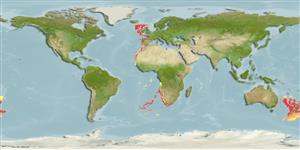
marino batipelagico; distribuzione batimetrica 200 - 1600 m (Ref. 247), usually 550 - 1450 m (Ref. 10717). Deep-water; 61°N - 54°S, 18°W - 172°W
Eastern Atlantic: along the slope from Scotland to Spain, Portugal, Senegal. Southwest Pacific: New Zealand (Ref. 26346).
Size / Peso / Age
Maturità: Lm ? range ? - ? cm
Max length : 110 cm TL maschio/sesso non determinato; (Ref. 247)
Short description
Chiavi di identificazione | Morfologia | Morfometria
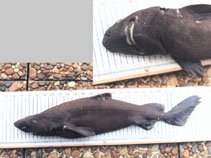
Spine anali: 0. Black in color; small dorsal fin spines; short snout; small lanceolate teeth without cusplets in upper jaw and huge high, knife-cusped cutting teeth in lower jaw; mouth very wide and broadly arched; caudal fin with weak subterminal notch and no lower lobe (Ref. 247).
Body shape (shape guide): elongated.
A rare species (Ref. 26346) inhabiting continental slopes (Ref. 247). Usually mesopelagic although taken most often near the bottom (Ref. 10717). Its razor-edged lower teeth is used to attack and dismember large prey (Ref. 247). Ovoviviparous (Ref. 205). Utilized dried salted for human consumption and for fishmeal (Ref. 247).
Life cycle and mating behavior
Maturità | Riproduzione | Deposizione | Uova | Fecundity | Larve
Probably ovoviviparous (Ref. 247). Distinct pairing with embrace (Ref. 205).
Compagno, L.J.V., 1984. FAO Species Catalogue. Vol. 4. Sharks of the world. An annotated and illustrated catalogue of shark species known to date. Part 1 - Hexanchiformes to Lamniformes. FAO Fish. Synop. 125(4/1):1-249. Rome, FAO. (Ref. 247)
IUCN Red List Status (Ref. 130435: Version 2025-1)
Threat to humans
Traumatogenic
Human uses
Pesca: scarso interesse commerciale
Strumenti
Special reports
Download XML
Fonti Internet
Estimates based on models
Preferred temperature (Fonte Biblio.
123201): 4.2 - 11.4, mean 7.7 °C (based on 164 cells).
Phylogenetic diversity index (Fonte Biblio.
82804): PD
50 = 0.6250 [Uniqueness, from 0.5 = low to 2.0 = high].
Bayesian length-weight: a=0.00389 (0.00176 - 0.00861), b=3.14 (2.95 - 3.33), in cm total length, based on LWR estimates for this species & (Sub)family-body (Ref.
93245).
Trophic level (Fonte Biblio.
69278): 3.9 ±0.7 se; based on diet studies.
Resilienza (Fonte Biblio.
120179): Basso, tempo minimo di raddoppiamento della popolazione 4.5 - 14 anni (Fec assumed to be <100).
Fishing Vulnerability (Ref.
59153): High to very high vulnerability (66 of 100).
🛈
Climate Vulnerability (Ref.
125649): Moderate to high vulnerability (46 of 100).
🛈
Nutrients (Ref.
124155): Calcium = 7.04 [1.09, 38.34] mg/100g; Iron = 0.23 [0.05, 0.90] mg/100g; Protein = 19.9 [17.3, 22.4] %; Omega3 = 0.139 [0.040, 0.507] g/100g; Selenium = 14.7 [3.5, 55.1] μg/100g; VitaminA = 28 [3, 232] μg/100g; Zinc = 0.432 [0.179, 1.137] mg/100g (wet weight);