Classification / Names
Κοινά ονόματα | Συνώνυμα | Catalog of Fishes(Γένος, Είδη) | ITIS | CoL | WoRMS | Cloffa
>
Siluriformes (Catfishes) >
Pseudopimelodidae (Bumblebee catfishes, dwarf marbled catfishes) > Pseudopimelodinae
Etymology: Rhyacoglanis: From the Greek words 'rhyax' (torrent) and 'glanis' (catfish), indicating a catfish inhabiting running waters in reference to its habitat (Ref. 128485); paranensis: Specific name is an adjective, in reference to the occurrence of the species in the upper Rio Paraná basin (Ref. 128485).
Environment: milieu / climate zone / εύρος βάθους / distribution range
Οικολογία
; Γλυκού νερού βενθικό(ς). Tropical
South America: Brazil.
Μέγεθος / Βάρος / Age
Γεννητική Ωρίμανση: Lm ? range ? - ? cm
Max length : 8.9 cm SL αρσενικό/απροσδιόριστο; (Ref. 128485)
Short description
Κλείδες προσδιορισμού | Μορφολογία | Μορφομετρία
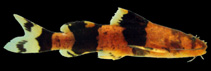
Μαλακές ραχιαίες ακτίνες (συνολικά) : 6; Μαλακές εδρικές ακτίνες: 5 - 7; Σπόνδυλοι: 31 - 33. This species can be distinguished from R. annulatus by the following set of characters: by having a uniformaly dark caudal peduncle band; wide subdorsal band; fewer number of total vertebrate; greater distance between the pelvic-fin and anus; and, shorter distance between the anus and anal fin. It further differs from R. epiblepsis by the pointed caudal-fin lobes (vs. rounded lobes) and few dark body spots present (vs. many body spots of less intense pigmentation). Additionally, it differs from R. seminiger by having distinctly separated subdorsal and subadipose bands (vs. fused bands), continuity between dark pigmentation on the caudal-fin lobes (vs. separation of the pigmentation on those lobes) and discrete, dark transverse pectoral and pelvic-fin stripes present (vs. fins largely uniformly dark). It can be differentiated from R. pulcher by lacking dorsal and ventral confluence between the dark subdorsal and subadipose bands (vs. dorsal and ventral continuity of those bands), no confluence between subadipose and caudal-peduncle bands (vs. dorsal and ventral continuity of those bands), and fewer number of total vertebrae (31-33 vs. 33-35) (Ref. 128485).
Cross section: oval.
Inhabits rapids habitat (Ref. 128485).
Life cycle and mating behavior
Γεννητική Ωρίμανση | Αναπαραγωγή | Γεννοβολία | Αβγά | Γονιμότητα | Προνύμφες
Shibatta, O.A. and R.P. Vari, 2017. A new genus of Neotropical rheophilic catfishes, with four new species (Teleostei: Siluriformes: Pseudopimelodidae). Neotropical Ichthyology 15(2):e160132. (Ref. 128485)
IUCN Red List Status (Ref. 130435: Version 2025-1)
Threat to humans
Harmless
Human uses
Εργαλεία
Special reports
Download XML
Διαδικτυακές πηγές
Estimates based on models
Phylogenetic diversity index (Αναφ.
82804): PD
50 = 0.5625 [Uniqueness, from 0.5 = low to 2.0 = high].
Bayesian length-weight: a=0.00389 (0.00180 - 0.00842), b=3.12 (2.94 - 3.30), in cm total length, based on all LWR estimates for this body shape (Ref.
93245).
Τροφικό Επίπεδο (Αναφ.
69278): 3.5 ±0.5 se; based on size and trophs of closest relatives
Fishing Vulnerability (Ref.
59153): Low vulnerability (10 of 100).
🛈