Klassifizierung / Names
Namen | Synonyme | Catalog of Fishes(Gattung, Arten) | ITIS | CoL | WoRMS | Cloffa
>
Siluriformes (Catfishes) >
Pseudopimelodidae (Bumblebee catfishes, dwarf marbled catfishes) > Pseudopimelodinae
Etymology: Rhyacoglanis: From the Greek words 'rhyax' (torrent) and 'glanis' (catfish), indicating a catfish inhabiting running waters in reference to its habitat (Ref. 128485); seminiger: Species name is an adjective from the Latin word 'semi' (half) and 'niger' (black), in reference to the dramatically contrasting light vs. dark coloration pattern (Ref. 128485).
Environment: milieu / climate zone / Tiefenbereich / distribution range
Ökologie
; süßwasser demersal. Tropical
South America: Brazil.
Size / Gewicht / Alter
Geschlechtsreife: Lm ? range ? - ? cm
Max length : 7.8 cm SL Männchen/unbestimmt; (Ref. 128485)
Kurzbeschreibung
Bestimmungsschlüssel | Morphologie | Morphometrie
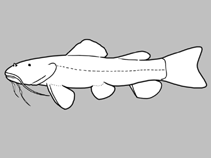
Rückenflossenweichstrahlen (insgesamt) : 6; Afterflossenweichstrahlen: 5 - 6; Wirbelzahl: 32 - 33. This species can be distinguished from all it congeners by having the dark subdorsal and subadipose bands seamlessly conjoined (vs. completely separate or joined only dorsally and ventrally by narrow horizontal connecting extensions). It further differs from R. annulatus by a uniformly dark caudal-peduncle band (vs. band with an unpigmented central section) and 32-33 total vertebrae (vs. 34-35). It also differs from R. pulcher by fewer total vertebrate count (32-33 vs. 34-55). Additionally, it differs from R. epiblepsis by the pointed caudal-fin lobes (vs. rounded lobes), absence of very dark spots on the body (vs. such spotting) and faint serrations limited to the base of the anterior margin of the pectoral-fin spine (vs. well-developed serrations along the entire anterior margin) (Ref. 128485).
Cross section: oval.
Found in very fast-flowing rapids with clear waters over a substrate composed almost exclusively of quartz sand and small rocks, with the river margins covered by riparian forest (Ref. 128485).
Life cycle and mating behavior
Geschlechtsreife | Fortpflanzung | Ablaichen | Eier | Fecundity | Larven
Shibatta, O.A. and R.P. Vari, 2017. A new genus of Neotropical rheophilic catfishes, with four new species (Teleostei: Siluriformes: Pseudopimelodidae). Neotropical Ichthyology 15(2):e160132. (Ref. 128485)
IUCN Rote Liste Status (Ref. 130435: Version 2025-1)
Bedrohung für Menschen
Harmless
Nutzung durch Menschen
Tools
Zusatzinformationen
Download XML
Internet Quellen
Estimates based on models
Phylogenetic diversity index (Ref.
82804): PD
50 = 0.5625 [Uniqueness, from 0.5 = low to 2.0 = high].
Bayesian length-weight: a=0.00389 (0.00180 - 0.00842), b=3.12 (2.94 - 3.30), in cm total length, based on all LWR estimates for this body shape (Ref.
93245).
Trophic level (Ref.
69278): 3.4 ±0.5 se; based on size and trophs of closest relatives
Fishing Vulnerability (Ref.
59153): Low vulnerability (10 of 100).
🛈