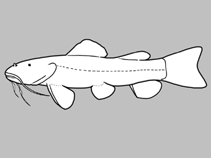
Classificação / Names
Nomes comuns | Sinónimos | Catalog of Fishes(Género, Espécies) | ITIS | CoL | WoRMS | Cloffa
>
Siluriformes (Catfishes) >
Pseudopimelodidae (Bumblebee catfishes, dwarf marbled catfishes) > Pseudopimelodinae
Etymology: Rhyacoglanis: From the Greek words 'rhyax' (torrent) and 'glanis' (catfish), indicating a catfish inhabiting running waters in reference to its habitat (Ref. 128485); annulatus: Species name is a Latin adjective meaning ringed, in reference to the caudal-peduncle band with a light inner region (Ref. 128485).
Environment: milieu / climate zone / intervalo de profundidade / distribution range
Ecologia
; Água doce demersal. Tropical
South America: Venezuela.
Tamanho / Peso / Idade
Maturidade: Lm ? range ? - ? cm
Max length : 4.3 cm SL macho/indeterminado; (Ref. 128485)
Descrição breve
Chaves de identificação | Morfologia | Morfometria
Vértebras: 34 - 35. This species can be distinguished from congeners by the presence of caudal-peduncle band with an unpigmented central region (vs. band uniformly dark), and a larger distance between anus and anal-fin origin (Ref. 128485).
Cross section: oval.
A rheophilic species, prefer rapids and other swift-flowing waters. Possibly rare, known only from two preserved specimens collected in widely separated areas from the southern portions of the Rio Orinoco basin (Ref. 128485).
Life cycle and mating behavior
Maturidade | Reprodução | Desova | Ovos | Fecundidade | Larvas
Shibatta, O.A. and R.P. Vari, 2017. A new genus of Neotropical rheophilic catfishes, with four new species (Teleostei: Siluriformes: Pseudopimelodidae). Neotropical Ichthyology 15(2):e160132. (Ref. 128485)
Categoria na Lista Vermelha da IUCN (Ref. 130435: Version 2025-1)
Ameaça para o homem
Harmless
Utilização humana
Ferramentas
Relatórios especiais
Descarregue XML
Fontes da internet
Estimates based on models
Phylogenetic diversity index (Ref.
82804): PD
50 = 0.5625 [Uniqueness, from 0.5 = low to 2.0 = high].
Bayesian length-weight: a=0.00389 (0.00180 - 0.00842), b=3.12 (2.94 - 3.30), in cm total length, based on all LWR estimates for this body shape (Ref.
93245).
Nível Trófico (Ref.
69278): 3.3 ±0.5 se; based on size and trophs of closest relatives
Fishing Vulnerability (Ref.
59153): Low vulnerability (10 of 100).
🛈