Classification / Names
Nomi Comuni | Sinonimi | Catalog of Fishes(Genere, Specie) | ITIS | CoL | WoRMS | Cloffa
>
Eupercaria/misc (Various families in series Eupercaria) >
Labridae (Wrasses)
Etymology: Polylepion: Derived from the Greek adjective 'polys' for many and the neuter noun 'lepion' meaning small scales; referring to the relatively numerous lateral-line scales occurring in the species under rhis genus (Ref. 128617); gilmorei: Named in honor of Richard Grant Gilmore, Jr. (Ref. 128563).
Environment: milieu / climate zone / distribuzione batimetrica / distribution range
Ecologia
marino associati a barriera corallina; distribuzione batimetrica 219 - 457 m (Ref. 128563). Tropical
Western Central Atlantic: Bahamas, Cuba, Curaçao, Dominica, and Honduras.
Size / Peso / Age
Maturità: Lm ? range ? - ? cm
Max length : 11.4 cm SL maschio/sesso non determinato; (Ref. 128563)
Short description
Chiavi di identificazione | Morfologia | Morfometria
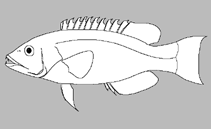
Spine dorsali (totale) : 11; Raggi dorsali molli (totale) : 11; Spine anali: 3; Raggi anali molli: 11; Vertebre: 28. This species is distinguished by the following set of characters: D XI,11; A III, 11; P ii17; lateral-line complete, 38-44 tubed scales; scales above lateral line 2-4; scales not extending onto bases of dorsal and anal fins; scales on forehead extending anteriorly beyond or nearly to level of anterior nostrils. Colouration: multiple orange-red bars of pigment on a whitish background may be seen on the dorsal portion of the trunk; red (adults) or black (juveniles) circular blotch on the dorsal portion of caudal-fin base (Ref. 128563).
Cross section: compressed.
Found in areas with hard substrates, including rocky ledges and patches of dead corals or rocks lying on silty sand bottoms (Ref. 128563).
Life cycle and mating behavior
Maturità | Riproduzione | Deposizione | Uova | Fecundity | Larve
Baldwin, C.C., D. Arcila, D.R. Robertson and L. Tornabene, 2023. Description of the first species of Polylepion (Teleostei: Labridae) from the Atlantic Ocean with analysis of evolutionary relationships of the new species. Ichthyology & Herpetology 111(2):182-190. (Ref. 128563)
IUCN Red List Status (Ref. 130435: Version 2025-1)
Threat to humans
Harmless
Human uses
Strumenti
Special reports
Download XML
Fonti Internet
Estimates based on models
Phylogenetic diversity index (Fonte Biblio.
82804): PD
50 = 0.6250 [Uniqueness, from 0.5 = low to 2.0 = high].
Bayesian length-weight: a=0.00977 (0.00470 - 0.02030), b=3.07 (2.90 - 3.24), in cm total length, based on LWR estimates for this (Sub)family-body shape (Ref.
93245).
Trophic level (Fonte Biblio.
69278): 3.4 ±0.4 se; based on size and trophs of closest relatives
Resilienza (Fonte Biblio.
120179): Alto, tempo minimo di raddoppiamento della popolazione meno di 15 mesi (Preliminary K or Fecundity.).
Fishing Vulnerability (Ref.
59153): Low vulnerability (10 of 100).
🛈