This website uses cookies to enhance your browsing experience and ensure the functionality of our site. For more detailed information about the types of cookies we use and how we protect your privacy, please visit our Privacy Information page.
×
Cookie Settings
This website uses different types of cookies to enhance your experience. Please select your preferences below:
Classification / Noms Noms communs | Synonymes | Catalog of Fishes(Genre, Espèce) | ITIS | CoL | WoRMS | Cloffa
> Characiformes (Characins) > Acestrorhamphidae (American tetras) > Hyphessobryconinae
Etymology: Hyphessobrycon:Greek, hyphesson, -on, -on = a little smaller + Greek, bryko = to bite (Ref. 45335); procyon:Name alludes tp the alpha star of the Canis Minor constellation, it represents the state of Amazonas in the Brazilian national flag, referring to its occurrence; noun in opposition.
Environnement : milieu / zone climatique / profondeur / gamme de distribution Écologie
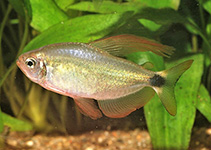
Rayons mous dorsaux (Total) : 9; Rayons mous anaux: 23 - 26; Vertèbres: 32. This species is distinguished from all its congeners, except diastatos, elachys, heliacus, loweae, notidanos, peugeoti and the Hyphessobrycon species of the rosy-tetra group (sensu Weitzman & Palmer, 1997), by having the dorsal-fin elongated in mature males (vs. not elongated); differs from Hyphessobrycon species of the rosy-tetra group by the absence of a dark blotch on dorsal-fin (vs. presence); differs from the remaining Hyphessobrycon species by having two humeral blotches (vs. one in heliacus, notidanos, peugeoti, loweae; humeral blotch inconspicuous or absent in elachys, diastatus); differs from diastatos, elachys, otidanos, loweae by having a higher number of branched anal-fin rays 23-26 (vs.15-18 in diastatos; 16-20 in elachys; 17-20 in notidanos; 17-21 in loweae); from heliacus by having the pelvic fin not filamentous in adult males (vs. pelvic-fin filamentous), and by chevron-like dark markings along the midline of the body absent or inconspicuous (vs. present and conspicuous); differs from peugeoti by having a silvery to yellowish color in live mature males (vs. mature males red in life), and higher number of branched anal-fin rays, 23-26, modally, 25 (vs. 21-24, modally, 22) (Ref. 128639).
Cross section: compressed.
Type locality of this species is a clear water river 40 m wide, 0.5-2 m deep, with swift current, rocky bottom, and reduced riparian vegetation, probably due to anthropogenic activities. Syntopic species included were Ancistrus sp., Characidium aff. zebra, Crenicichla pellegrini, Eigenmannia gr. trilineata, Farlowella amazonum , Gymnotus coropinae, Helogenes marmoratus, Hyphessobrycon sp., Leporinus maculatus, Moenkhausia comma, Moenkhausia collettii , Otocinclus mura, Pimelodella cf. howesi, Poptella compressa, Satanoperca jurupari and Tatia dunni. The stomach contents of the two paratypes included nematoids, chironomids larvae, unidentified vegetal fragments and sediments (Ref. 128639).
Cycle de vie et comportement reproducteur Maturité | Reproduction | Frai | Œufs | Fécondité | Larves
Pastana, M.N.L. and W.M. Ohara, 2016. A new species of Hyphessobrycon Durbin (Characiformes: Characidae) from rio Aripuanã, rio Madeira basin, Brazil. Zootaxa 4161(3):386-398. (Ref. 128639)
Statut dans la liste rouge de l'IUCN (Ref. 130435: Version 2025-2 (Global))
Dynamique des populations Paramètres de croissance Âges / tailles maximales Longueur-poids rel. Rel. longueur-longueur. Fréquences de longueurs Conversion de masse Recrutement Abondance
Cycle de vie Reproduction Maturité Maturité/épines rel. Fécondité Frai Agrégats de frai Œufs Développement de l'œuf Larves Dynamique des populations larvaires
Physiologie Composition corporelle Nutriments Consommation d'oxygène Type de natation Vitesse de nage Pigments visuels Son de poisson Maladies et parasites Toxicité (CL50)
Indice de diversité phylogénétique (Réf. 82804): PD50 = 0.5000 [Uniqueness, from 0.5 = low to 2.0 = high].
Bayesian length-weight: a=0.01995 (0.00906 - 0.04395), b=3.01 (2.83 - 3.19), in cm total length, based on all LWR estimates for this body shape (Ref. 93245).
Niveau trophique (Réf. 69278): 2.9 ±0.3 se; based on size and trophs of closest relatives
Résilience (Réf. 120179): Haut, temps minimum de doublement de population inférieur à 15 mois (Preliminary K or Fecundity.).
Vulnérabilité de la pêche (Ref. 59153): Low vulnerability (10 of 100). 🛈