Classification / Names
ชื่อสามัญ | ชื่อพ้อง | Catalog of Fishes(สกุล, ชนิด) | ITIS | CoL | WoRMS | Cloffa
>
Cichliformes (Cichlids, convict blennies) >
Cichlidae (Cichlids) > Pseudocrenilabrinae
Etymology: Labeotropheus: Latin, labeo = one who has large lips + Greek, tropaion = defeat, a memorial of a fighting war, trophy; because of their specialized teeth were such an obvious feeding adaptation (Ref. 45335); alticodia: The specific epithet combines the Latin adjective for deep or tall, alti, with a Latin word for head, specifically the head of a flower, codia, in reference to the striking head depth of this species (Ref. 128773).
Environment: milieu / climate zone / ระดับความลึก / distribution range
นิเวศวิทยา
; น้ำจืด กลุ่มสัตว์หน้าดิน,กลุ่มสัตว์พื้นท้องน้ำ. Tropical
Africa: Malawi.
ขนาด / น้ำหนัก / Age
วัยเจริญพันธุ์: Lm ? range ? - ? cm
Max length : 8.6 cm SL เพศผู้/กระเทย; (Ref. 128773)
Short description
เครื่องมือที่ใช้ในการแยกชนิดสัตว์,สิ่งมีชีวิตออกจากกัน | สัณฐานวิทยา | ความยาวต่างๆ
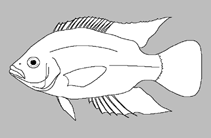
เงี่ยงครีบหลัง (รวม) : 16 - 17; ก้านครีบอ่อนที่หาง (รวม) : 8 - 9; เงี่ยงครีบก้น: 3; ก้านครีบอ่อนที่ก้น: 7 - 8. Diagnosis: Labeotropheus alticodia differs from the slender-bodied Labeotropheus, , L. simoneae, L. chirangali and L. rubidorsalis, as well as L. chlorosiglos, due to its greater body depth, 37.4-40.6% of standard length vs. 26.3-33.4% in L. trewavasae, 26.9-30.8% in L. simoneae, 26.6-33.2% in L. chirangali, 31.6-36.1% in L. rubidorsalis, 31.9-34.7% in L. chlorosiglos; it also differs from the slender Labeotropheus due to a greater distance between the insertion of the dorsal fin and the insertion of the anal fin, 16.4-18.1% of standard length vs. 12.7-15.5% in L. trewavasae, 14.6-16.0% in L. simoneae, 13.7-15.7% in L. chirangali, 13.5-15.7% in L. rubidorsalis (Ref. 128773). Labeotropheus alticodia differs from all other robust-bodied Labeotropheus, except L. fuelleborni, by the nuptial colouration of the males: male L. alticodia have a pale, powder-blue body, and the dorsal and caudal fins are whitish blue with yellow trailing edges, while the anal fin is a pale yellow orange; additionally, the pelvic fins are a pale yellow orange with white leading edges; the morphometric and meristic values largely overlap with the other robust Labeotropheus, with the following exceptions: L. alticodia differs from L. fuelleborni due to a longer distance between the tip of the snout and the origin of the dorsal fin, 33.6-35.9% of standard length vs. 30.8-33.7%, a longer rostral length, 42.0-48.8% of head length vs. 40.4-42.0%, a shorter upper jaw, 14.4-20.1% of head length vs. 20.2-23.9%, and a smaller snout pad, 11.6-14.8% of head length vs. 14.9-17.2%; it differs from L. artatorostris due to a deeper preorbital depth, 26.9-34.5% of head length vs. 19.7-26.8%, and a typically longer rostral length, 42.0-48.4% of head length vs. 22.9-43.7%; it differs from L. candipygia by greater distances between the insertion of the dorsal fin and the insertion of the anal fin, 16.4-18.1% of standard length vs. 13.9-16.7%, as well as between the insertion of the dorsal fin and the origin of the anal fin, 31.3-32.9% of standard length vs. 27.4-31.7%; it differs from L. aurantinfra by a greater distance between the tip of the snout and the attachment of the pelvic fins, 41.0-49.1% of standard length vs. 36.9-43.7%, a greater preorbital depth, 26.9-34.5% of head length vs. 21.3-31.7%, and a greater snout length, 30.4-35.7% of head length vs. 26.7-33.1%; finally, it differs from L. obscurus due to a smaller eye diameter, 24.9-27.5% of head length vs. 27.3-32.4%, and more teeth in the left half of the lower jaw, 29-35 vs. 20-26 (Ref. 128773).
Life cycle and mating behavior
วัยเจริญพันธุ์ | การสืบพันธุ์ | การวางไข่ | เซลสืบพันธ์ของเพศเมีย(ไข่) | ความดกของไข่ | ตัวอ่อน
Pauers, M.J. and T.B. Phiri, 2023. Six new species of Labeotropheus (Cichliformes: Cichlidae) from the Malawian shore of Lake Malawi, Africa. Ichthyology & Herpetology 111(2):264-292. (Ref. 128773)
IUCN Red List Status (Ref. 130435: Version 2025-1)
Threat to humans
Harmless
Human uses
การประมง: ไม่มีผลประโยชน์
เครื่องมือ
Special reports
Download XML
แหล่งที่มาจากอินเตอร์เน็ต
Estimates based on models
Phylogenetic diversity index (อ้างอิง
82804): PD
50 = 0.5005 [Uniqueness, from 0.5 = low to 2.0 = high].
Bayesian length-weight: a=0.01445 (0.00674 - 0.03099), b=2.99 (2.82 - 3.16), in cm total length, based on LWR estimates for this (Sub)family-body shape (Ref.
93245).
ระดับชั้นอาหาร (อ้างอิง
69278): 3.3 ±0.4 se; based on size and trophs of closest relatives
ความสามารถในการกลับคืนสู่ปกติ (อ้างอิง
120179): ความสูง, เวลาต่ำสุดที่จะทำให้ประชากรเพิ่มขึ้นเป็น 2 เท่าใช้เวลาน้อยกว่า 15 เดือน (Preliminary K or Fecundity.).
Fishing Vulnerability (Ref.
59153): Low vulnerability (10 of 100).
🛈