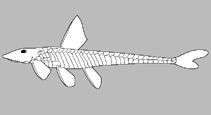
Aphanotorulus rubrocauda

You can sponsor this page

Aphanotorulus rubrocauda Oliveira, Rapp Py-Daniel & Zawadzki, 2017

muatnaik fotos/gambar dan video
imej Google
Image of Aphanotorulus rubrocauda
No image available for this species;
drawing shows typical species in Loricariidae.

klasifikasi / Names Nama-nama umum | Sinonim (persamaan) | Catalog of Fishes(Marga, Jenis) | ITIS | CoL | WoRMS | Cloffa

> Siluriformes (Catfishes) > Loricariidae (Armored catfishes) > Hypostominae
Etymology: Aphanotorulus: Greek, aphanes = hidden + Latin, torulus, -i = muscle, little string (Ref. 45335)rubrocauda: 'rubrocauda'(Latin), i.e., 'rubro', meaning red; and 'cauda', meaning caudal fin (Ref. 129297).

Environment: milieu / climate zone / kisaran kedalaman / distribution range Ekologi

; air tawar dasar (demersal). Tropical

Penyebaran Negara-negara | Daerah-daerah FAO | Ecosystems | Kemunculan | peta titik | Introduksi | Faunafri

South America: Brazil.

Size / Weight / umur

Kematangan: Lm ?  range ? - ? cm
Max length : 24.1 cm SL jantan/; (Ref. 129297)

Biologi     Daftar kata (contoh epibenthic)

Facultative air-breathing in the genus; Found in dark colored water river, with large boulders and rocky substrates (Ref. 129297).

Life cycle and mating behavior Kematangan | Reproduksi, perkembang biakan | Pemijahan | telur-telur | Fecundity | Larva

rujukan utama Upload your references | Acuan | Koordinator : Fisch-Muller, Sonia | mitra

Oliveira, A.S., L.H. Rapp Py-Daniel and C.H. Zawadzki, 2017. A new species of Aphanotorulus (Siluriformes: Loricariidae) from the rio Aripuanã basin, Brazil. Neotropical Ichthyology 15(1):[1-10]. (Ref. 129297)

Status IUCN Red List (Ref. 130435: Version 2025-1)


CITES

Not Evaluated

CMS (Ref. 116361)

Not Evaluated

ancaman kepada manusia

  Harmless


penggunaan manusia

FAO - Publication: search | FishSource |

informasi lanjut

Trophic ecology
Food items (preys)
Komposisi makanan
Konsumsi makanan
Food rations
Pemangsa
Ekologi
Ekologi
Home ranges
Population dynamics
Growth parameters
Max. ages / sizes
Length-weight rel.
Length-length rel.
ukuran frekuensi
Mass conversion
pemulihan
Kelimpahan
Life cycle
Reproduksi, perkembang biakan
Kematangan
Maturity/Gills rel.
Fecundity
Pemijahan
Spawning aggregations
telur-telur
pekembangan telor
Larva
Dinamika larva
Penyebaran
Negara-negara
Daerah-daerah FAO
Ecosystems
Kemunculan
Introduksi
BRUVS - Videos
Anatomy
Area insang
Brain
Otolith
Physiology
Body composition
Nutrients
Oxygen consumption
Swimming type
Swimming speed
Visual pigments
Fish sound
Diseases & Parasites
Toxicity (LC50s)
Genetika
genom
Genetika
Heterozygosity
Diturunkan
Human related
Aquaculture systems
profil budidaya air
Strain
Ciguatera cases
Stamps, coins, misc.
Outreach
mitra
Taxonomy
Nama-nama umum
Sinonim (persamaan)
Morfologi
Morfometrik
Gambar
Acuan
Acuan

Alat, peralatan

laporan khas

muat turun XML

Sumber internet

AFORO (otoliths) | Aquatic Commons | BHL | Cloffa | Websites from users | semak peneliti ikan | CISTI | Catalog of Fishes: Marga, Jenis | DiscoverLife | ECOTOX | FAO - Publication: search | Faunafri | Fishipedia | Fishtrace | GloBI | Google Books | Google Scholar | Google | IGFA World Record | OneZoom | Open Tree of Life | Otolith Atlas of Taiwan Fishes | PubMed | Reef Life Survey | Socotra Atlas | TreeBase | Tree of Life | Wikipedia: pergi, Cari | World Records Freshwater Fishing | Zoobank | Zoological Record

Estimates based on models

Phylogenetic diversity index (Acuan 82804):  PD50 = 0.5078   [Uniqueness, from 0.5 = low to 2.0 = high].
Bayesian length-weight: a=0.01549 (0.00719 - 0.03336), b=2.98 (2.81 - 3.15), in cm total length, based on LWR estimates for this (Sub)family-body shape (Ref. 93245).
Daya lenting (Acuan 120179):  sedang, Waktu penggandaan populasi minimum 1.4 - 4.4 tahun (Preliminary K or Fecundity.).
Fishing Vulnerability (Ref. 59153):  Low vulnerability (19 of 100). 🛈