


Egglestonichthys ulbubunitj Larson, 2013
Uploaden van uw Foto's en video's
Google afbeelding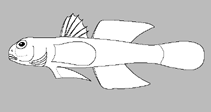 No image available for this species;
drawing shows typical species in Gobiidae.
Google afbeelding
drawing shows typical species in Gobiidae.
Classificatie / Namen Lokale namen | Synoniemen | Catalog of Fishes(Genus, Soort(en)) | ITIS | CoL | WoRMS | Cloffa
> Gobiiformes (Gobies) > Gobiidae (Gobies) > Gobiinae
Etymology: ulbubunitj: Named ulbubunitj for the Ulbu Bunidj clan in Arnhem Land (at the suggestion of senior Traditional Owner Jonathan Nadji); noun in apposition,.
Eponymy: Dr David Eggleston was Fisheries Research Officer at the Fisheries Research Station, Hong Kong. [...] Not a true eponym as named for a people; the Ulbu Bunitj clan in Arnhem Land, Northern Territory, Australia, where the goby occurs. (Ref. 128868), visit book page.
Etymology: ulbubunitj: Named ulbubunitj for the Ulbu Bunidj clan in Arnhem Land (at the suggestion of senior Traditional Owner Jonathan Nadji); noun in apposition,.
Eponymy: Dr David Eggleston was Fisheries Research Officer at the Fisheries Research Station, Hong Kong. [...] Not a true eponym as named for a people; the Ulbu Bunitj clan in Arnhem Land, Northern Territory, Australia, where the goby occurs. (Ref. 128868), visit book page.
Milieu: milieu / Klimaatzone / Diepte / verspreidingsgebied Ecologie
Verspreiding Gebieden | FAO regio's | Ecosystemen | Voorkomen | Verspreidingskaart | Introducties | Faunafri
Eastern Indian Ocean: Australia.
Grootte / Gewicht / Leeftijd
Korte beschrijving Determinatiesleutels | Morfologie | Morfometrie
Dorsale stekels (totaal) : 7; Dorsale zachte stralen (totaal) : 10; Anale stekels: 1; Anale zachte stralen: 10; Wervels: 26. This species is distinguished by the following characters: small, slender and round-headed, with small eyes, long pointed caudal fin and 3-7 pectoral-fin rays free from membrane; D2 I,10; A I,10; pectoral-fin rays 19-21; longitudinal scales 22-25; TRB 7-9; the side of head naked, predorsal scales 9-12, extending forward to behind eyes; eyes are small and dorsolateral; interorbital broad and convex; jaws oblique, with small caniniform teeth; no head pores; reduced papillae pattern on head arranged in mostly longitudinal pattern, the papillae often pointed, fleshy and may be on short raised ridges. When alive, the eyes silver, head and body colour pale yellowish-white, with six or seven indistinct dusky bands across nape and sides, and a large oval black spot on posterior part of first dorsal fin (Ref. 95099).
Cross section: oval.
Cross section: oval.
Specimens were collected by a 2-meter beam trawl or small dredge over (and occasionally
in) very soft to firm mud (sometimes with broken shell and plant detritus such as drifts of leaves), at depths of 1-16 m. Water quality varied with the tide, from 25.8-28.4°C and 28.0-30.3 ppt‰ salinity. Reported to co-occur with estuarine fishes such as small polynemids, juvenile sciaenids,
engraulids and cynoglossids in this soft-substrate habitat (Ref. 95099).
Levenscyclus en paargedrag Maturiteit | Voortplanting | Paaien | Eieren | Fecunditeit | Larven
Hoofdreferentie
Upload uw referenties | Referenties | Coördinator | Medewerkers
Larson, H.K., 2013. A new species of Egglestonichthys from northern Australian estuaries (Teleostei, Gobiidae, Gobiinae). aqua, Int. J. Ichthyol. 19(3):147-154. (Ref. 95099)
Status op de Rode Lijst van het IUCN (Ref. 130435: Version 2025-2 (Global))
Bedreigd (EN) (B1ab(iii)+2ab(iii)); Date assessed: 19 March 2024
CITES
Not Evaluated
Gevaar voor de mens
Harmless
Gebruik door de mens
Visserij: bycatch
FAO - Publication: search | FishSource |
Meer informatie
Trofische ecologie
Voedsel (prooien)
Dieetsamenstelling
Voedselconsumptie
Voedselrantsoenen
Predatoren
Voedsel (prooien)
Dieetsamenstelling
Voedselconsumptie
Voedselrantsoenen
Predatoren
Populatiedynamica
Groeiparameters
Max. leeftijden / maten
Lengte-gewicht rel.
Lengte-lengte rel.
Lengtefrequenties
Massaconversie
Rekrutering
Abundantie
Groeiparameters
Max. leeftijden / maten
Lengte-gewicht rel.
Lengte-lengte rel.
Lengtefrequenties
Massaconversie
Rekrutering
Abundantie
Levenscyclus
Voortplanting
Maturiteit
Rijpheid/kieuwen rel.
Fecunditeit
Paaien
Paaibestanden
Eieren
Ontwikkeling van de eieren
Larven
Larvale populatiedynamiek
Voortplanting
Maturiteit
Rijpheid/kieuwen rel.
Fecunditeit
Paaien
Paaibestanden
Eieren
Ontwikkeling van de eieren
Larven
Larvale populatiedynamiek
Anatomie
Kieuwoppervlak
Hersenen
Otoliet
Kieuwoppervlak
Hersenen
Otoliet
Fysiologie
Lichaamssamenstelling
Voedingsstoffen
Zuurstofverbruik
Type zwemmen
Zwemsnelheid
Visuele pigmenten
Vis geluid
Ziekten en parasieten
Toxiciteit (LC50)
Lichaamssamenstelling
Voedingsstoffen
Zuurstofverbruik
Type zwemmen
Zwemsnelheid
Visuele pigmenten
Vis geluid
Ziekten en parasieten
Toxiciteit (LC50)
Genetica
genoom
Genetica
Heterozygositeit
Erfelijkheid
Genetische diversiteit
genoom
Genetica
Heterozygositeit
Erfelijkheid
Genetische diversiteit
Menselijk gerelateerd
Aquacultuursystemen
Aquacultuurprofielen
Kweeklijnen
Ciguatera gevallen
Postzegels, munten, diversen.
Aquacultuursystemen
Aquacultuurprofielen
Kweeklijnen
Ciguatera gevallen
Postzegels, munten, diversen.
Tools
Speciale rapporten
Bekijk gegevens voor het houden in een aquarium | Bekijk Fact Sheets voor de soort | Bekijk Aquacultuur Fact Sheets
Download XML
Internetbronnen
AFORO (otoliths) | Aquatic Commons | BHL | Cloffa | Websites from users | Bekijk FishWatcher | CISTI | Catalog of Fishes: Genus, Soort(en) | DiscoverLife | ECOTOX | FAO - Publication: search | Faunafri | Fishipedia | Fishtrace | GloBI | Google Books | Google Scholar | Google | IGFA World Record | OneZoom | Open Tree of Life | Otolith Atlas of Taiwan Fishes | PubMed | Reef Life Survey | Socotra Atlas | TreeBase | Tree of Life | Wikipedia: ga naar, zoek | World Records Freshwater Fishing | Zoobank | Zoological Record
Schattingen op basis van modellen
Fylogenetische diversiteitsindex (Ref. 82804): PD50 = 0.5156 [Uniqueness, from 0.5 = low to 2.0 = high].
Bayesian length-weight: a=0.00741 (0.00347 - 0.01582), b=3.09 (2.91 - 3.27), in cm total length, based on LWR estimates for this (Sub)family-body shape (Ref. 93245).
Trofisch niveau (Ref. 69278): 3.1 ±0.3 se; based on size and trophs of closest relatives
Weerstandsvermogen (Ref. 120179): Hoog, minimale populatieverdubbelingstijd minder dan 15 maanden (Preliminary K or Fecundity.).