


Microglanis sparsus Ruiz, 2016
Ladda upp din foton och Videor
Google image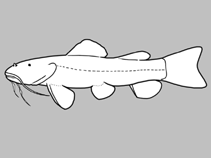 No image available for this species;
drawing shows typical species in Pseudopimelodidae.
Google image
drawing shows typical species in Pseudopimelodidae.
Klassificering / Namn Populärnamn | synonymer | Catalog of Fishes(Släkte, Arter) | ITIS | CoL | WoRMS | Cloffa
> Siluriformes (Catfishes) > Pseudopimelodidae (Bumblebee catfishes, dwarf marbled catfishes) > Batrochoglaninae
Etymology: Microglanis: Greek, mikros = small + Greek, glanis = a fish that can eat the bait without touching the hook; a cat fish (Ref. 45335); sparsus: Name from Latin 'sparsus' meaning ‘sprayed’, referring to the mottled color pattern observed on this species; an adjective.
Etymology: Microglanis: Greek, mikros = small + Greek, glanis = a fish that can eat the bait without touching the hook; a cat fish (Ref. 45335); sparsus: Name from Latin 'sparsus' meaning ‘sprayed’, referring to the mottled color pattern observed on this species; an adjective.
Miljö: miljö / Klimatzon / djupintervall / distributionsområde Ekologi
; sötvatten bottenlevande. Tropical
Utbredning Territorier | FAO områden | Ekosystem | Förekomster | Prickkarta | Utplanteringar | Faunafri
South America: Brazil.
Storlek / Vikt / Ålder
Kort beskrivning Bestämningsnycklar | Morfologi | Morfometri
Mjukstrålar i analfenan: 9 - 11. This species is distinguished from all its congeners by the following set of characters: lateral line short and not reaching vertical through last dorsal-fin ray, with only 5-7 pores; pectoral-fin spine generally with only retrorse serrations; anal-fin rays 9-11. Colouration: head and trunk are mottled with light and dark brown color; light transverse band on the occipital region is narrow, mottled brown, and poorly defined; dark brown saddles poorly defined on the nuchal, subdorsal, and subadipose regions; axis of gill filaments with a dark stripe. Further distinguished in having a smaller adipose fin base length 18.8-20.4% SL (vs. 20.4-31.8 in M. cibelae, M. cottoides, M. eurystoma, M. leptostriatus, M. minutus, M. nigripinnis, M. parahybae, M. pataxo, M. robustus); greater caudal peduncle length 15.7-17.6% SL (vs. 10.0-15.7 in M. carlae, M. cibelae, M. cottoides, M. eurystoma, M. iheringi, M. maculatus, M. malabarbai, M. nigripinnis, M. parahybae, M. pataxo, M. pellopterygius, M. poecilus, M. secundus, M. variegatus); and greater caudal-peduncle depth 13.1-14.7% SL (vs. 10.1-13.1 in M. carlae, M. cibelae, M. cottoides, M. eurystoma, M. iheringi, M. leptostriatus, M. malabarbai, M. minutus, M. reikoae, M. nigripinnis, M. parahybae, M. pataxo, M. pellopterygius, M. poecilus, M. secundus, M. variegatus) (Ref. 130492).
Cross section: oval.
Cross section: oval.
Locality of collection has a well-preserved riparian forest, a river bed mainly muddy, with some sandy patches covered by organic matter, and abundant submerged leaf-litter. Stomach contents of two specimens examined included Ephemeroptera, Chironomidae larvae, and adult Diptera, denoting an insectivorous habit, typical for benthonic small catfish (Ref. 130492).
Livscykel och parningsbeteende Könsmognad | Reproduktion | Lek | Ägg | Fekunditet | Larver
Huvudreferens
Ladda upp dina referenser | referenser | Koordinator : Shibatta, Oscar Akio | Medarbetare
Ruiz, W.B.G., 2016. Three new species of catfishes of the genus Microglanis from Brazil (Teleostei: Pseudopimelodidae), with comments on the characters used within the genus. Ichthyol. Explor. Freshwat. 27(3):211-232. [22 Nov. 2016 is the publication date without ZooBank registration, 18 Nov. with an electronic prepublication date; this serves as the date for Oct., Nov. and Dec.] (Ref. 130492)
Status på IUCN:s rödlista (Ref. 130435: Version 2025-2 (Global))
Data deficient (DD) ; Date assessed: 02 February 2021
CITES
Not Evaluated
Hot mot människor
Harmless
Mänskliga användningsområden
Fiskeri: saknar intresse
FAO - Publication: search | FishSource |
Ytterligare information
Trofisk ekologi
Livsmedelsartiklar (preys)
Födosammansättning
Födointag
Matransoner
Predatorer
Livsmedelsartiklar (preys)
Födosammansättning
Födointag
Matransoner
Predatorer
Ekologi
Ekologi
Ekologi
Populationsdynamik
Tillväxtparametrar
Max. åldrar / storlekar
Längd-vikt rel.
Längd-längd rel.
Längd-frekvenser
Massakonvertering
Rekrytering
Abundans
Tillväxtparametrar
Max. åldrar / storlekar
Längd-vikt rel.
Längd-längd rel.
Längd-frekvenser
Massakonvertering
Rekrytering
Abundans
Livscykel
Reproduktion
Könsmognad
Mognad/Gills rel.
Fekunditet
Lek
Lekande aggregat
Ägg
Utveckling av ägg
Larver
Larvdynamik
Reproduktion
Könsmognad
Mognad/Gills rel.
Fekunditet
Lek
Lekande aggregat
Ägg
Utveckling av ägg
Larver
Larvdynamik
Anatomi
Gälyta
Hjärna
Otolit
Gälyta
Hjärna
Otolit
Fysiologi
Kroppssammansättning
Näringsämnen
Syreförbrukning
Typ av simning
Simhastighet
Visuella pigment
Ljud från fisk
Sjukdomar & Parasiter
Toxicitet (LC50)
Kroppssammansättning
Näringsämnen
Syreförbrukning
Typ av simning
Simhastighet
Visuella pigment
Ljud från fisk
Sjukdomar & Parasiter
Toxicitet (LC50)
Genetik
Genom
Genetik
Heterozygositet
Ärftlighet
Genetisk mångfald
Genom
Genetik
Heterozygositet
Ärftlighet
Genetisk mångfald
Människorelaterad
Vattenbrukssystem
Vattenbruksprofiler
Avelslinjer
Ciguatera-fall
Frimärken, mynt, diverse.
Vattenbrukssystem
Vattenbruksprofiler
Avelslinjer
Ciguatera-fall
Frimärken, mynt, diverse.
Verktyg
Särskilda rapporter
Kontrollera för underhåll av akvarium | Kontrollera om det finns faktablad om arter | Kontrollera om det finns faktablad om vattenbruk
Ladda ner XML
Internet-källor
AFORO (otoliths) | Aquatic Commons | BHL | Cloffa | Websites from users | Check FishWatcher | CISTI | Catalog of Fishes: Släkte, Arter | DiscoverLife | ECOTOX | FAO - Publication: search | Faunafri | Fishipedia | Fishtrace | GloBI | Google Books | Google Scholar | Google | IGFA World Record | OneZoom | Open Tree of Life | Otolith Atlas of Taiwan Fishes | PubMed | Reef Life Survey | Socotra Atlas | TreeBase | Tree of Life | Wikipedia: Go, sök | World Records Freshwater Fishing | Zoobank | Zoologiskt register
Uppskattningar baserade på modeller
Index för fylogenetisk mångfald (Ref. 82804): PD50 = 0.5000 [Uniqueness, from 0.5 = low to 2.0 = high].
Bayesian length-weight: a=0.00692 (0.00292 - 0.01638), b=3.12 (2.91 - 3.33), in cm total length, based on LWR estimates for this (Sub)family-body shape (Ref. 93245).
Trofisk nivå (Ref. 69278): 3.1 ±0.4 se; based on size and trophs of closest relatives