


Enneapterygius sericus Dewa, Harazaki & Motomura, 2024
Spotted-head triplefin
Uploaden van uw Foto's en video's
Google afbeelding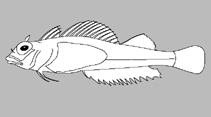 No image available for this species;
drawing shows typical species in Tripterygiidae.
Google afbeelding
drawing shows typical species in Tripterygiidae.
Classificatie / Namen Lokale namen | Synoniemen | Catalog of Fishes(Genus, Soort(en)) | ITIS | CoL | WoRMS | Cloffa
> Blenniiformes (Blennies) > Tripterygiidae (Triplefin blennies) > Tripterygiinae
Etymology: Enneapterygius: Greek, ennea = nine times + Greek, pterygion = little fin (Ref. 45335); sericus: Name from Latin 'sericus' meaning 'silk', referring to the shiny whitish body of this species; noun in apposition.
Etymology: Enneapterygius: Greek, ennea = nine times + Greek, pterygion = little fin (Ref. 45335); sericus: Name from Latin 'sericus' meaning 'silk', referring to the shiny whitish body of this species; noun in apposition.
Milieu: milieu / Klimaatzone / Diepte / verspreidingsgebied Ecologie
Verspreiding Gebieden | FAO regio's | Ecosystemen | Voorkomen | Verspreidingskaart | Introducties | Faunafri
Western Pacific: Ryukyu Is., Taiwan, Indonesia, Australia and Solomon Is.; probably in the Mariana Is. (Guam) and the Hall Islands.
Grootte / Gewicht / Leeftijd
Korte beschrijving Determinatiesleutels | Morfologie | Morfometrie
Dorsale stekels (totaal) : 15 - 17; Dorsale zachte stralen (totaal) : 9 - 11; Anale stekels: 1; Anale zachte stralen: 17 - 21. The new species is distinguished by the following set of characters: D1 III, D2 XII-XIV, D3 9-11, with first spine of D1 shorter than that of D2, its length 5.5-10.2% SL (mean 8.2%); pectoral-fin rays ii-v (iv) + 3-6 (4) + iv-viii (vii) = 13-16; A 17–21; scales below first notched lateral-line scale 3 or 3½; pored lateral line scales 15-18; scale rows in longitudinal series 32-37; circumpeduncular scales 8-12; single transverse scale row between posteriormost pored scale and anteriormost notched scale; mandibular-pore formula usually 3 + 1 + 3; orbital tentacle short, slender and pointed, its length shorter than nasal tentacle. Colouration: body generally semi-transparent white with reddish blotches and saddles; bright white blotches aligned along midlateral scale series; the dorsal surface of head with brownish blotches; head, snout and cheek, opercle, pectoral fin base, and base of 8 lowermost pectoral-fin rays black in nuptial males; undersurface of head, including pelvic-fin base, and anterior part of abdomen black, pigment sometimes extending to anus (Ref. 130804).
Cross section: oval.
Cross section: oval.
Occurs usually on exposed shallow rocky reefs in depths less than 5 m, haracteristically on the upper surface of rocks covered by patches of ca. 1-2 mm length algae, whereas other congeners tend to occur on vertical surfaces. Reproductive season at Yaku-shima Island extends from the end of February to April (ca. 18-21 °C), spawning usually taking place in the morning. During the spawning season, males display nuptial coloration, which can alter quickly depending on the situation for as a female approaches the male’s melanophores on head become more obvious, forming a blackish mask on the head and body. Also, the brownish blotches on the dorsal head surface become paler and almost completely fade. During spawning, brownish pigmentation on the nape continues to change, sometimes forming blotches or lines, and becoming dense or pale. When alive, brownish blotches on the dorsal head surface are more distinct in young individuals, but paler in nuptial males and relatively large females (Ref. 130804).
Levenscyclus en paargedrag Maturiteit | Voortplanting | Paaien | Eieren | Fecunditeit | Larven
Hoofdreferentie
Upload uw referenties | Referenties | Coördinator : Fricke, Ronald | Medewerkers
Dewa, Y., S. Harazaki and H. Motomura, 2024. Enneapterygius sericus, a new species of triplefin (Perciformes: Tripterygiidae) from the western Pacific Ocean. Ichthyol. Res.: [1-13]. [First published online, pp. 1-13, 30 Jan. 2024.] (Ref. 130804)
CITES
Not Evaluated
Gevaar voor de mens
Harmless
Gebruik door de mens
Visserij: van geen belang
FAO - Publication: search | FishSource |
Meer informatie
Trofische ecologie
Voedsel (prooien)
Dieetsamenstelling
Voedselconsumptie
Voedselrantsoenen
Predatoren
Voedsel (prooien)
Dieetsamenstelling
Voedselconsumptie
Voedselrantsoenen
Predatoren
Ecologie
Ecologie
Ecologie
Populatiedynamica
Groeiparameters
Max. leeftijden / maten
Lengte-gewicht rel.
Lengte-lengte rel.
Lengtefrequenties
Massaconversie
Rekrutering
Abundantie
Groeiparameters
Max. leeftijden / maten
Lengte-gewicht rel.
Lengte-lengte rel.
Lengtefrequenties
Massaconversie
Rekrutering
Abundantie
Levenscyclus
Voortplanting
Maturiteit
Rijpheid/kieuwen rel.
Fecunditeit
Paaien
Paaibestanden
Eieren
Ontwikkeling van de eieren
Larven
Larvale populatiedynamiek
Voortplanting
Maturiteit
Rijpheid/kieuwen rel.
Fecunditeit
Paaien
Paaibestanden
Eieren
Ontwikkeling van de eieren
Larven
Larvale populatiedynamiek
Anatomie
Kieuwoppervlak
Hersenen
Otoliet
Kieuwoppervlak
Hersenen
Otoliet
Fysiologie
Lichaamssamenstelling
Voedingsstoffen
Zuurstofverbruik
Type zwemmen
Zwemsnelheid
Visuele pigmenten
Vis geluid
Ziekten en parasieten
Toxiciteit (LC50)
Lichaamssamenstelling
Voedingsstoffen
Zuurstofverbruik
Type zwemmen
Zwemsnelheid
Visuele pigmenten
Vis geluid
Ziekten en parasieten
Toxiciteit (LC50)
Genetica
genoom
Genetica
Heterozygositeit
Erfelijkheid
Genetische diversiteit
genoom
Genetica
Heterozygositeit
Erfelijkheid
Genetische diversiteit
Menselijk gerelateerd
Aquacultuursystemen
Aquacultuurprofielen
Kweeklijnen
Ciguatera gevallen
Postzegels, munten, diversen.
Aquacultuursystemen
Aquacultuurprofielen
Kweeklijnen
Ciguatera gevallen
Postzegels, munten, diversen.
Tools
Speciale rapporten
Bekijk gegevens voor het houden in een aquarium | Bekijk Fact Sheets voor de soort | Bekijk Aquacultuur Fact Sheets
Download XML
Internetbronnen
AFORO (otoliths) | Aquatic Commons | BHL | Cloffa | Websites from users | Bekijk FishWatcher | CISTI | Catalog of Fishes: Genus, Soort(en) | DiscoverLife | ECOTOX | FAO - Publication: search | Faunafri | Fishipedia | Fishtrace | GloBI | Google Books | Google Scholar | Google | IGFA World Record | Nationale databanken | OneZoom | Open Tree of Life | Otolith Atlas of Taiwan Fishes | PubMed | Reef Life Survey | Socotra Atlas | TreeBase | Tree of Life | Wikipedia: ga naar, zoek | World Records Freshwater Fishing | Zoobank | Zoological Record
Schattingen op basis van modellen
Fylogenetische diversiteitsindex (Ref. 82804): PD50 = 0.5000 [Uniqueness, from 0.5 = low to 2.0 = high].
Bayesian length-weight: a=0.00617 (0.00290 - 0.01310), b=3.04 (2.86 - 3.22), in cm total length, based on LWR estimates for this (Sub)family-body shape (Ref. 93245).
Trofisch niveau (Ref. 69278): 3.1 ±0.3 se; based on size and trophs of closest relatives
Weerstandsvermogen (Ref. 120179): Hoog, minimale populatieverdubbelingstijd minder dan 15 maanden (Preliminary K or Fecundity.).