


Carica il tuo foto e Video
Google image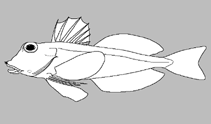 No image available for this species;
drawing shows typical species in Triglidae.
Google image
drawing shows typical species in Triglidae.
Classificazione / Nomi Nomi Comuni | Sinonimi | Catalog of Fishes(Genere, Specie) | ITIS | CoL | WoRMS | Cloffa
> Perciformes/Scorpaenoidei (Scorpionfishes) > Triglidae (Searobins) > Prionotinae
Etymology: Prionotus: Greek, prion, -onos = saw + Greek, noton = back (Ref. 45335); pictus: Name 'pictus' from the Latin word meaning 'painted', in reference to the variegated patterns and colors and individual distribution of colors, with white markings as if splashed with paint.
Etymology: Prionotus: Greek, prion, -onos = saw + Greek, noton = back (Ref. 45335); pictus: Name 'pictus' from the Latin word meaning 'painted', in reference to the variegated patterns and colors and individual distribution of colors, with white markings as if splashed with paint.
Ambiente: milieu / zona climatica / distribuzione batimetrica / gamma di distribuzione Ecologia
marino demersale; distribuzione batimetrica ? - 5 m (Ref. 137950). Tropical
Distribuzione Territories | Aree FAO | Ecosistemi | Presenze | Mappa dei ritrovamenti | Introduzioni | Faunafri
Southeast Pacific: Galapagos Is.
Dimensione / Peso / Età
Breve descrizione Chiavi di identificazione | Morfologia | Morfometria
Spine dorsali (totale) : 10; Raggi dorsali molli (totale) : 12; Raggi anali molli: 11. This species is distinguished from its congeners by the following set of characters: D X,12; A 11; P1 14 plus three ventral free rays; P2 I,5; first dorsal fin nearly triangular, first three spines about equal in length, second spine longest, first spine slightly shorter, third spine slighly shorter than second, anterior margin of first spine with pronounced serrations; membranes without a black spot or ocellus specifically on fourth or fifth membranes; pectoral fins fan-shaped semicircular when expanded and long, usually reaching to last third of second-dorsal-fin base or beyond when flat (but variable); snout concave, sharply rising, duck-billed profile, eyes protruding well above profile, snout broadly rounded from dorsal view, no prominent rostral extensions or spiny edges to lachrymal plate; presence of nasal cirrus, about twice length of nasal opening, no supraocular cirrus; mouth relatively small, lower jaw subterminal and without a knob; head with prominent bony plates, ridges and granulations; head spines comprising preocular, postocular, sphenotic, pterotic, parietal, nuchal, opercular, preopercular (without a supplemental spine), and a cleithral (humeral) spine over pectoral fin (rostral, preorbital, and suborbital spines absent and no postfrontal groove); scales ctenoid and small, about 48 pored lateral-line scales, about 94 vertical rows of lateral scales, nuchal and opercular-flap scales present, ventral scales extend forward just past level of anterior insertion of pelvic fins; body common brownish orange pattern to blotched in colors varying from brown to red, to a darker, almost black-and-white pattern; often bright orange ventrally; white patches like splashed paint on head and body in individual unique patterns; a line of prominent white spots highlighting some of the pored lateral-line scales; lip markings a variety of spots and bars (not a simple three dark bands on a white background, at front, middle and corner of jaw); pectoral fin with irregular spot pattern, clearest on common color form, with small rounded spots concentrated on fifth through tenth membranes, becoming reticulations on distal lowermost rays; a thick blue margin on lower 10 rays; pectoral-fin base around origin of rays with an irregular pattern (not discrete rounded spots); caudal fin with dark bars, one at base and a distal wide bar often splitting into two (dark fish can have a black striped pattern); free pectoral-fin rays thick and prominently banded. Juvenile with brown mottled color pattern and relatively longer pectoral fins, reaching past end of second dorsal fin; uniform orangish with two prominent black-edged white saddles along dorsal midline in front of and behind soft-dorsal-fin base of juveniles; and gill rakers short spiny tubercles in two rows of 11, inner and outer, on lower limb of first arch (Ref. 137950).
Body shape (shape guide): elongated; Cross section: oval.
Body shape (shape guide): elongated; Cross section: oval.
Ciclo vitale e comportamento di accoppiamento Maturità | Riproduzione | Deposizione | Uova | Fecondità | Larve
Riferimento principale
Caricare le referenze | Bibliografia | Coordinatore | Collaboratori
Victor, B.C., 2025. Prionotus pictus, a new endemic species of searobin from the Galapagos Islands, Ecuador (Teleostei: Triglidae). Journal of the Ocean Science Foundation 43:12-38. (Ref. 137950)
CITES
Not Evaluated
Minaccia per l'uomo
Harmless
Usi umani
Pesca: di nessun interesse
FAO - Publication: search | FishSource |
Informazioni ulteriori
Ecologia trofica
Articoli alimentari (prede)
Alimentazione
Consumo di cibo
Razioni alimentari
Predatori
Articoli alimentari (prede)
Alimentazione
Consumo di cibo
Razioni alimentari
Predatori
Ecologia
Ecologia
Ecologia
Dinamica della popolazione
Parametri di crescita
Età massima / dimensioni massime
Rapporto lunghezza-peso.
Lunghezza-lunghezza rel.
Lunghezza-frequenze
Conversione di massa
Reclutamento
Abbondanza
Parametri di crescita
Età massima / dimensioni massime
Rapporto lunghezza-peso.
Lunghezza-lunghezza rel.
Lunghezza-frequenze
Conversione di massa
Reclutamento
Abbondanza
Ciclo di vita
Riproduzione
Maturità
Maturità/Gli occhielli sono relativi.
Fecondità
Deposizione
Aggregazioni riproduttive
Uova
Sviluppo delle uova
Larve
Dinamica popolazioni larvali
Riproduzione
Maturità
Maturità/Gli occhielli sono relativi.
Fecondità
Deposizione
Aggregazioni riproduttive
Uova
Sviluppo delle uova
Larve
Dinamica popolazioni larvali
Anatomia
Area branchiale
Cervello
Otolite
Area branchiale
Cervello
Otolite
Fisiologia
Composizione corporea
Nutrienti
Consumo di ossigeno
Tipo di nuoto
Velocità di nuoto
Pigmenti visivi
Suono del pesce
Malattie e parassiti
Tossicità (LC50)
Composizione corporea
Nutrienti
Consumo di ossigeno
Tipo di nuoto
Velocità di nuoto
Pigmenti visivi
Suono del pesce
Malattie e parassiti
Tossicità (LC50)
Genetica
Genome
Genetica
Eterozigosi
Ereditarietà
Diversità genetica
Genome
Genetica
Eterozigosi
Ereditarietà
Diversità genetica
Legato all'uomo
Sistemi di acquacoltura
Profili di acquacoltura
Varietà
Casi di Ciguatera
Francobolli, monete, materiale vario.
Sistemi di acquacoltura
Profili di acquacoltura
Varietà
Casi di Ciguatera
Francobolli, monete, materiale vario.
Strumenti
Libro elettronico | Giuda pratica | Generatore frequenze di lunghezza | Strumento Parametri Biologici | Mappa dei ritrovamenti |
Cattura-MSY |
Rapporti speciali
Controllo della manutenzione dell'acquario | Verificare la presenza di schede informative sulle specie | Verifica delle schede informative sull'acquacoltura
Scarica XML
Fonti Internet
AFORO (otoliths) | Aquatic Commons | BHL | Cloffa | Websites from users | Check FishWatcher | CISTI | Catalog of Fishes: Genere, Specie | DiscoverLife | ECOTOX | FAO - Publication: search | Faunafri | Fishipedia | Fishtrace | GloBI | Google Books | Google Scholar | Google | IGFA World Record | OneZoom | Open Tree of Life | Otolith Atlas of Taiwan Fishes | PubMed | Reef Life Survey | Socotra Atlas | TreeBase | Tree of Life | Wikipedia: Go, ricerca | World Records Freshwater Fishing | Zoobank | Record zoologico
Stime basate su modelli
Indice di diversità filogenetica (Fonte Biblio. 82804): PD50 = 0.5000 [Uniqueness, from 0.5 = low to 2.0 = high].
Bayesian length-weight: a=0.00589 (0.00260 - 0.01333), b=3.09 (2.89 - 3.29), in cm total length, based on LWR estimates for this (Sub)family-body shape (Ref. 93245).
Livello trofico (Fonte Biblio. 69278): 3.6 ±0.6 se; based on size and trophs of closest relatives
Resilienza (Fonte Biblio. 120179): Medio, tempo minimo di raddoppiamento della popolazione 1.4 - 4.4 anni (Preliminary K or Fecundity.).